

Our College
About Us
The College of Humanities and Social Sciences offers a broad range of academic pursuits. Our major areas of study are organized in 14 units designated as schools, departments or programs. These various disciplines give students a fuller understanding of the past, present and future roles of both the individual and society in shaping human experience. The humanities and the social sciences are cornerstones of a liberal arts education. In courses and other learning experiences provided by the college, our students become familiar with the most significant accomplishments of the human intellect and spirit and gain appreciation for the potential we have as humans and as societies.
We are committed to the liberal arts tradition of advancing human knowledge through serious scholarship, superior instruction, and the freedom of academic inquiry. Our faculty employs the latest teaching and learning technology while emphasizing accessibility and the benefits of student-teacher interaction. Humanities and Social Sciences majors are broadly educated to think critically and independently, to articulate ideas and appreciate diverse perspectives, and to exercise reason and make informed judgments. These tools prepare graduates for life in a complex world, help them enter a wide variety of professions, and lay the foundations for lifelong learning.
Our Mission
Human-Centered Education with Real-World Applications
Our degree programs emphasize human understanding, interdisciplinary problem solving, text and data analysis, sustainability, and evidence-based decision-making. Our college is the place where students build expertise and skills to become adaptive, resilient, and publicly engaged leaders who are prepared for careers in our rapidly changing world.
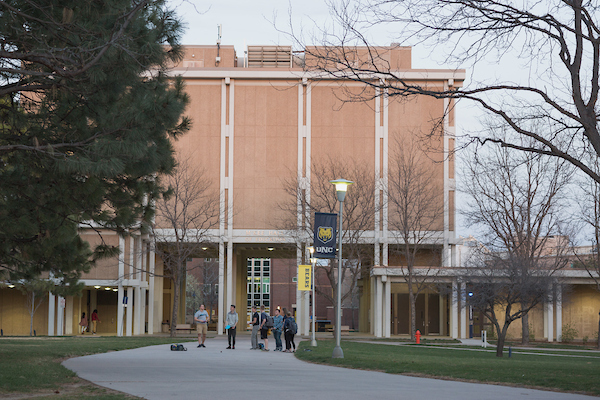
Students walking in Candeleria Hall

Land Acknowledgement
The University of Northern Colorado acknowledges the forty-eight tribes that are historically tied to the state of Colorado. The University occupies the lands in the territories of the Ute, Cheyenne, and Arapaho peoples. Thus, the land on which UNC is situated is tied to the history and culture of native and indigenous peoples. UNC appreciates this connection and respects the land. Additionally, the University community pays its respect to Elders past, present, and future, and to those who have stewarded this land throughout the generations.

The Humanities
The humanities help us understand what it means to be human. Through the study of culture, language, history, philosophy, and creative expression, students explore how people make meaning, communicate ideas, and shape the world around them. Humanities disciplines examine how systems of thought have developed over time—and how they continue to influence decisions, values, and identities today. By connecting past and present, humanistic inquiry equips students to think critically, engage across cultures, and imagine more just and sustainable futures.
The Social Sciences
The social sciences examine how individuals, groups, and societies function and adapt in a changing world. Using observation, data, and evidence-based research, social scientists study patterns of behavior, systems of exchange and communication, and the ways communities organize, govern, and collaborate. These disciplines help students understand how people interact across cultures and contexts, preparing them to analyze complex social challenges and contribute practical solutions in real-world settings.
The Value of a Liberal Arts Degree
A liberal arts education develops the skills employers and communities value most: critical thinking, communication, adaptability, and ethical decision-making. By combining perspectives from the humanities and social sciences, students learn to analyze information, understand diverse viewpoints, and apply knowledge to complex problems. Graduates leave prepared for a wide range of careers—and for meaningful civic and professional engagement in an ever-changing world.