Written by Duard Headley | Translated by Carlos José Pérez Sámano
Signs of Growth: Collaboration and Innovation in UNC’s ASL Programs
Señales de crecimiento: colaboración e innovación en los programas de lengua de signos americana (ASL) de la UNC
As a leader in its field, the Department of American Sign Language and Interpreting Studies is striving to set students up for success
Como un líder en su campo, el Departamento de Lengua de Signos Americana y Estudios de Interpretación se esfuerza por preparar a los estudiantes para que alcancen el éxito.
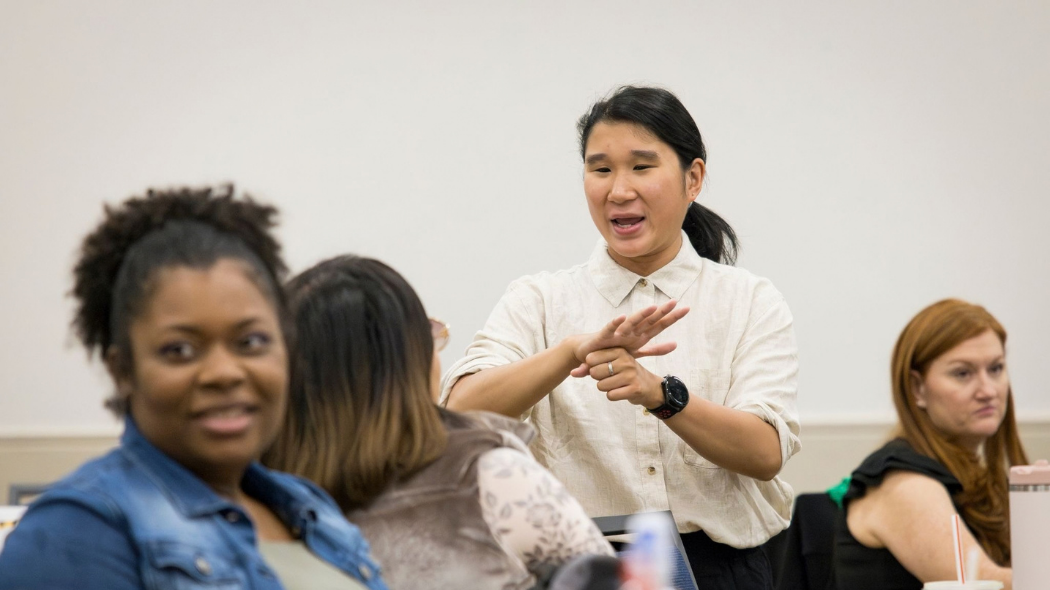
Right now, in an elementary school classroom somewhere, a group of young students is likely gathered, perhaps seated on a colorful classroom rug or in rows at their desks, as their teacher demonstrates how to say the alphabet through distinct hand shapes.
A closed fist with the thumb on the side for A, an open palm, facing outwards with the thumb tucked across for B and so on.
This simple demonstration is, in many instances, the students’ first glimpse into the world of American Sign Language (ASL). For many of them, their education stops there — a handful of letters and maybe knowledge of how to say “thank you” (flat hand, fingertips to chin, moving the hand out and down slightly towards the other person).
Those who end up following that path into college and attend the University of Northern Colorado (UNC) will find an institution with a lineup of ASL programs just as unique as the language itself.
Iterating and Innovating
In more than one way, 2026 has been a standout year for UNC’s Department of American Sign Language and Interpreting Studies (ASLIS).
Not only did the summer mark the 10-year anniversary of the ASL-English Interpretation (ASLEI) degree, the program also welcomed its largest student cohort in UNC history this year, reflecting the growing demand for trained ASL interpreters and UNC’s dedication to fulfilling those needs.
The department’s Teaching ASL (TASL) Master’s program — the only master’s-level program in the country that focuses explicitly on ASL education — also welcomed the largest cohort of students in four years, more than doubling student enrollment from 2025.
Despite those successes, the department and its faculty aren’t content to rest on their laurels.
“We don’t like the status quo,” said Melinda Kisling, senior lecturer and ASL program coordinator. “We’re always looking for that ‘something’ that is innovative and will foster growth. We’re focused on the students and their goals, and that’s an ever-changing, ever-evolving aim.”
With an eye on the future, the faculty of UNC’s ASL programs are looking to develop new offerings for students in the years to come.
A new bachelor’s degree in ASL Studies will soon be available for students to enroll in, with the goal of providing those interested in gaining advanced ASL proficiency without needing to pursue careers as interpreters, specifically.
The inspiration for this new degree came, at least in part, from Kisling’s experience seeing how many students outside of the ASL program were interested in taking ASL classes.
“It might be because people are seeing sign language more around campus through our students, through interpreters or however else, and become interested that way,” Kisling said. “However it’s happening, we’re thrilled, and want to get more people involved however we can.”
In addition to that second bachelor’s degree, the program is also working to develop two new official professional certificates — one in Leadership and Supervision for Interpreters and one in Legal Interpreting.
“No matter where our students end up, we hope to provide them with an education and the professional standards to make a positive impact, all while taking into consideration the human and moral sides of the work they’re doing,” said Taylor Hartman, assistant professor and TASL program coordinator.
Video credit: Ryan Moore
Strong Foundation, Strong Education
The growth and development of UNC’s ASLIS programs didn’t happen by accident or happy coincidence. According to Randy Thuesen, senior lecturer and ASLEI program coordinator, the foundation for this recent success has been in the making for years.
“The pillars that make up the foundation for our programs are collaboration, growth and community,” Thuesen said.
Hartman concurred, highlighting how interconnected each part of the ASLIS programs really are.
“We’re not solid, just focusing on our own work,” Hartman said. “We’re very interactive and collaborative. The strength of our group is a representation of the strength of our program.”
In addition to the program’s academic offerings for students, the ASLIS department serves as a leader in the field of ASL education, signed language interpreter preparation and professional development by hosting events — like summer workshops with the Colorado Registry of Interpreters for the Deaf and an upcoming conference of the American Sign Language Teachers Association — and by fostering local partnerships with organizations like Front Range Community College to allow students enrolled in Front Range’s 2-year ASL degree program to transfer directly to UNC to complete their 4-year degree.
That spirit of collaboration is evident in nearly every ASL program faculty and staff member, as well as the program’s students.
Makayla Lynch is an ASLEI and Communication Studies double-major now in her second year in the ASL program. Even amidst this busy schedule, she has taken to the program with enthusiasm, serving as the vice president of the university’s student-led ASL Club in addition to her coursework.
According to Lynch, one of the first moments she realized just how unique and dedicated the ASL faculty were during last year’s ASL Carnival, a fundraiser/festival hosted by the ASL Club featuring food, tie-dye, games and, most importantly, the Pie Your Professor event.
“We had professors out there in trash bags and goggles, and people could pay like, $5 to throw a pie in their face. We thought we’d get a handful of people wanting to do it, but there ended up being a line down the entire field,” Lynch said. “It was incredible, the faculty were so enthusiastic and good-natured and it was just the biggest hit.”
Lynch recalls one faculty member going so far as to run back to their place of residence to scrounge up enough loose change to pay for one more pie-ing.
When not engaged in extraordinary extracurriculars, the ASLIS faculty strive to build a foundation of curriculum that will provide UNC students with the highest level of competency to best prepare them for the world after graduation.
At the federal level, there is no detailed definition for what makes an ASL interpreter “qualified,” according to Thuesen. Each state has its own standards that interpreters are held to, meaning a qualified professional in one state might not be able to get a job in another.
For that reason, the ASLIS department’s English Interpretation programs aim to educate students based on the highest level, with the strictest standards for producing professional signed language professionals.
“Language is tied to both cognitive and social development in children, as well as many other necessary life skills,” Thuesen said. “If someone accepts a job as an interpreter without appropriate skills or credentials, they can have a huge impact on a deaf person’s life — or a hearing person’s, for that matter.”
Emily Girardin, a member of the ASLIS department’s staff and director of the Preparing School Interpreters Project, highlighted just how far and wide the graduates of UNC’s ASL programs have spread.
“[It’s] a professional community that now spans nearly two decades, more than 40 states, and generations of educational interpreters committed to supporting the deaf and hard of hearing students they serve,” Girardin wrote in an article contributed to UNC’s news website earlier this year.
That educational foundation — centered around allowing students to take their skills anywhere once they graduate — goes hand-in-hand with the ASLIS department’s culture of collaboration and innovation.
The result is a series of programs that serve as strong leaders in the field of ASL educator and interpreter training; programs that show no signs of slowing down any time soon.
“We, as interpreters, can have a huge impact on people’s lives and how they learn,” Thuesen said. “That’s something we take seriously, and we’re always working to find new, innovative, transformative ways to make sure those impacts are positive ones.”
En este mismo momento, en un salón de clases de alguna escuela primaria, es probable que haya un grupo de jóvenes alumnos reunidos, quizá sentados en una colorida alfombra o en filas junto a sus pupitres, mientras su profesor les enseña cómo decir el alfabeto mediante distintas formas con las manos.
Un puño cerrado con el pulgar a un lado para la A, una palma abierta, mirando hacia fuera con el pulgar cruzado para la B, y así sucesivamente.
Esta sencilla demostración es, en muchos casos, el primer contacto de los alumnos con el mundo de la lengua de signos estadounidense (ASL). Para muchos de ellos, su aprendizaje se queda ahí: unas pocas letras y quizá saber cómo decir «gracias» (mano plana, yemas de los dedos en la barbilla, moviendo la mano ligeramente hacia fuera y hacia abajo, en dirección a la otra persona).
Sin embargo, para unos pocos, momentos como estos marcan el inicio de un recorrido de toda una vida dedicado al aprendizaje, la enseñanza y la interpretación de este lenguaje visual único, la lengua de signos americana (ASL), una carrera profesional cuya demanda se encuentra en su punto más alto.
Aquellos que decidan seguir ese camino hasta la universidad y se matriculen en la Universidad del Norte de Colorado (UNC) encontrarán una institución con una oferta de programas de ASL tan singular como el propio lenguaje.
Iteración e innovación
En más de un sentido, 2026 ha sido un año excepcional para el Departamento de Lengua de Signos Americana y Estudios de Interpretación (ASLIS) de la UNC.
El verano no solo marcó el décimo aniversario de la licenciatura en Interpretación de Lengua de Signos Americana e Inglés (ASLEI), sino que el programa también acogió este año a la generación de estudiantes más numerosa de la historia de la UNC, lo que refleja la creciente demanda de intérpretes de ASL cualificados y el compromiso de la UNC para satisfacer esas necesidades.
El programa de maestría en Enseñanza de la ASL (TASL) del departamento —el único programa de maestría del país que se centra explícitamente en la enseñanza de la ASL— también acogió a la mayor generación de estudiantes en cuatro años, duplicando con creces la matrícula con respecto a 2025.
A pesar de esos éxitos, el departamento y su profesorado no se conforman con dormirse en los laureles.
«No nos gusta el statu quo», afirmó Melinda Kisling, profesora titular y coordinadora del programa de ASL. «Siempre estamos buscando ese “algo” que sea innovador y fomente el crecimiento. Nos centramos en los estudiantes y en sus objetivos, y ese es un propósito en constante cambio y evolución».
Con la mirada puesta en el futuro, el profesorado de los programas de ASL de la UNC pretende desarrollar nuevas ofertas para los estudiantes en los próximos años.
Próximamente estará disponible una nueva titulación de grado en Estudios de ASL, con el objetivo de ofrecer a quienes estén interesados la posibilidad de adquirir un dominio avanzado de la ASL sin necesidad de dedicarse específicamente a la interpretación.
La inspiración para esta nueva titulación surgió, al menos en parte, de la experiencia de Kisling al observar cómo muchos estudiantes ajenos al programa de lengua de signos americana (ASL) estaban interesados en asistir a clases de ASL.
«Quizá sea porque la gente ve cada vez más la lengua de signos en el campus a través de nuestros estudiantes, de los intérpretes o de cualquier otra forma, y así se va despertando su interés», explicó Kisling. «Sea como sea, estamos encantados y queremos que se sume más gente de cualquier forma que podamos».
Además de esa segunda titulación de grado, el programa también está trabajando en el desarrollo de dos nuevos certificados profesionales oficiales: uno en Liderazgo y Supervisión para Intérpretes y otro en Interpretación Jurídica.
«Independientemente de dónde acaben nuestros estudiantes, esperamos proporcionarles una formación y los estándares profesionales necesarios para que puedan ejercer una influencia positiva, sin dejar de tener en cuenta los aspectos humanos y morales del trabajo que realizan», afirmó Taylor Hartman, profesor adjunto y coordinador del programa TASL.
Créditos de video: Ryan Moore
Una base sólida, una educación sólida
El crecimiento y el desarrollo de los programas ASLIS de la UNC no se han producido por casualidad ni por una feliz coincidencia. Según Randy Thuesen, profesor titular y coordinador del programa ASLEI, las bases de este reciente éxito se han ido forjando a lo largo de los años.
«Los pilares que conforman la base de nuestros programas son la colaboración, el crecimiento y la comunidad», afirmó Thuesen.
Hartman se mostró de acuerdo y destacó lo interconectadas que están realmente todas las partes de los programas ASLIS.
«No trabajamos de forma aislada, centrándonos únicamente en nuestro propio trabajo», señaló Hartman. «Somos muy interactivos y colaborativos. La fortaleza de nuestro grupo es un reflejo de la fortaleza de nuestro programa».
Además de la oferta académica del programa para los estudiantes, el departamento de ASLIS desempeña un papel de liderazgo en el ámbito de la enseñanza de la lengua de signos americana (ASL), la formación de intérpretes de lengua de signos y el desarrollo profesional, mediante la organización de eventos —como talleres de verano con el Registro de Intérpretes para Sordos de Colorado y una próxima conferencia de la Asociación Americana de Profesores de Lengua de Signos— y el fomento de colaboraciones locales con organizaciones como el Front Range Community College, para que los estudiantes matriculados en el programa de grado de dos años en ASL de Front Range puedan pasar directamente a la UNC para completar su título de cuatro años.
Ese espíritu de colaboración se refleja en casi todos los miembros del personal académico y administrativo del programa de ASL, así como en los propios estudiantes.
Jesse Bruning, estudiante de segundo grado de la especialidad ASLEI, afirmó que la comunidad estudiantil fuera del aula contribuye realmente a que los programas de la UNC destaquen y a que la experiencia sea memorable.
«El Club de ASL organiza constantemente eventos que nos permiten practicar el idioma de forma continua y nos brindan la oportunidad de conectar directamente con la comunidad sorda», explicó Bruning. «Además, trabajar codo con codo con mis compañeros marca una gran diferencia: sacamos tiempo para practicar juntos, nos apoyamos mutuamente y crecemos como grupo. Ese equilibrio entre el trabajo en clase, los eventos estudiantiles y la conexión real con la comunidad es lo que realmente hace que la experiencia aquí en la UNC sea completa».
Makayla Lynch cursa una doble titulación en ASLEI y Ciencias de la Comunicación y se encuentra actualmente en su segundo año en el programa de ASL. A pesar de su apretada agenda, se ha involucrado en el programa con entusiasmo y, además de sus estudios, ejerce como vicepresidenta del Club de ASL de la universidad, dirigido por los propios estudiantes.
Lynch coincidió con la valoración de Bruning, destacando lo dinámica que se percibe la comunidad de estudiantes, profesores y personal de ASL en el campus.
Según Lynch, uno de los primeros momentos en los que se dio cuenta de lo especial y dedicado que era el profesorado de ASL fue durante el Carnaval de ASL del año pasado, un festival y evento benéfico organizado por el Club de ASL en el que había comida, tintes para teñir camisetas, juegos y, lo más importante, el evento «Pie Your Professor» (Lanza un pastel a tu profesor).
«Teníamos a profesores ahí fuera con bolsas de basura y gafas protectoras, y la gente podía pagar unos 5 dólares por lanzarles un pastel a la cara. Pensábamos que solo habría un puñado de personas dispuestas a hacerlo, pero al final se formó una cola que recorría todo el campo», explicó Lynch. «Fue increíble, el profesorado se mostró muy entusiasta y de buen humor, y fue todo un éxito».
Lynch recuerda que unx profesorx se regresó a su casa para juntar cambio suficiente para pagar un lanzamiento más del pastel.
Además, Bruning señaló que el profesorado del programa de lengua de signos americana (ASL) se esfuerza por hacer que el ambiente dentro del aula sea tan acogedor como lo es fuera de ella.
«Sinceramente, en los 15 años que llevaba sin estudiar, no me imaginaba que volvería a una facultad o universidad para seguir formándome, y no sabía qué esperar al volver. Por suerte, mi regreso a los estudios no fue tan brusco como pensaba», afirmó Bruning. «El profesorado y el personal son increíblemente accesibles y dedicados. Cada profesor vincula directamente nuestros trabajos de clase con las exigencias de la interpretación en el mundo real. Las tareas son exigentes, pero de una forma que estimula activamente el pensamiento crítico y nos mantiene motivados.
Cuando no están inmersos en extraordinarias actividades extracurriculares, el profesorado de ASLIS se esfuerza por sentar las bases de un plan de estudios que proporcione a los estudiantes de la UNC el máximo nivel de competencia para prepararlos de la mejor manera posible para el mundo tras la graduación.
A nivel federal, no existe una definición detallada de lo que hace que un intérprete de ASL esté «cualificado», según Thuesen. Cada estado tiene sus propias normas a las que deben ajustarse los intérpretes, lo que significa que un profesional cualificado en un estado podría no conseguir trabajo en otro.
Por ese motivo, los programas de interpretación en inglés del departamento de ASLIS tienen como objetivo formar a los estudiantes al más alto nivel, con las normas más estrictas para formar a profesionales del lenguaje de signos.
«El lenguaje está vinculado tanto al desarrollo cognitivo y social de los niños como a muchas otras habilidades necesarias para la vida», afirmó Thuesen. «Si alguien acepta un trabajo como intérprete sin las habilidades o credenciales adecuadas, puede tener un impacto enorme en la vida de una persona sorda —o, de hecho, aún en la de una persona oyente—».
Emily Girardin, miembro del personal del departamento de ASLIS y directora del Proyecto de Formación de Intérpretes Escolares, destacó hasta qué punto se han dispersado los titulados de los programas de lengua de signos americana (ASL) de la UNC.
«[Se trata de] una comunidad profesional que abarca ya casi dos décadas, más de 40 estados y generaciones de intérpretes educativos comprometidos con el apoyo a los estudiantes sordos y con discapacidad auditiva a los que atienden», escribió Girardin en un artículo publicado en la página web de noticias de la UNC a principios de este año.
Esa base educativa —centrada en permitir que los estudiantes puedan aplicar sus habilidades en cualquier lugar una vez que se gradúen— va de la mano con la cultura de colaboración e innovación del departamento de ASLIS.
El resultado es una serie de programas que se erigen como referentes destacados en el ámbito de la formación de educadores e intérpretes de lengua de signos americana (ASL); programas que no dan señales de que vayan a perder impulso en un futuro próximo.
«Nosotros, como intérpretes, podemos tener un enorme impacto en la vida de las personas y en su forma de aprender», afirmó Thuesen. «Es algo que nos tomamos muy en serio, y siempre estamos trabajando para encontrar formas nuevas, innovadoras y transformadoras de garantizar que ese impacto sea positivo».