Article
August 10, 2026
Special Contribution by Emily Girardin, Ed.D., project director
A Circle Spanning Nearly Two Decades: UNC’s Preparing School Interpreters Project
A gathering of alumni, a national impact, a commitment to the future
On Monday, July 13, 54 American Sign Language-English interpreters — all graduates from the University of Northern Colorado (UNC) — stood together in a circle at the University of Nevada, Las Vegas.
Some had graduated from UNC nearly two decades ago, while others had crossed the commencement stage just weeks before. They represented more than 40 states, different paths to the profession and graduating cohorts from 2008 through May 2026. Yet, in that moment, graduation years and professional titles faded into the background. Faculty stood beside former students who had become colleagues. Internship supervisors reconnected with former interns. Recent graduates met the professionals they had admired throughout their preparation.
It was more than a gathering of alumni; it was a professional community united by a shared commitment to school interpreting and equitable access for deaf and hard of hearing students.
The gathering marked the opening of Empowering Us to Influence Others, an Appreciative Inquiry-based ShareShop hosted by the Preparing School Interpreters (PSI) Project (OSEP Grant H325K210024; 2021–2026), housed within UNC’s Department of American Sign Language and Interpreting Studies.
Held immediately before and after the National Association of Interpreters in Education (NAIE)’s 10-year anniversary conference, the event brought together 50 OSEP Scholars and four PSI Project team members to reconnect, celebrate the profession’s strengths and envision how they could influence the future of school interpreting.
“There’s something powerful about creating space for people to share stories of what’s already giving life to our profession,” said Amy Kroll, ’08, one of the ShareShop’s facilitators and the PSI’s curriculum and instructional coordinator. “Those conversations help us see new possibilities, spark hope and remind us that the future isn’t something we wait for — it’s something we create together.”
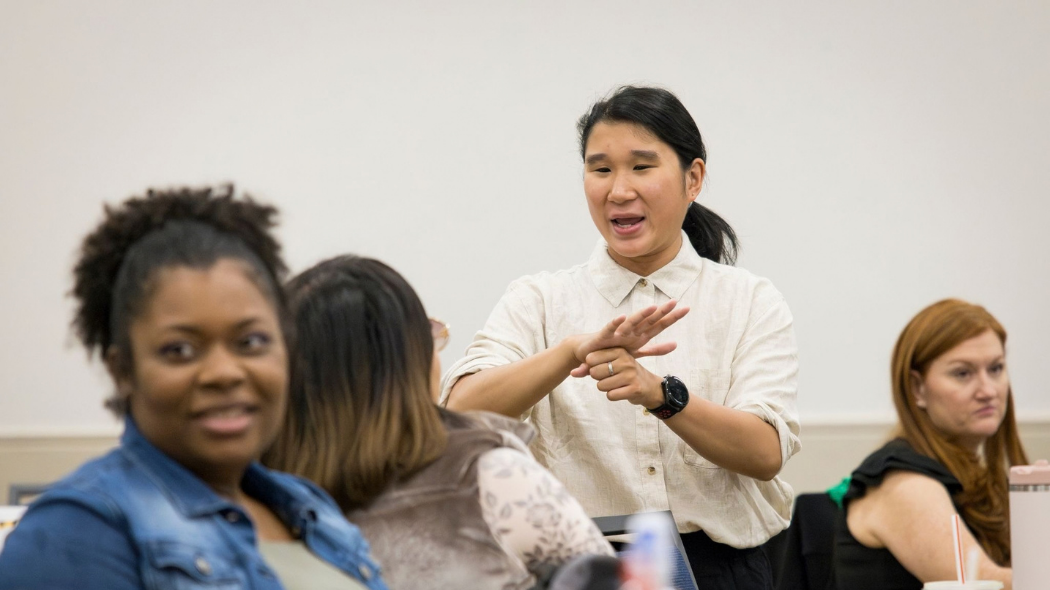
The ShareShop was coordinated by PSI Project Director Emily Girardin, Ed.D., ’12. Designed as a highly interactive learning experience, the event invited participants to engage in storytelling, interviews, dream boards, gallery walks, collaborative discussions and shared reflection. Rather than relying on traditional presentations, the facilitation team created opportunities for every voice to contribute while exploring one central question: What is already working, and how can we build upon it?
“Rather than focusing on what isn’t working, we intentionally explored what is working and how we can build upon those strengths,” said Laurel Apodaca, ’20, a PSI Project mentor who serves as a school interpreter in rural Illinois. “That simple shift transformed my perspective and mindset.”
The timing of the ShareShop was intentional. Meeting before the conference allowed participants to build relationships and establish a shared foundation through Appreciative Inquiry. Returning together after several days of volunteering created space to reflect, celebrate successes and transform those experiences into future leadership goals. For many, the experience became much more than professional development — it strengthened their sense of belonging within a national community of school interpreters.
“This event was something I never realized I needed,” said Ashley Humphreys, ’26. “It strengthened not only my professional relationships but also the foundation of my practice. The experience reminded me that growth is not something we achieve alone. It is cultivated through collaboration, shared experiences and a community committed to supporting one another and the students we serve.”
Between the pre- and post-conference sessions, the PSI Project partnered with NAIE — the national professional organization for school interpreters — to support its 10-year anniversary conference.
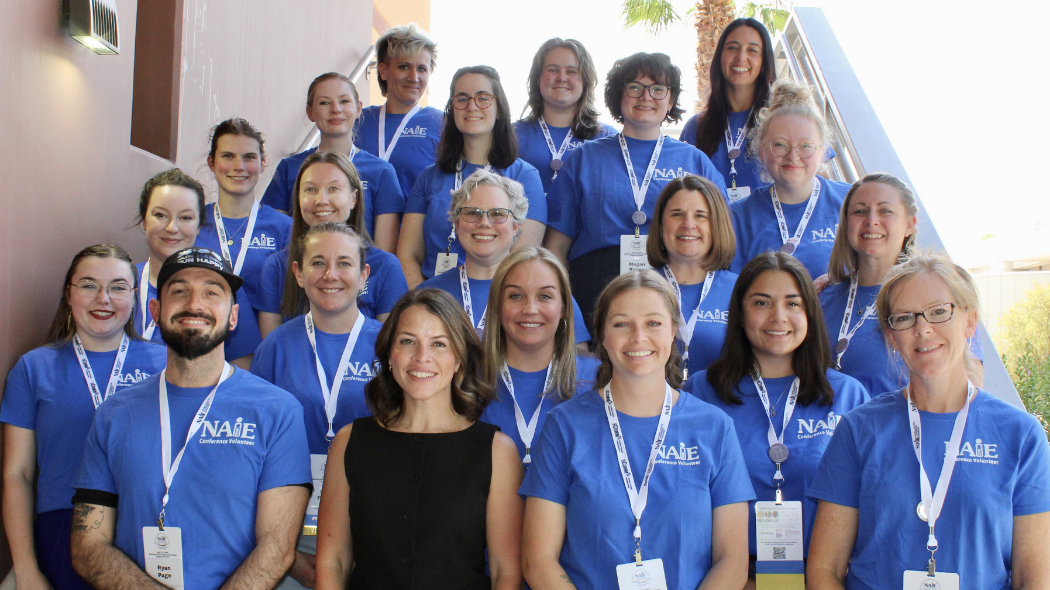
Twenty-one scholars from the project’s three most recent graduating cohorts served in key volunteer and leadership roles, contributing to conference registration, hospitality, logistics, interpreting services, presenter support and conference operations. Their work helped deliver a national conference while providing graduates with meaningful opportunities to give back to the profession that had invested in them.
Ryan Page, ’21, served as a volunteer team lead, reflecting on the collaborative spirit that emerged throughout the week.
“Each volunteer was instrumental in facilitating the experience. It underscored that our success is contingent on each other and demonstrated the power of coming together to build something bigger than any one individual,” Page said.
For many participants, volunteering represented more than professional service.
“The most meaningful part of volunteering was the feeling of being part of an organization that my professor, Susan Brown, helped architect,” said Megan Kupec, ’26. “Volunteering during the 10th anniversary celebration felt like one of the best ways to honor her memory.”
Susan Brown, a longtime UNC faculty member and former coordinator of the ASL-English Interpretation bachelor’s program, passed away in June. Throughout the week, her influence was evident, not only in the organization she helped build, but also in the graduates who continue her commitment to educational interpreting.
As participants returned to the ShareShop following the conference, something unexpected happened. After several days of volunteering, they came back physically exhausted but emotionally energized. Conversations shifted naturally toward the future as participants shared dreams for their schools, states and the educational interpreting profession. By the final afternoon, participants had returned to the circle where the week began, this time sharing commitments for how they would carry those ideas home.
For Girardin, that closing circle represented something much larger than the conclusion of a successful event.
“When I looked around the room, I wasn’t thinking about graduation years,” Girardin said. “I was thinking about community. That’s what made the week so meaningful. The conference will end, but those relationships — and the responsibility to support one another and the students we serve — will continue long after everyone returns home. If there’s a lasting legacy of the Preparing School Interpreters Project, I hope it’s that enduring sense of community and belonging.”
Fifty-four interpreters entered the week standing together in a circle. They left as part of something much larger; a professional community that now spans nearly two decades, more than 40 states, and generations of educational interpreters committed to supporting the deaf and hard of hearing students they serve.
Through the Preparing School Interpreters Project, UNC has done more than prepare highly qualified school interpreters. It has cultivated a national network of leaders, mentors and colleagues who will continue strengthening the profession, and one another, for years to come.