Written by Duard Headley | Translated by Carlos José Pérez Sámano
Bringing Students to the Scientific Frontier
Acercar a los estudiantes a la vanguardia científica
From boats to hikes, lecture halls to dorms, the Frontiers of Science Institute brings high schoolers on a hands-on learning experience like no other
Desde excursiones en barco hasta rutas de senderismo, pasando por salones y residencias universitarias, el Instituto «Frontiers of Science» ofrece a los alumnos de preparatoria una experiencia de aprendizaje práctico sin igual.
What is science?
Is it the expansion of human knowledge through meticulous research and innovation?
Is it gaining a better understanding of the natural world through first-hand wilderness experiences and exploration?
Is it slapping together makeshift boats out of cardboard and duct tape, setting them afloat in a choppy lake, climbing aboard and hoping the craft will carry you across safely and that your understanding of the laws of buoyancy is sound enough to save you from a soggy fate?
Yes, yes and, well, yes, according to the principles that guide the University of Northern Colorado (UNC)’s Frontiers of Science Institute (FSI).
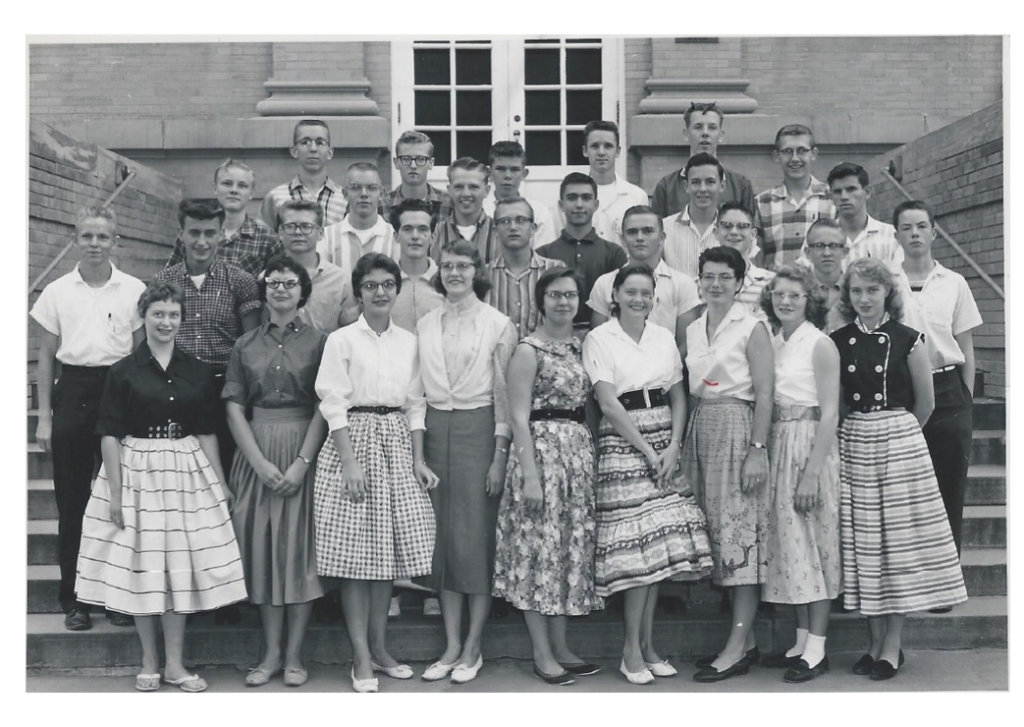
Founded nearly seven decades ago in 1959 as an initiative aimed at getting more women and residents of rural areas into STEM, FSI is a yearly program that provides high school sophomores, juniors and seniors with a six-week-long, immersive, residential learning experience based out of UNC’s Greeley campus.
The founding cohort of the Frontiers of Science Institute in 1959
This year’s cohort arrived on campus during the second week of June, composed of 16 high school students in total — 13 from across Colorado and three from states across the country. The program concluded on Saturday, July 18, with a presentation of research and celebration of the students’ accomplishments.
The program is directed by Victoria Duncan, Ph.D., who also serves as assistant director of the Mathematics and Science Teaching Institute in the College of Natural and Health Sciences (NHS).
“We want to help demystify what college looks like for them,” Duncan said. “To give them the confidence and familiarity with what it’s like so that they can hit the ground running in a few years when it’s their turn.”
FSI does just that in a variety of ways.
Throughout the program, student participants live in UNC dorms, eat in UNC dining halls, attend lectures in UNC classrooms and conduct experiments in the university’s various labs, halls and athletic facilities.
“It’s been a great introduction to learning how to be more independent,” said Rikki Skilbred, a student participant and junior at Compass Community Collaborative School in Fort Collins. “We’re living on our own, cooking and eating on our own and making a lot of connections through group-building activities, which are all great things to know how to do before we’ve even left high school.”
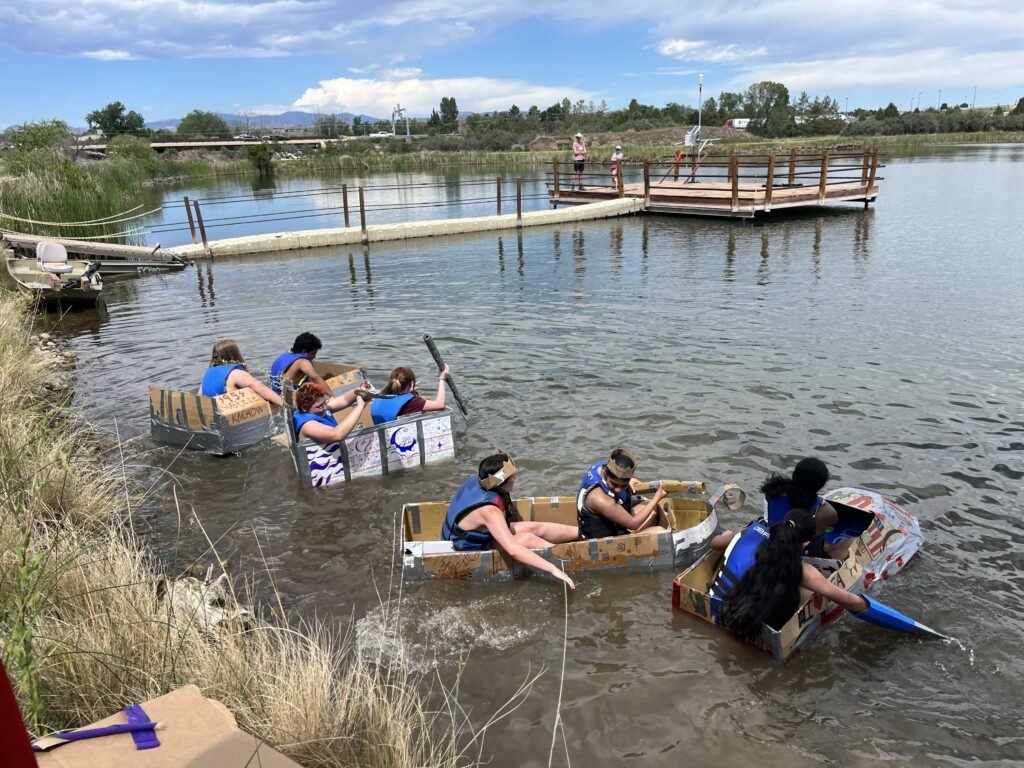
One such activity just so happens to be a nautical physics competition that takes place on a lake at Colorado Youth Outdoors in Fort Collins. Using knowledge of buoyancy and physics gained from lessons earlier in the program, students fashion boats out of cardboard, tape and other classroom materials with the goal of making it safely to a makeshift island in the middle of the pool.
Many stay dry and successfully traverse the treacherous waters. Others, Duncan said, go for an unplanned swim.
FSI students taking to the water for the boating challenge
“Either way, it’s so much fun for everyone and absolutely hysterical,” Duncan said. “It’s a blast to see how competitive they can be and how much fun they have taking what they’ve learned and putting it to a very tangible test.”
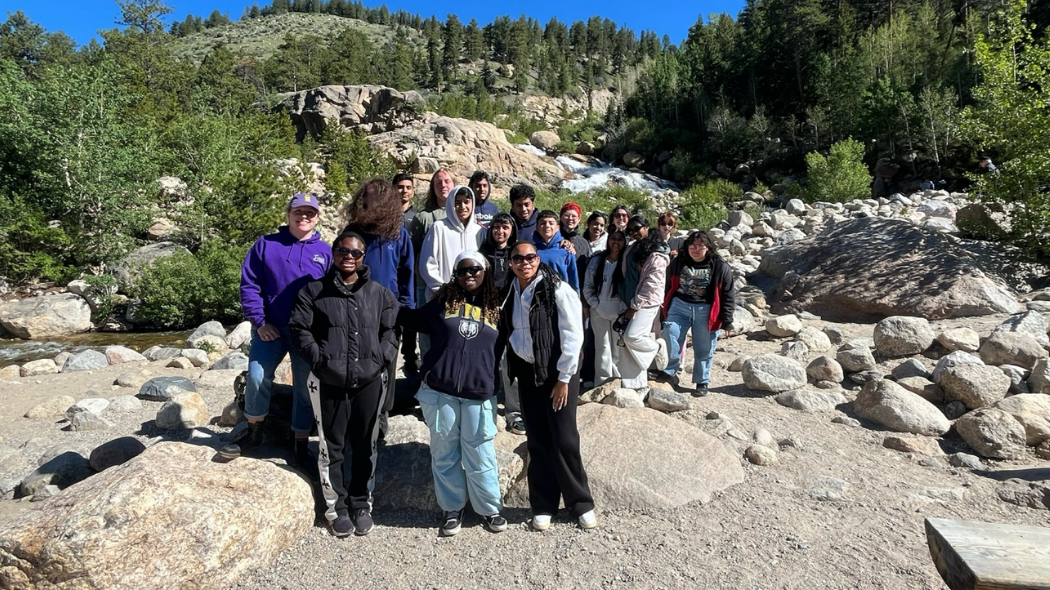
A variety of field trips are also a key part of the program. From visiting local organizations like Xcel Energy to taking hikes deep into the Colorado wilderness, students are encouraged to explore science beyond the confines of the classroom.
Domenica Plaza Homiston, a senior at Fairview High School in Boulder, said her experience during FSI directly influenced her plans for the future.
“We did a wilderness medicine class that I really enjoyed,” Plaza Homiston said. “Learning things like how to apply a tourniquet and how to dress a wound from actual physicians assistants made me realize that’s the kind of thing I’ve always wanted to do. I didn’t even know that was a thing before this.”
During their time in FSI, students are broken up into groups of two or three and assigned to a mentor — usually a UNC graduate student, but sometimes an NHS faculty member — who guides them through research topics, helps them design and execute their projects and serves as a role model and professional expert for the students to learn from.
Kara Phillips is an upcoming graduate of UNC’s Kinesiology doctoral program who specializes in Exercise Physiology. Now in her final year of graduate school and having recently successfully defended her dissertation, Phillips has served as an FSI mentor four times — one for each year of her doctoral program.
“Every year, the experience pushes me to be creative in how I can tailor my expertise to what the students want to learn,” Phillips said. “Every year, I feel like I learn as much from the students as they learn from me.”
Throughout her years mentoring for FSI, Phillips said she’s been proud to further the program’s mission of making science accessible for everyone — not just those who can afford it.
“That’s a huge part of what FSI is all about,” she said.
Duncan concurred, citing FSI’s longstanding history of doing outreach to students from all walks of life and tradition of providing large amounts of financial aid to those who participate in the program.
The university has raised over $100,000 for FSI each of the last three years and received grants from six corporate and foundation donors this year, including Xcel Energy, Adolph Coors Foundation, Union Pacific, Chevron, Suncor Energy, and the Rollie R. Kelley Family Foundation. The funding supports programmatic costs and provides scholarships for students to reduce their cost of attendance.
In 2025, every student who attended FSI received some form of financial aid, and thanks in part to Duncan’s efforts writing grants and fostering relationships with sponsors from local communities, as well as through the generous contributions of several FSI alumni, the same is true for all 16 students in the 2026 cohort.
“My biggest goal is to give students an opportunity to experience science hands-on, especially those who might not get the chance to do it otherwise,” Duncan said. “Science shouldn’t be this thing only the elite can study. Anyone from anywhere can be a scientist.”
That mission rang true for Sai Dasari, a senior at Rock Canyon High School in Littleton.
“A big reason I would recommend it is due to the diversity of the program,” Dasari said. “I signed up for it as a STEM-based experience, but I’ve learned so much about teamwork, working on new projects with new people and diving into topics that I never even knew existed.”
Dasari’s interest in science was first sparked in the third grade, when he and a classmate tackled a project on the topic of skin cancer in a unique way, presenting their work in the form of a puppet show.
Since that bit of research theatre, Dasari has undertaken a variety of science-related passion projects, even volunteering at a local hospital, where his desire to enter the field of medicine was born.
As someone who has loved working on scientific projects from a young age, Dasari said FSI was just the thing for kindling that spark.
“This program really helps people build interest and passion in things they can do, and I think that’s a really important part of science and of everything,” Dasari said. “Without passion, what’s the point in doing it?”
¿Qué es la ciencia?
¿Es la ampliación del conocimiento humano a través de la investigación meticulosa y la innovación?
¿Es llegar a comprender mejor el mundo natural mediante experiencias de primera mano en la naturaleza y la exploración?
¿Consiste en improvisar barcas con cartón y cinta adhesiva, ponerlas a flote en un lago agitado, subir a bordo y esperar que la embarcación te lleve al otro lado sano y salvo y que tu comprensión de las leyes de la flotabilidad sea lo suficientemente sólida como para salvarte de acabar empapado?
Sí, sí y, bueno, sí, según los principios que rigen el Instituto de las Fronteras de la Ciencia (FSI) de la Universidad del Norte de Colorado (UNC).
Fundado hace casi siete décadas, en 1959, como una iniciativa destinada a fomentar la participación de más mujeres y residentes de zonas rurales en las disciplinas de ciencias, tecnología, ingeniería y matemáticas (STEM), el FSI es un programa anual que ofrece a los alumnos de segundo, tercer y cuarto curso de preparatoria una experiencia de aprendizaje inmersiva y residencial de seis semanas de duración, con sede en el campus de Greeley de la UNC.
La primera generación de el Instituto de las Fronteras de la Ciencia en 1959
La generación de este año llegó al campus durante la segunda semana de junio, compuesta por un total de 16 estudiantes de secundaria: 13 procedentes de distintos puntos de Colorado y tres de otros estados del país. El programa concluyó el sábado 18 de julio con una presentación de los trabajos de investigación y una celebración de los logros de los estudiantes.
El programa está dirigido por Victoria Duncan, Ph.D., quien también ejerce como subdirectora del Instituto de Enseñanza de las Matemáticas y las Ciencias de la Facultad de Ciencias Naturales y de la Salud (NHS).
«Queremos ayudarles a desmitificar cómo es la universidad», afirmó Duncan. «Dales la confianza y la familiaridad necesarias para que, dentro de unos años, cuando les llegue el turno, puedan empezar con el pie derecho».
El FSI hace precisamente eso de diversas maneras.
A lo largo del programa, los estudiantes participantes se alojan en las residencias de la UNC, comen en los comedores de la UNC, asisten a clases en las aulas de la UNC y realizan experimentos en los distintos laboratorios, salas e instalaciones deportivas de la universidad.
«Ha sido una introducción estupenda para aprender a ser más independientes», afirmó Rikki Skilbred, una estudiante participante que cursa 3.º de Preparatoria en la Compass Community Collaborative School de Fort Collins. «Vivimos por nuestra cuenta, cocinamos y comemos solos, y establecemos muchos vínculos a través de actividades de trabajo en equipo, todas ellas cosas estupendas que conviene saber hacer incluso antes de terminar el instituto».
Una de esas actividades es precisamente una competición de física náutica que tiene lugar en un lago de Colorado Youth Outdoors, en Fort Collins. Aprovechando los conocimientos sobre flotabilidad y física adquiridos en las clases anteriores del programa, los alumnos construyen barcas con cartón, cinta adhesiva y otros materiales del aula con el objetivo de llegar sanos y salvos a una isla improvisada en medio de la piscina.
Muchos se mantienen secos y atraviesan con éxito las traicioneras aguas. Otros, según Duncan, acaban dándose una mojada inesperada.
Los estudiantes participando en el reto de los botes en el agua.
«Sea como sea, es muy divertido para todos y absolutamente divertido», dijo Duncan. «Es genial ver lo competitivos que pueden llegar a ser y lo mucho que disfrutan aplicando lo que han aprendido y poniéndolo a prueba de forma muy tangible».
Las diversas excursiones también son una parte fundamental del programa. Desde visitar organizaciones locales como Xcel Energy hasta realizar rutas de senderismo por lo más profundo de la naturaleza salvaje de Colorado, se anima a los alumnos a explorar la ciencia más allá de los límites del salón de clase.
Domenica Plaza Homiston, alumna de último curso del instituto Fairview High School de Boulder, afirmó que su experiencia durante el FSI influyó directamente en sus planes de futuro.
«Hicimos una clase de medicina en entornos naturales que me gustó mucho», explicó Plaza Homiston. «Aprender cosas como cómo aplicar un torniquete o cómo vendar una herida de la mano de auténticos auxiliares médicos me hizo darme cuenta de que eso es lo que siempre he querido hacer. Antes de esto, ni siquiera sabía que eso existía».
Durante su estancia en el FSI, los estudiantes se dividen en grupos de dos o tres y se les asigna un mentor —normalmente un estudiante de posgrado de la UNC, aunque a veces es un miembro del profesorado de la NHS— que les orienta en los temas de investigación, les ayuda a diseñar y llevar a cabo sus proyectos y actúa como modelo a seguir y experto profesional del que los estudiantes pueden aprender.
Kara Phillips está a punto de graduarse en el programa de doctorado en Kinesiología de la UNC y está especializada en fisiología del ejercicio. Ahora, en su último año de posgrado y tras haber defendido recientemente con éxito su tesis doctoral, Phillips ha ejercido de mentora del FSI en cuatro ocasiones —una por cada año de su programa de doctorado—.
«Cada año, esta experiencia me impulsa a ser creativa a la hora de adaptar mis conocimientos a lo que los alumnos quieren aprender», afirmó Phillips. «Cada año, siento que aprendo tanto de los alumnos como ellos de mí».
A lo largo de sus años como mentora en FSI, Phillips afirmó que se ha sentido orgullosa de contribuir a la misión del programa de hacer que la ciencia sea accesible para todos, no solo para aquellos que pueden permitírselo.
«Eso es una parte fundamental de la esencia de FSI», afirmó.
Duncan se mostró de acuerdo y destacó la larga trayectoria de FSI en el acercamiento a estudiantes de todos los ámbitos sociales, así como su tradición de proporcionar una importante ayuda económica a quienes participan en el programa.
La universidad ha recaudado más de 100 000 dólares para FSI en cada uno de los últimos tres años y este año ha recibido subvenciones de seis empresas y fundaciones donantes, entre las que se incluyen Xcel Energy, la Fundación Adolph Coors, Union Pacific, Chevron, Suncor Energy y la Fundación de la Familia Rollie R. Kelley. La financiación cubre los gastos del programa y proporciona becas a los estudiantes para reducir el costo de su asistencia.
En 2025, todos los alumnos que asistieron al FSI recibieron algún tipo de ayuda económica y, gracias en parte a los esfuerzos de Duncan a la hora de solicitar subvenciones y fomentar las relaciones con patrocinadores de las comunidades locales, así como a las generosas contribuciones de varios antiguos alumnos del FSI, lo mismo ocurre con los 16 alumnos de la generación de 2026.
«Mi principal objetivo es brindar a los estudiantes la oportunidad de experimentar la ciencia de forma práctica, especialmente a aquellos que, de otro modo, quizá no tendrían la oportunidad de hacerlo», afirmó Duncan. «La ciencia no debería ser algo que solo la élite pueda estudiar. Cualquiera, venga de donde venga, puede ser científico».
Esa misión caló hondo en Sai Dasari, estudiante de último curso de la preparatoria Rock Canyon High School de Littleton.
«Una de las principales razones por las que lo recomendaría es la diversidad del programa», señaló Dasari. «Me inscribí en él como una experiencia centrada en las STEM, pero he aprendido muchísimo sobre el trabajo en equipo, sobre cómo trabajar en nuevos proyectos con gente nueva y sobre cómo profundizar en temas que ni siquiera sabía que existían».
El interés de Dasari por la ciencia se despertó por primera vez en tercer curso, cuando él y un compañero de clase abordaron un proyecto sobre el cáncer de piel de una forma original, presentando su trabajo en forma de espectáculo de marionetas.
Desde aquella pequeña experiencia de investigación teatral, Dasari ha llevado a cabo diversos proyectos relacionados con la ciencia que le apasionan, e incluso ha hecho voluntariado en un hospital local, donde nació su deseo de dedicarse a la medicina.
Dasari, a quien le ha encantado trabajar en proyectos científicos desde muy joven, afirmó que el FSI era justo lo que necesitaba para avivar esa chispa.
«Este programa ayuda de verdad a la gente a desarrollar interés y pasión por las cosas que pueden hacer, y creo que eso es una parte muy importante de la ciencia y de todo en general», afirmó Dasari. «Sin pasión, ¿qué sentido tiene hacerlo?»