Article
October 20, 2026
Written by Student Writer Austin Watts
Anthropology Students Enter the Real Jurassic Park
Thanks to new grant funding, UNC students and alumni spend a summer week digging up ancient dinosaur fossils in remote Wyoming
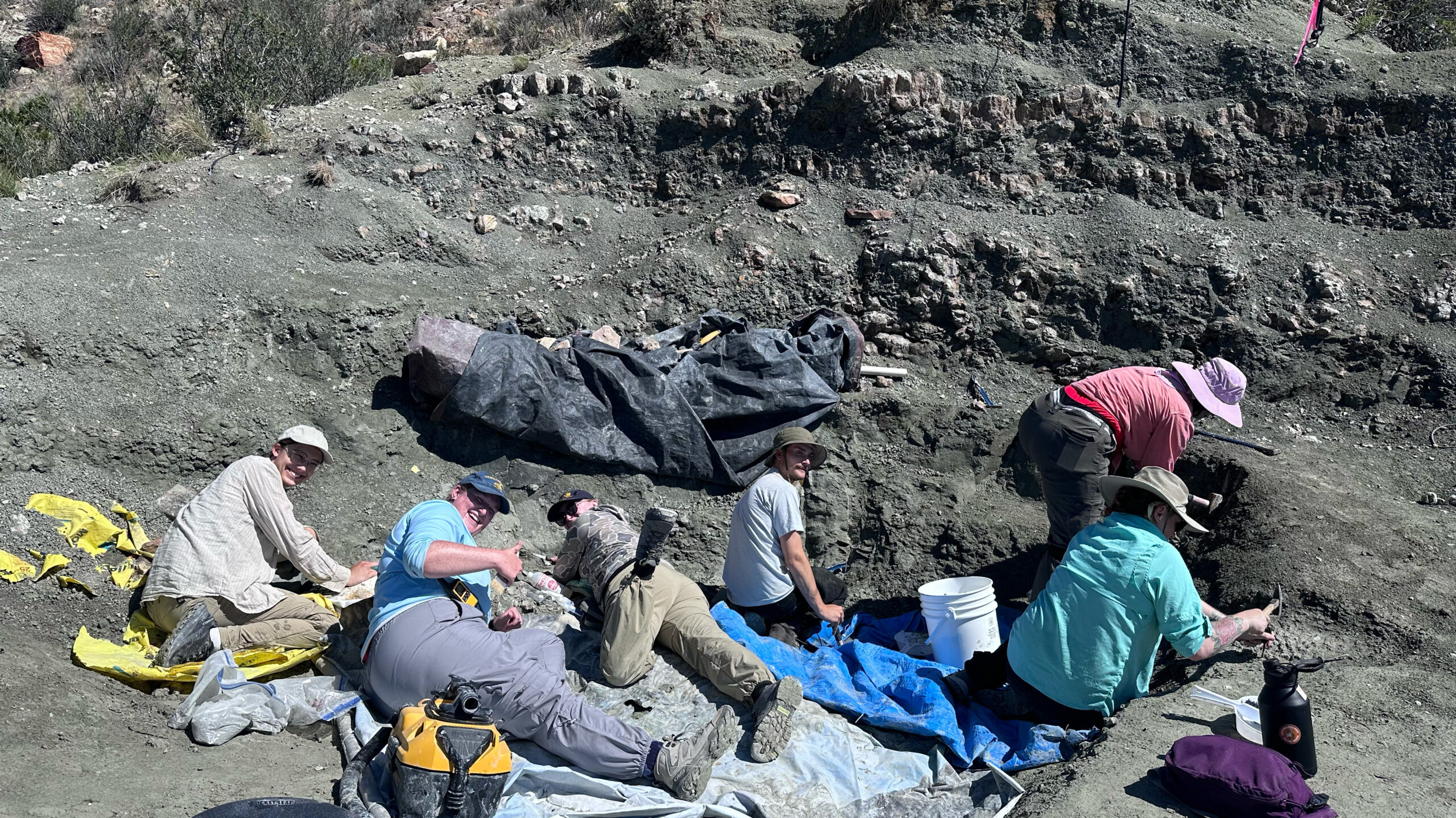
Equipped with chisels, brushes and lots of water, University of Northern Colorado (UNC) students and alumni spend a week each summer digging for dinosaurs.
Specifically, they’re carefully uncovering Jurassic-era dinosaur fossils on a remote swath of land near Douglas, Wyoming. Led by Anthropology faculty and funded by a multi-year grant from the David B. Jones Foundation, this hands-on excavation offers undergraduates accessible, low-cost field experience — from carefully carving bones from rock matrix to analyzing their composition with portable X-ray fluorescence (XRF) devices. By bridging classroom instruction with real-world field science, this unique offering hones confidence, builds career readiness and strengthens UNC’s Anthropology alumni network.
It all started back in 1986, when a Wyoming rancher discovered what appeared to be some kind of bone jutting out of wide swaths of prairie land. After contacting the Wyoming Dinosaur Center, the bone was confirmed to be the first of many dinosaur fossils that would be unearthed at the site. Since then, paleontologists have been traveling from around the country to excavate the area year-round.
Now, each summer, UNC students look forward to a week of work contributing to the decades-long project.
Spearheading the annual operation is Marian Hamilton, Ph.D., associate professor of Anthropology. Hamilton has been at the helm of the trip since its inception at UNC in 2023. While she and her colleagues regularly set up mock field experiences in the classroom during the academic year, she encourages students to participate in this real field experience.
“The field is messier than the classroom,” Hamilton said. “There are always issues that come up, and part of being a good archaeologist and field scientist is learning how to start, fix and recalibrate. You can’t really learn that until you’re in the field.”
Back in June, to start the journey, participants met faculty on campus to begin the hours-long drive to the site, which is a mile’s hike from the nearest point accessible by car. Hamilton and her team haul loads of equipment under the scorching summer sun until they arrive at the site, where they set up shades, turn on some tunes and get to work unearthing dinosaur bones.
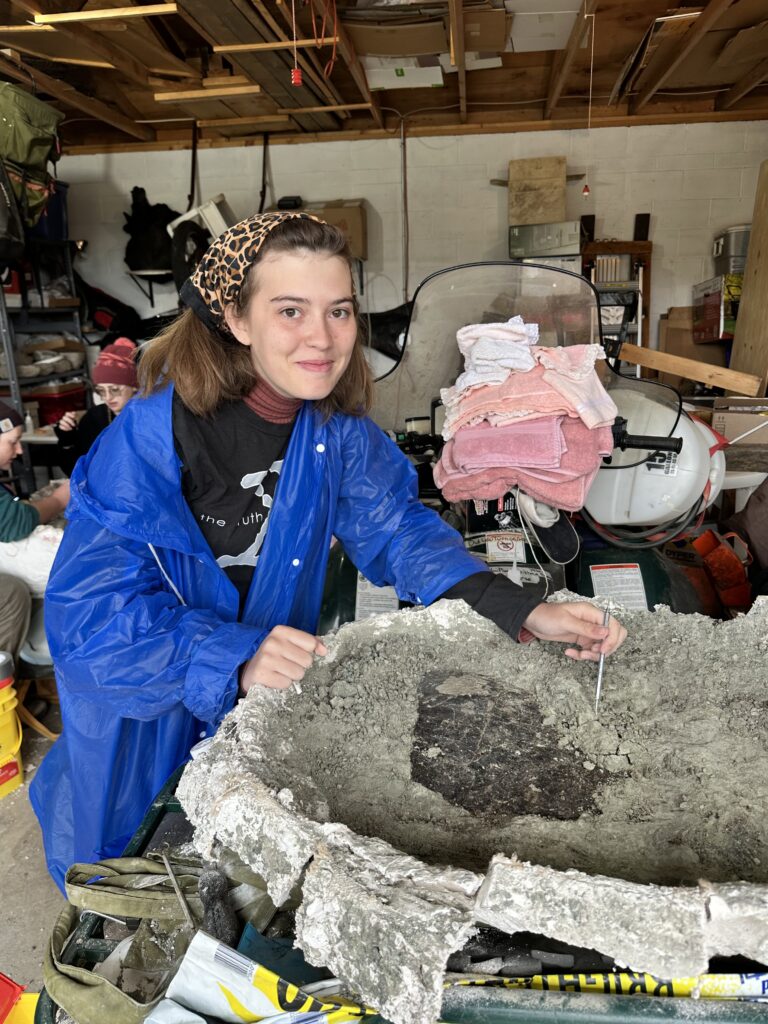
“In movie portrayals of excavations, you brush the sand away, and there’s a perfect triceratops head or something like that,” Hamilton said. “But that’s not how they actually come out of the ground. The matrix is hard, so you chisel carefully, because you could break the bone as easily as you’re going to break the rock. It’s really delicate, detailed work.”
The dinosaurs the students and alumni dug up included an Apatosaurus (one of the big, long-necked dinosaurs) and an Allosaurus.
“It’s a lot about how much patience you have,” said Jane Walston, a senior Ecology major.
Walston never anticipated digging up fossils during her time at college, but found herself immensely enjoying being hunched over a small area slowly chipping and brushing away at the material with primarily dental tools for most of the week.
“This work is making me deeply consider fieldwork and research that explores fossils,” Walston said. “Paleontology always seemed like such a hypothetical activity, something you think about doing as a kid. But after this course, it not only feels real, but also like something I could see myself doing in the future.”
She plans to join the trip as an alumna for as many years as she can.
Hands-on, fast-paced field training is a critical stepping stone for undergraduate Anthropology students aiming to enter the workforce, particularly in archaeology. Federal and state regulations require the presence of archaeologists on infrastructure projects to protect Indigenous cultural sites and paleontological resources, making these roles essential across the construction sector. While a bachelor’s degree satisfies the educational baseline, Hamilton says that practical experience is critical for hiring.
However, whether the field trip would be a possibility each year wasn’t always certain.
At the program’s inception four years ago, Hamilton primarily used internal funding sources to support the trip.
“I pretty much drained all of my available money in the department to cobble together room and board and all this other stuff for students,” she added. “It was very bare-bones, eating peanut butter and jelly sandwiches every single day, and we didn’t know if we would be able to come back the next year.”
As with any field, paleontologists need a clear timeline to be able to conduct the most effective research. Uncertainty about future funding opportunities created challenges for Hamilton and her colleagues as they attempted to develop the best possible research plan for their students.
However, all of that changed when the site’s managing nonprofit, the Wyoming Dinosaurium, was awarded the David B. Jones Foundation grant earlier this year, with Hamilton as the principal investigator.
Established in May 1998, the David B. Jones Foundation is a private organization that provides grants to domestic entities to support paleontological education, research and charitable efforts. In addition to supporting provisions for meals and lodging for all participants, the grant funds a three-year program, the first excavation of which was completed this summer.
For Hamilton and her team, this is a game changer.
“Now we can set up these long-term projects that we know we’re going to be able to return to over the next couple of years,” Hamilton said. “Knowing that we have the three years of funding and then also having more available [departmental] funding means that we can make things a little bit more comfortable.”
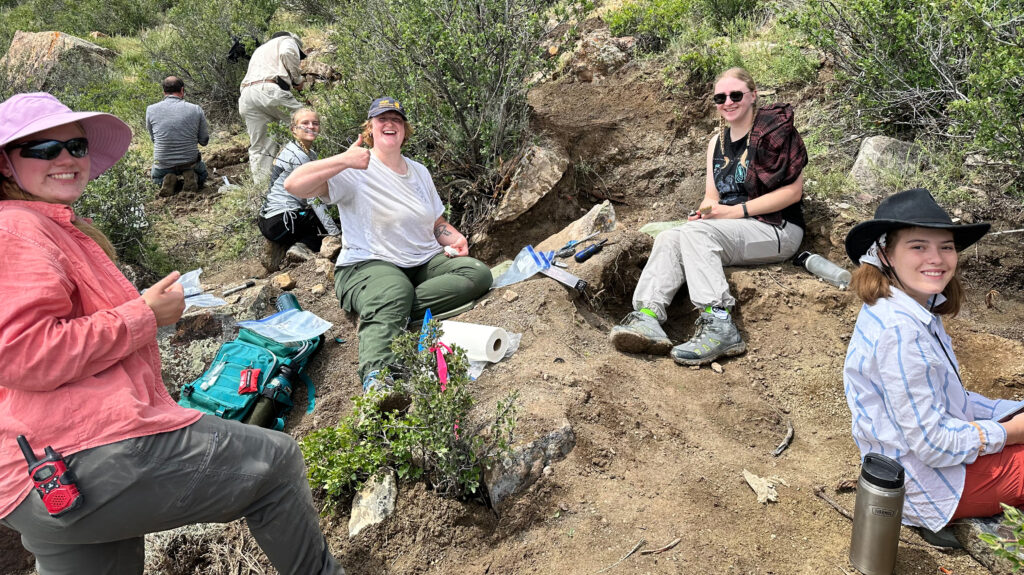
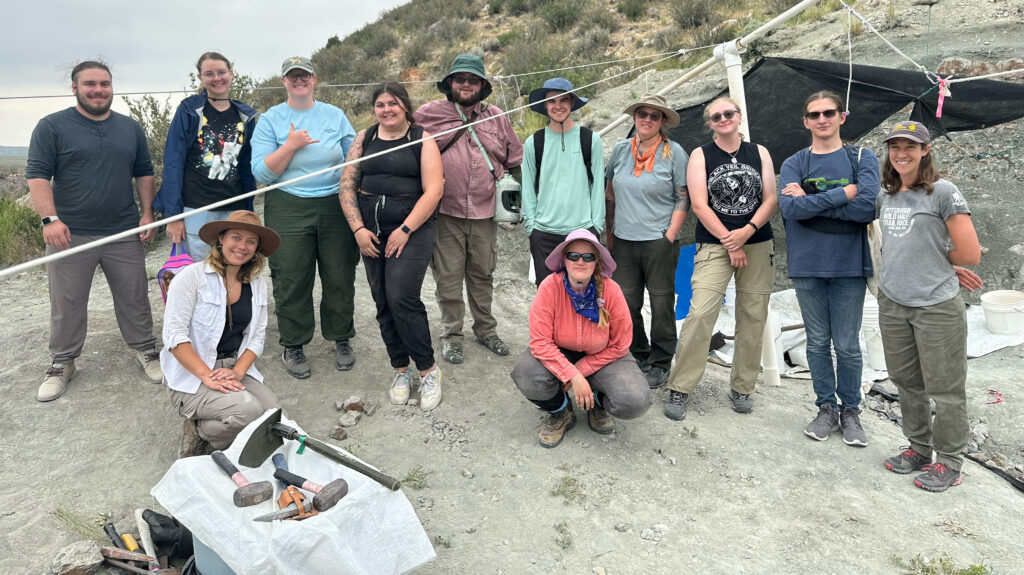
The annual trip is offered both as a credit-bearing course, Anthropology 408, and a volunteer experience open to all. While Anthropology students typically make up the bulk of the team, Earth and Atmospheric Sciences, Biology and Chemistry students have also joined the excavation over the years. In addition to integrating a diverse population of undergraduate students, the volunteer option also invites Anthropology alumni to rejoin the trip.
These former participants frequently return to the field alongside faculty, serving as a vital bridge between professors and new undergraduates. Experienced alumni help guide field operations, assist with advanced equipment and mentor first-time students.
“What we’re really building here is this incredible tiered mentor system,” Hamilton said. “Having [alumni] and the students who are there learning it all for the first time means that you can divide up for more specific instruction.”
This collaborative structure benefits both sides, giving alumni hands-on leadership experience, data analysis, and co-publishing opportunities while bolstering support for incoming students and faculty alike. Additionally, beyond the manual labor, students also get hands-on experience with state-of-the-art tech like portable X-ray fluorescence (XRF) devices. By firing low-intensity X-rays into specimens, the cutting-edge tool measures elemental composition to reveal whether a fossil is still mostly bone or has transformed entirely into rock.
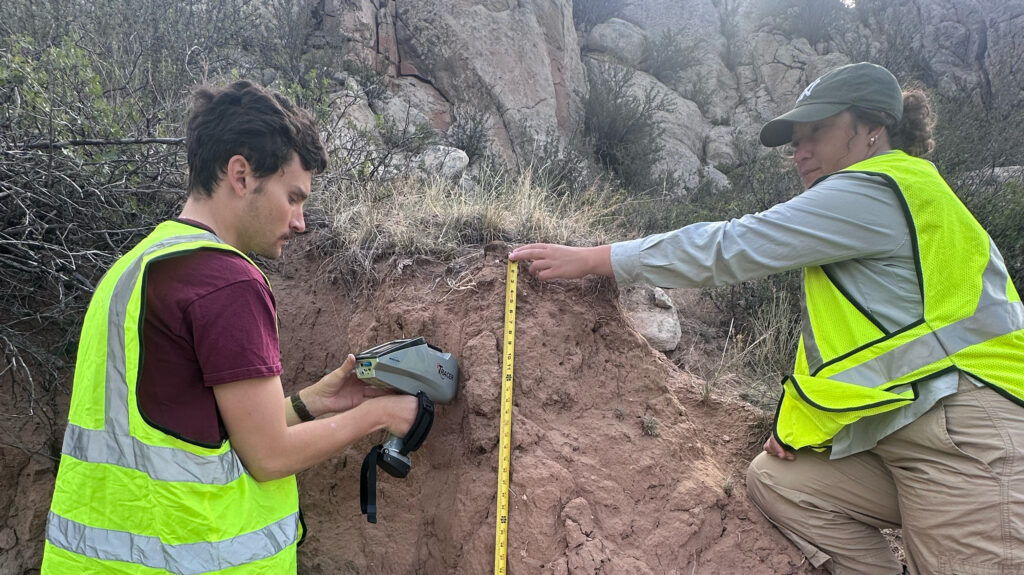
“This field opportunity has definitely made me more confident in my ability to act in the field, especially the fields of paleontology and archaeology,” said Zachary Raine. “While I am a grad student in History, opportunities like this nonetheless keep me interested in things outside of my own field of study while allowing me to remain conscious of my own flexibility.”
For Hamilton, watching her students’ growth over the course of a single week — going from hesitant beginners to confident researchers shouting findings across the hill — is the ultimate reward. Across the Anthropology Department, she is ensuring that her students’ education is personal.
“Our Anthropology Department is small but mighty,” Hamilton said. “The amount of hands-on opportunities that we’re able to generate for our students takes so much hard work and dedication, and I am so proud to work in a department filled with people who do that day in and day out, and with students who rise to every single opportunity.”