
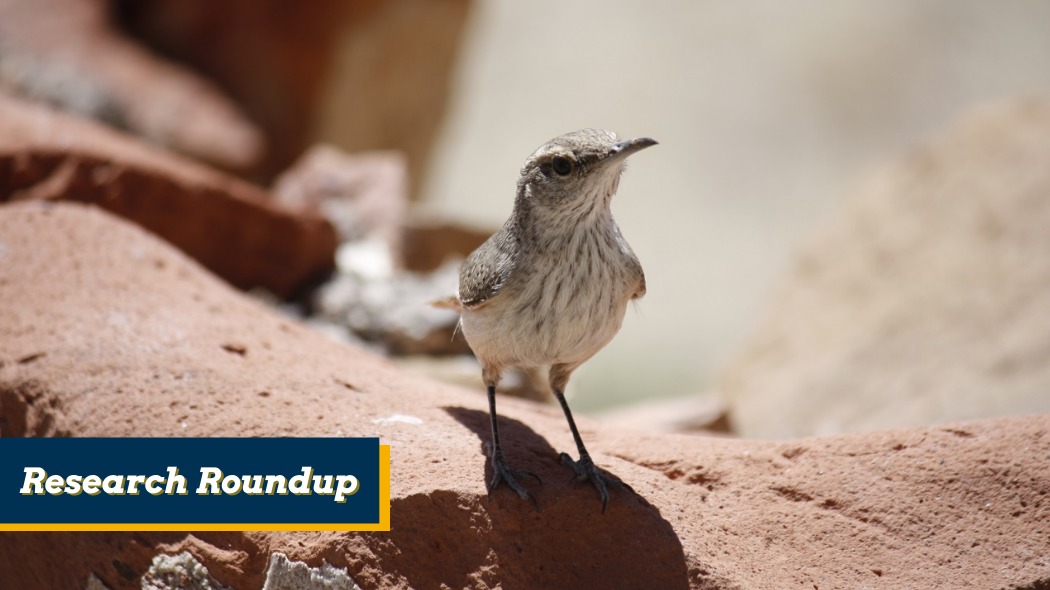
A photo of a Colorado rock wren perched on a boulder, with stylized text that reads

Article

March 19, 2026

Written by Duard Headley

Research Roundup: Songs of Spring

Lauryn Benedict, Ph.D., talks tunes and tweets, sharing the lessons that can be learned from bird songs

Research Roundup is a series that features Q&As with UNC faculty to share insights about their research in an approachable, bite-sized format. Each installment highlights the questions driving their work, why it matters and how it connects to broader issues in our community and beyond. 


Of all the sights, smells and sounds that signal the return of spring, few are as resonant or resounding as bird songs.  

From the crooning of cardinals to the chattering of chickadees and the myriad melodies of robins, wrens, bluejays and more, stepping outside and hearing the sounds of an avian orchestra is a warm and welcome herald of a new season and life and growth.  

But beyond the beauty of these tunes, what can the way birds sing tell us about nature, evolution and communication as a whole?  According to Lauryn Benedict, Ph.D., professor and associate chair of Biological Sciences in the College of Natural and Health Sciences, the answer is: quite a lot. 
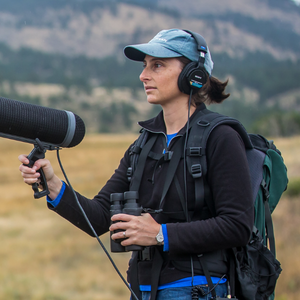
UNC professor Lauryn Benedict out in the Colorado wilderness.

“We can use [the study of] birds to get at questions that will help us understand the things that cause each and every sound we hear to be distinct and beautiful.”

-Lauryn Benedict, Ph.D.  

In this edition of Research Roundup, Benedict shared her insights into how bird songs can shed light on questions from a variety of topics – from ecology to linguistics, neurobiology, evolutionary biology and more.   

I study birds, and most of my research has to do with the different sounds they make. I ask questions like, “Why does one bird sing a song that sounds different from another?”, “Why does a single bird species sound the way it does?” and “What can the ways that birds communicate tell us about language and the evolution of communication overall?” 

In addition to how ecologically rich and beautiful birds are, I’m interested in what their sounds can tell for the sake of understanding ecology and the evolution of signaling, communication and language.

Firstly, birds are incredibly varied. There are somewhere around 11,000 bird species in the world, and almost all of them make some kind of sound.

Beyond that, birds communicate in the same modalities that we do – they use a lot of both visual and vocal signaling, which is something humans do a lot of, too. Because of that, we can more easily understand the ways in which they communicate compared to looking at, say, a dog; we’re not as good at perceiving the wide variety of things a dog can smell, for example.

Finally, about half of all birds fall into a group called passerines – the birds we know as perching songbirds. Most passerines learn their songs as they develop; they aren’t born with innate knowledge of how to sing. Because of that, they’re one of the best natural models we have for examining how animals – including humans – learn new sounds and acquire languages. They’re a great study system for understanding the neurobiology of sound learning and production across a variety of diverse species.

From an evolutionary perspective, we can think of bird song as analogous to human languages. When examining language evolution, you can map out their evolution through complex trees, grouping languages together based on similarities like we do with the group we refer to as romance languages – Spanish, Italian, French, Portuguese and Romanian, mainly.

It’s the same idea with bird sounds. We can examine the factors that cause bird songs to be diverse from one another – for example, asking if all species of sparrows sound the same because they’re all sparrows or if they all sound the same because they all live in forest habitats.

We can use bird songs to get at questions that will help us better understand the things that cause each and every sound we hear to be distinct and beautiful.

Additionally, by looking at the psychology of bird song, we can learn about how brains – including human brains – control behavior. We have mapped within bird brains the song learning and song production pathways, which allows us to link different parts of the brain to learning, development and behavior. Through birds, we can better understand some of the mechanics of neurobiology and physiology as a whole. 

Our main field project involves canyon wrens and rock wrens here in Colorado. Using things like mist nets – giant nets made of very thin string that are invisible to birds – we catch, mark and then immediately release birds to examine their natural behaviors. In particular, we try to find individual birds over and over again, maybe those who are defending a territory.

When we catch a bird, we measure things like its beak length, wing and leg size, etc. Once we’ve documented it, we’ll put bands on its legs. We use metal bands issued by the federal government as well as colored bands that are used specifically for our field projects; these bands don’t hurt the birds in any way and unique color combinations identify each bird.

By banding and then releasing wild birds, we can record their movements, how many offspring they have, patterns of both individual and group behavior and more.

Our lab collaborates with a wide variety of disciplines, from conservation biologists to linguists. Currently, we’re working with a linguist, people who study bird musicality, people who study genetics and more.

Linguists at the Austrian Academy of Sciences in Vienna are using data from a survey my colleagues and I conducted on parrot vocal learning, and I was recently part of a collaborative paper that included work by many physiologists and evolutionary biologists that examined large scale factors that contribute to singing in female birds.

It’s great to have the opportunity to do those kinds of collaborations because it leads to exploring questions and methods that you might not have thought of on your own.

One of the main ways this research can be applied in practice is for conservation work. If, for example, people are working to conserve bird populations in an area, monitoring those populations is a huge part of that, and the major way we do that is simply by going out and counting birds in different areas by sight and by sound.

When noting down the sounds birds are making, it’s easier to get an accurate and helpful picture of a local population if you know the difference between various species, male song versus female song, etc.

Doing so tells us whether populations are increasing or decreasing, if a species is threatened in some way, if offspring are being created and more.

Birds also bring joy to many people across the world. I have projects that embrace that general outreach; I love talking to school and birding groups, and I co-created a video series that answers questions about birds in a fun, light-hearted format for general audiences.


Graduate Student Highlight: Cristina Barros
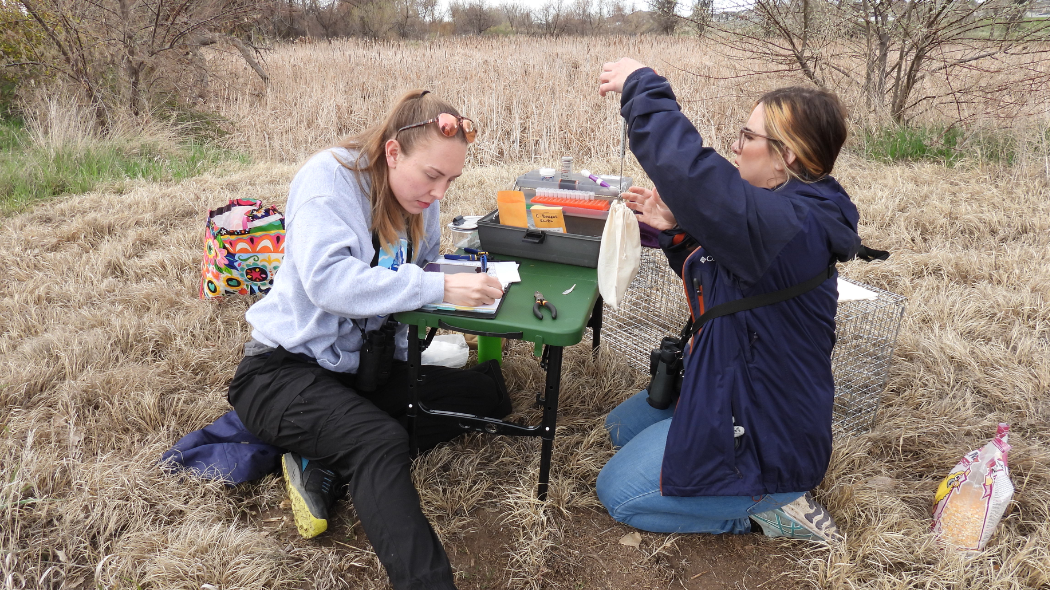
Two graduate students working at a small research station in the field.
Above: Cristina Barros (right) conducting field research with fellow student Delaynie Byrne (left).

Cristina Barros, a fifth-year doctoral student in the Biological Sciences program, has framed her research at UNC around a deceptively simple, yet pervasive question: why is there so little research on female birds?

“In biology, it feels like it’s sometimes assumed that because we’ve extensively studied the males of a species, we can stop there and have all the understanding we need to,” Barros said. “We’ve seen this in humans, too – we’re only recently beginning to learn and understand more about women’s health specifically.”

Alongside Benedict, who also has a long-standing interest in studying female birds, Barros is conducting research on female red-winged blackbirds and their songs. She’s hoping to gain insight into the differences in purpose between male and female bird songs, how evolution has impacted whether female birds sing at all, what female song and behavior can indicate about a species as a whole and more.

“I don’t approach it with the mindset of wanting to learn exclusively about the female side of the story,” Barros said. “Rather, I want to show more people that learning about the female side of the story can also tell us more about the male side of the story too. They’re two parts of the same story.”

On top of conducting field work catching, examining and cataloguing birds and helping to educate and provide experience to the undergraduate research assistants that work with her, Barros is engaged in discussion with other professionals in the field, looking to shed more light on a side of biological studies that has sat in the dark for far too long.

“I recently presented some of my work at a symposium dedicated to female bird research, and when talking with others who are also studying female birds, many said their results were so much different than what they had been expecting,” Barros said. “We realized that, quite frankly, no one had done this kind of research before and that so much was different when comparing male and female birds.”

At the symposium, Barros and her colleagues discovered that, due to the lack of research on female birds, the same methods used for studying male birds wouldn’t cut it. To more accurately fit female birds’ biology and unique environmental experiences, new, distinct techniques are needed – something that opens up an entirely new door when it comes to avian research.

Through her work at UNC, Barros said she has gained an appreciation for working alongside her peers and enjoys helping to inspire aspiring biologists as they discover their passion for their field of study.

“As graduate researchers, I think it can be easy to forget that we’re doing new, novel research,” Barros said. “It can be really unsettling to feel like you don’t know what you’re doing, but it’s about learning how to be comfortable with that uncomfortable feeling and still pushing on in spite of it.”