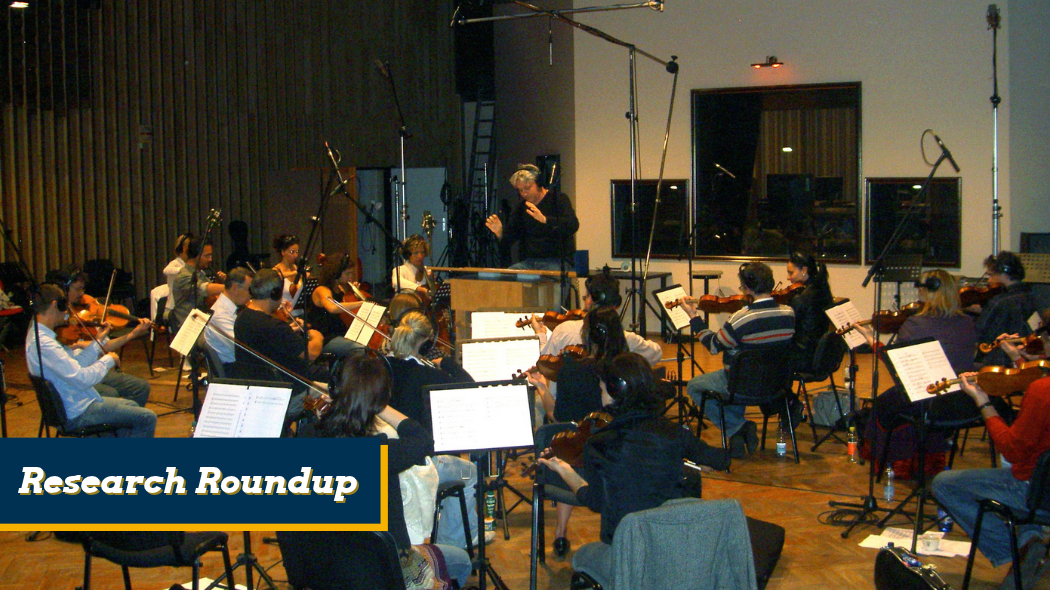
UNC professor and professional composer Ludek Drizhal conducting a group of musicians.

Article

November 6, 2026

Written by Duard Headley

Research Roundup: Scoring the Sounds of the Silver Screen

World Soundtrack Award nominee Ludek Drizhal shares the stories behind the songs he composes, and how he’s teaching the next generations of musicians

Research Roundup is a series that features Q&As with UNC faculty to share insights about their research in an approachable, bite-sized format. Each installment highlights the questions driving their work, why it matters and how it connects to broader issues in our community and beyond.  


For thousands of years, music has served as the heartbeat of humanity.  

What starts as a simple vibration ripples to life as a sound wave, dancing through the air into our ears, where it lights up the brain like a firework. Music can make people cry, inspire them to dance, to laugh, to sing. It can induce goosebumps or cause someone to stare wistfully into the distance at the whims of a melancholy melody. 

Nowhere is that more true than in the entertainment people watch. Across all genres of film and television, music is used to enhance the spectacles on the screen, heightening emotion and driving the story in ways that no other medium can.  

Ludek Drizhal, associate professor of Digital Media Composition and Music Theory in the University of Northern Colorado (UNC)’s School of Music, has been composing music for nearly his entire life. Based in Los Angeles, he currently works as a composer for film and television, bringing decades of professional experience to his teaching at UNC.
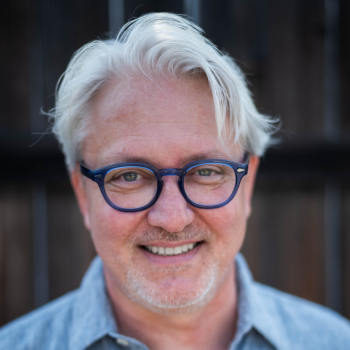
A professional headshot of UNC professor and composer Ludek Drizhal.

“Music is communication. You’re communicating emotion through melody, harmony, rhythm, pacing, silence and structure. Actually, sometimes what you leave out is more important than what you put in.”

-Ludek Drizhal 

He’s had the chance to work with acclaimed directors, award-winning actors and industry-leading musicians on a wide variety of projects. Most recently, his soundtrack for the recently-released film Starbright was nominated for the Public Choice Award in the World Soundtrack Awards alongside scores for films like KPop Demon Hunters and Avatar: Fire and Ash.

In this month’s Research Roundup, Drizhal shared the story behind the sound, illuminating his creative process, personal history with music and how he crafted the critically-acclaimed composition that is the Starbright soundtrack.

I’m a composer, conductor, and music producer. I’ve written music for quite a few films and television shows, and I’ve been lucky enough to work with some wonderful directors in the U.S. and Europe. I’ve also done a lot of arranging and producing for recording artists over the years.

But I actually come from a classical music background. I grew up in Prague and started studying violin when I was very young, with Dr. Josef Müller, who was the principal violinist of the Prague Radio Symphony Orchestra.

At the same time, I was always noodling on the piano, making things up, improvising. And eventually, some of those little ideas started turning into actual compositions.

Then, when I moved to the States in ’86, I sort of went in a completely different direction. I got into roots rock, started writing songs, played as a studio musician. I even had a couple of record deals as a singer-songwriter. Neither one worked out particularly well, but, you know, that’s part of the journey.

So I eventually found my way back to classical music. And somewhere along the way, I was asked to write music for a theater production. I really enjoyed that experience, especially the idea of writing music to support a story.

And from there, film scoring just seemed like a natural next step. It wasn’t something I had necessarily planned. It just sort of happened, and it felt right.

Well, there’s actually a story behind that.  

You know, the Soviets occupied Czechoslovakia in 1968. I was little over two years old at the time, and whenever my parents went away, they would leave me with my grandparents.

So one night, my grandmother was working a night shift and it was just me and my grandfather at home.

And somewhere in the middle of the night, the whole house started shaking. There’s this incredible rumbling and rattling. Now, living in L.A., you’d think, “oh, it’s an earthquake!” But no, these were Russian tanks rolling down the street.

I was terrified. I ran into my grandfather’s bedroom and climbed into bed with him. And he pulled the covers over us, took out this little harmonica, and started playing a tune. Just a simple folk song. And then he showed me how to play it.

Well, by the time my uncle came over the next morning, I could actually play the tune for him. My uncle also happened to be a renown violin professor at the very prestigious Brno Conservatory. And he was impressed, I guess, because not long after that, he bought me my first violin.

And that’s really how it all started.

So when you ask me what music means to me… I mean, music is me. I don’t really know how to separate the two.

When things get tough, I turn to music. When things are wonderful, I do exactly the same thing.

Music has come to my rescue more times than I can count. And I think that goes all the way back to that night with my grandfather.

No matter what’s going on in my life, no matter where I am, music is always there. It’s what keeps me going.

The film entertainment industry has changed so much since I started working in the early 2000s. These days, filmmaking is so much more accessible. It seems like everybody is making a movie!

So that’s definitely something you now have to navigate. For me, I try to stay open to different kinds of projects, different genres, even things I haven’t done before. Sometimes it’s a lot outside my comfort zone, but I actually like that. And you may not hit bullseye every time you try, but I see it as a challenge. You gotta take things professionally, not personally.

The thing about writing music for film is that it’s not just about being a good composer. You really have to understand storytelling. You need a strong dramatic instinct, but you also have to be very analytical about what you’re doing.

You have to understand how music works emotionally, but also technically. Why does a particular piece of music work in one scene but not another? How does it connect to what comes before and after? How do you build a musical arc that holds the whole story together?

And sometimes, I’ll write version after version of something and nothing feels quite right. It can drive you a little crazy! But that’s part of the process.

And really, that’s what makes it interesting to me. Every film is different. Every story needs something different. So I don’t think there’s one formula that works for everything.

I try to approach each project with fresh ears and figure out what that particular story needs from the music.

Background Info: Starbright is a fantasy film directed by Francesco Lucente and written by Joseph Bitonti and Olimpia Lucente. The film stars John Rhys-Davies, Diego Boneta, Alexandra Dowling, Ted Levine, Becky Ann Baker, Gbenga Akinnagbe, Tom Carey and John Westley. The plot follows a young woman who discovers a fallen star and must protect it from dark forces that wish to exploit its power. 

I wrote the score for the film, and the process was definitely not a short one. I first read the script in 2006, and started playing with themes around 2008, then we started filming in 2016.

A couple of years after that, after we were close to locking picture, I started working on the actual score. Once we dove into the actual scoring, that process lasted about six months. Once we had all the music written, we recorded in Prague around 2022 or 2023. Then the film went through extensive dubbing and visual FX process. The film was released at the beginning of this year — it was a real journey.

[As for the music], the film has three distinct elements — the family drama, the fantasy world and the villains/action. So that had to be reflected in the music.

For the family material, I wanted there to be a kind of Americana quality. There are little traces of those traditions in the harmonies, the melodies and the way some of the phrases are shaped.

The fantasy music is really a completely different world. Harmonically, it’s much less grounded. I use a lot of mediant and chromatic-mediant relationships and harmonic shifts that don’t necessarily function in the traditional sense. I wanted it to feel a little unpredictable, almost as though the music could drift somewhere unexpected at any moment.

The music for the villains and action let me go in a much more aggressive direction. There’s a lot of virtuosic orchestral writing, more dissonance, sharper rhythms and just a lot more physical energy in the orchestra.

I love Penderecki and Bartók, so I couldn’t resist bringing in some extended techniques — screeching strings, brass clusters, pitch bends, tapping, all kinds of unusual textures. For percussion, we used things like waterphones, bottles, cans and other found sounds, giving a more unpredictable and sometimes slightly unsettling character, which was a nice contrast to the warmth of the family music and the more magical quality of the fantasy material.

Music is communication. You’re communicating emotion through melody, harmony, rhythm, pacing, silence and structure. Actually, sometimes what you leave out is more important than what you put in. 

It’s a little like language. Some people are better communicators than others, and I think the same is true in music. Some music communicates very clearly and some of it just doesn’t. 

A lot of that can be taught. You can study technique, harmony, orchestration, form, history and spend a lot of time with the great repertoire.  

All of that gives you a kind of toolbox. Then, when something in your music isn’t working — emotionally, structurally, technically — you have ways of figuring out why and hopefully fixing it.

But the first thing is being able to hear that it isn’t working. That takes serious self-criticism. Nothing you write can be too precious to you. You need thick skin. I think that’s especially important now because there is so much music being created. There’s a tremendous amount of noise out there, and real talent can easily get lost in it. So, I tell students that their standards have to be extremely high.  

I hold them to the same standard that producers and directors hold me to. If students bring me a piece and I wouldn’t feel comfortable playing it for a professional filmmaker, it’s my obligation to tell them.

Sometimes, the best lesson is realizing that a piece just isn’t going to work. You throw it away, learn from it and have the courage to start again. Having nothing to show for your time spent writing is a part of being a composer too.

I’m not going to pretend I have the answers about AI, because I don’t. And I certainly can’t predict where all of this is going.  

I do remember when composers first started using computers more seriously. There was a lot of backlash then too, and a lot of misunderstanding. People sometimes assumed the computer was somehow doing the composing, which of course wasn’t true.

To me, tools are tools. And as the tools get more sophisticated, the questions around them become more complicated. A knife can be used to cut bread or to hurt a person. The tool itself isn’t really the issue — it’s how someone chooses to use it.  

So, can AI be a good thing? I suppose it can. It depends entirely on how it’s used, and what role it ends up playing in the creative process.

If I had my way, I’d probably be sitting in a little cabin on a cliff somewhere in Big Sur with manuscript paper and a piano, just noodling around all day.

But that’s not really the world we live in. We have to make a living, and everything moves incredibly fast now. Deadlines are getting tighter, expectations are higher and there’s more and more pressure to produce work quickly.  

So, I think the real question is how we use these new tools without losing the human part of the process that makes the music worth listening to in the first place.