Written by Student Writer Austin Watts | Translated by Carlos José Pérez Sámano
Supporting the Whole Student: A Look at Well-Being Resources
Apoyo integral al estudiante: un vistazo a los recursos para el bienestar
How UNC prioritizes "humans first" thinking by providing a holistic safety net, from food and financial aid to mental health support
Cómo la UNC prioriza el enfoque "las personas son lo primero” proporcionando una red de seguridad integral, desde ayuda alimentaria y económica hasta apoyo en salud mental.
Last year, 45% of undergraduate students and 36% of graduate students at the University of Northern Colorado (UNC) reported experiencing loneliness, according to a survey of 647 students administered by UNC’s Office of Health Promotion. New national data from Active Minds and higher education virtual health care provider TimelyCare suggest the issue is intensifying. Nearly two-thirds (64.7%) of college students across the country now report feeling lonely, and nearly three in ten (28.8%) report experiencing severe psychological distress.
In 2023, U.S. Surgeon General Vivek Murthy declared loneliness a public health “epidemic,” warning that chronic loneliness and isolation pose a profound threat to overall health and well-being. Loneliness can negatively affect university students’ physical and mental health, as well as their academic performance, making it not only a wellness concern but also a student success issue.
This epidemic, however, is not distributed equally. At UNC, loneliness rates were notably higher among trans and gender-nonconforming students; a trend mirrored nationally, where 70.3% of LGBTQ+ students identify as lonely compared to 60.6% of their peers. This sense of isolation has created a ripple effect, with a majority of college students now reporting they are deeply concerned about at least one friend’s mental health.
Introducing RADical Health
To help students make friends and build resilience to combat loneliness, the Office of Health Promotion has launched the RADical Health Program, where students meet in small groups with peer leaders to focus on community. This mental health support experience has been proven nationwide to strengthen the skills of stress management, self-care, communication, self-awareness and decision-making in college students.
John Hancock, assistant vice president for Wellness and Support in the Division of Student Affairs, sees the program as a vital tool for students.
“RADical Health targets connections,” Hancock said. “Our students at UNC are not unlike students nationally who report significant levels of loneliness. The fact that this program targets that and provides support is great.”
Currently, RADical Health is a pilot program focusing on a small group of first-time Bears who joined UNC this spring, but Hancock has high hopes for expanding the program in the near future.
“We know from other institutions that were early adopters of RADical Health that affinity-based groups have a lot of potential,” Hancock said. “By the fall, we hope to offer students the opportunity to join a RADical Health group that connects to one of their identities—for example, groups for international students, out-of-state students, LGBTQ+ students, or students of color [etc.].”
For many students, finding a sense of belonging is what keeps them moving through a demanding college schedule, including one UNC student who says their communities have been vital to their success and mental health.
“I actually thrive under some pressure; I find myself happiest when I am going to school, my internship and work,” they said. “Since I started college, I have worked really hard to create a community for myself in all these different facets of my life. I think humans are social creatures, so the best way to keep my mental health in a good spot is to be around people. Talking to my community and letting them know I am struggling has been really important to me.”
Striving for a Safety Net
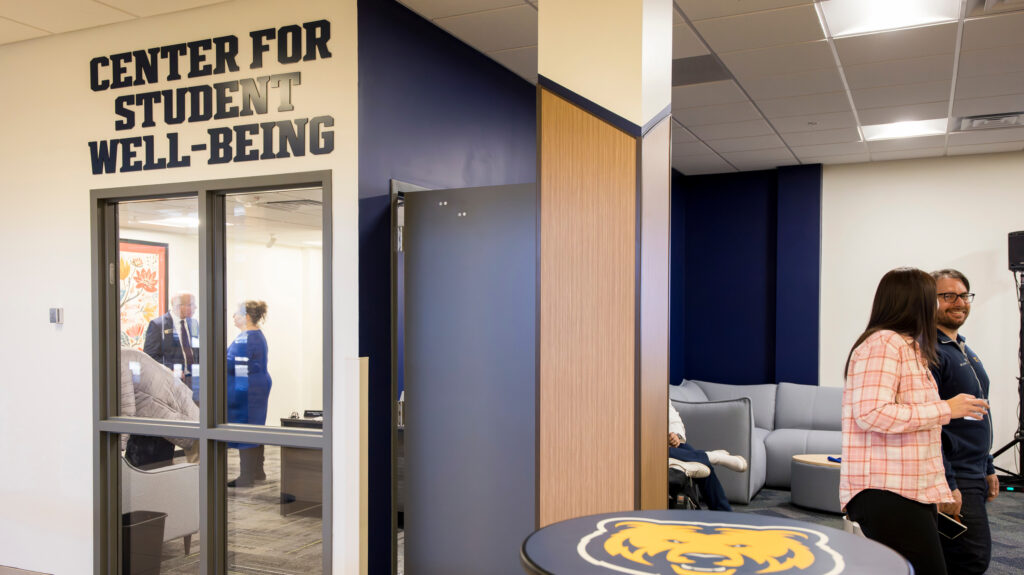
Addressing loneliness and supporting mental health are part of a broader approach to well-being at UNC. Along with the Office of Health Promotion, there is the Center for Student Well-Being (CSW), located on the first floor of the University Center. There, through experienced case management, students have access to a holistic safety net of resources.
At the forefront of these efforts are the resource navigators. For a typical student, diving into the maze of government financial assistance can be a full-time job, often leaving students both overwhelmed and underserved. The CSW’s resource navigators are there to provide the expertise necessary to unlock financial support for students in need.
Resource Navigator Lauren Crowley says she uses her background in case management to guide students toward stability.
“A lot of my role is helping students navigate public applications like SNAP and Medicaid,” said Crowley. “Many students come in who assume they don’t qualify, and they are quite shocked when they do.”
Having attended a much larger university for her own undergraduate studies, Crowley is particularly struck by the close-knit nature of UNC. She views the frequent student referrals she receives from faculty as a testament to their deep personal investment in student success; this faculty support is met with equal appreciation by the students themselves. Crowley has come to deeply admire their resilience, citing it as a defining characteristic of the UNC culture.
“A lot of my students come from difficult financial backgrounds or family situations, and yet they are so motivated to finish their degree,” she said. “They [know] they can rely on us and they’re willing to advocate for themselves.”
Crowley provided the example of a hypothetical student seeking help for childcare amid a government shutdown. With the Colorado Child Care Assistance Program for Families (CCAP) frozen, she would utilize a “systems-thinking” approach to address the issue holistically, focusing on eliminating other financial barriers to free up the student’s existing resources. Additionally, connecting the student to resources such as the Bear Pantry and partnering with Project Self-Sufficiency for further support would help the student to balance their budget to pay for childcare.
Feeding the Bears
Bear Pantry, UNC’s on-campus food pantry offering free groceries and essentials to students and employees, works closely with the CSW. Operating largely from generous donor funding, Bear Pantry is partnered with Feeding America and Weld Food Bank. The latter collaboration fuels the Weld Food Bank’s Mobile Food Pantry, a monthly fixture that rolls onto campus, typically on the second Tuesday of each month, to provide fresh produce, dairy and meat to students, faculty and the Greeley community.
According to Taylor Schiestel, director of the CSW, this partnership is one of the program’s most vital.
“When we receive donor funding, we can spend that money at the food bank and get way more than we ever could at [a grocery store],” Schiestel said. “For example, we can buy boxes of meat for $25 at the Weld Food Bank that would cost hundreds of dollars at [a grocery store].”
In addition to helping students navigate government assistance programs and food insecurity, the CSW offers emergency support funding for students experiencing unexpected emergencies resulting in financial burden. Schiestel detailed experiences assisting students with transportation and housing expenses, medical expenses and even emergency vet bills for emotional support animals. Determining emergency funding eligibility is a collaborative process spearheaded by a diverse committee of university leadership from multiple departments.
Stopping the Stigma
For many students, the first barrier to accessing resources is overcoming stigma related to safety net programs. With this in mind, Crowley and her colleagues are consistently and proactively working to establish a welcoming environment at the CSW.
“I don’t start the conversation with resources,” Crowley said. “I always start with, ‘What is going on with you?'”
Schiestel emphasized that by normalizing the pursuit of basic needs, the university can transform a student’s entire academic trajectory.
“The biggest thing is eliminating the stigma of meeting with someone for resources,” she said. “What students go through on a day-to-day basis is hard enough. If we can ease that burden or walk through it with them, that is what we want to do.”
At its core, the work being done at the CSW is about shifting the narrative from survival to success. By removing the weight of food insecurity, financial crisis and mental health barriers, UNC is ensuring that a student’s potential is never hindered by their circumstances.
“No one should feel they can’t receive their basic human needs because they are prioritizing something else,” Schiestel said. “If we can make it easier for students, that is our ultimate goal.”
El año pasado, el 45 % de los estudiantes universitarios y el 36 % de los estudiantes de posgrado de la Universidad del Norte de Colorado (UNC) declararon sentirse solos, según una encuesta realizada a 647 estudiantes por la Oficina de Promoción de la Salud de la UNC. Los nuevos datos nacionales de Active Minds y del proveedor de atención médica virtual para la educación superior TimelyCare sugieren que el problema se está agravando. Casi dos tercios (64,7 %) de los estudiantes universitarios de todo el país afirman sentirse solos, y casi tres de cada diez (28,8 %) afirman sufrir un grave malestar psicológico.
En 2023, el cirujano general de los Estados Unidos, Vivek Murthy, declaró la soledad como una «epidemia» de salud pública y advirtió que la soledad crónica y el aislamiento representan una grave amenaza para la salud y el bienestar general. La soledad puede afectar negativamente a la salud física y mental de los estudiantes universitarios, así como a su rendimiento académico, lo que la convierte no solo en un problema de bienestar, sino también en una cuestión que afecta al éxito de los estudiantes. Sin embargo, esta epidemia no se distribuye de manera uniforme. En la UNC, las tasas de soledad eran notablemente más alt as entre los estudiantes trans y de género no conforme, una tendencia que se refleja a nivel nacional, donde el 70.3 % de los estudiantes LGBTQ+ se identifican como solitarios, en comparación con el 60.6 % de sus compañeros. Esta sensación de aislamiento ha creado un efecto dominó, y la mayoría de los estudiantes universitarios afirman ahora estar profundamente preocupados por la salud mental de al menos un amigo.
Presentamos RADical Health Para ayudar a los estudiantes a hacer amigos y desarrollar resiliencia para combatir la soledad, la Oficina de Promoción de la Salud ha puesto en marcha el programa RADical Health, en el que los estudiantes se reúnen en pequeños grupos con líderes de su misma edad para centrarse en la comunidad. Esta experiencia de apoyo a la salud mental ha demostrado en todo el país que refuerza las habilidades de gestión del estrés, autocuidado, comunicación, autoconciencia y toma de decisiones en los estudiantes universitarios.
John Hancock, subdirector de Bienestar y Apoyo de la División de Asuntos Estudiantiles, considera que el programa es una herramienta fundamental para los estudiantes.
«RADical Health se centra en las conexiones», afirma Hancock. «Nuestros estudiantes de la UNC no son diferentes a los estudiantes de todo el país que declaran sentir niveles significativos de soledad. El hecho de que este programa se centre en eso y ofrezca apoyo es fantástico».
Actualmente, RADical Health es un programa piloto centrado en un pequeño grupo de estudiantes de primer año que se incorporaron a la UNC esta primavera, pero Hancock tiene grandes esperanzas de ampliar el programa en un futuro próximo. «Sabemos por otras instituciones que fueron pioneras en la adopción de RADical Health que los grupos basados en afinidades tienen un gran potencial», afirma Hancock. «Para otoño, esperamos ofrecer a los estudiantes la oportunidad de unirse a un grupo RADical Health que conecte con una de sus identidades, por ejemplo, grupos para estudiantes internacionales, estudiantes de otros estados, estudiantes LGBTQ+ o estudiantes de color [etc.]».
Para muchos estudiantes, encontrar un sentido de pertenencia es lo que les permite seguir adelante con un exigente horario universitario, incluido un estudiante de la UNC que afirma que sus comunidades han sido fundamentales para su éxito y su salud mental.
«De hecho, me siento mejor bajo cierta presión; soy más feliz cuando voy a la escuela, a mis prácticas y al trabajo», afirma. «Desde que empecé la universidad, he trabajado muy duro para crear una comunidad para mí en todas estas facetas diferentes de mi vida. Creo que los seres humanos somos criaturas sociales, por lo que la mejor manera de mantener mi salud mental en buen estado es estar rodeado de gente. Hablar con mi comunidad y hacerles saber que estoy pasando por dificultades ha sido muy importante para mí».
En busca de una red de seguridad Abordar la soledad y apoyar la salud mental forman parte de un enfoque más amplio del bienestar en la UNC. Junto con la Oficina de Promoción de la Salud, existe el Centro para el Bienestar Estudiantil (CSW), ubicado en el primer piso del Centro Universitario. Allí, gracias a una gestión de casos con amplia experiencia, los estudiantes tienen acceso a una red de seguridad integral de recursos.
A la vanguardia de estos esfuerzos se encuentran los orientadores de recursos. Para un estudiante típico, sumergirse en el laberinto de la ayuda financiera del gobierno puede ser un trabajo de tiempo completo, que a menudo deja a los estudiantes abrumados y desatendidos. Los orientadores de recursos del CSW están ahí para proporcionar los conocimientos necesarios para desbloquear la ayuda financiera para los estudiantes que la necesitan.
La orientadora de recursos Lauren Crowley dice que utiliza su experiencia en la gestión de casos para guiar a los estudiantes hacia la estabilidad.
«Gran parte de mi trabajo consiste en ayudar a los estudiantes a navegar por aplicaciones públicas como SNAP y Medicaid», explica Crowley. «Muchos estudiantes vienen pensando que no cumplen los requisitos y se sorprenden mucho cuando descubren que sí los cumplen».
Habiendo asistido a una universidad mucho más grande para sus propios estudios de licenciatura, a Crowley le llama especialmente la atención el carácter tan unido de la UNC. Considera que las frecuentes referencias de estudiantes que recibe del profesorado son una prueba de su profundo compromiso personal con el éxito de los estudiantes; este apoyo del profesorado es igualmente apreciado por los propios estudiantes. Crowley ha llegado a admirar profundamente su resiliencia, citándola como una característica definitoria de la cultura de la UNC.
«Muchos de mis alumnos provienen de entornos económicos o situaciones familiares difíciles, y sin embargo están muy motivados para terminar sus estudios», afirmó. «Saben que pueden confiar en nosotros y están dispuestos a defenderse por sí mismos».
Crowley puso como ejemplo a una estudiante hipotética que buscaba ayuda para el cuidado de sus hijos en medio de un cierre del gobierno. Con el Programa de Asistencia para el Cuidado Infantil de Colorado para Familias (CCAP) congelado, ella utilizaría un enfoque de «pensamiento sistémico» para abordar el problema de manera integral, centrándose en eliminar otras barreras económicas para liberar los recursos existentes del estudiante. Además, poner al estudiante en contacto con recursos como Bear Pantry y asociarse con Project Self-Sufficiency para obtener más apoyo le ayudaría a equilibrar su presupuesto para pagar el cuidado infantil.
Alimentando a los osos Bear Pantry, el banco de alimentos del campus de la UNC que ofrece comestibles y productos básicos gratuitos a estudiantes y empleados, trabaja en estrecha colaboración con el CSW. Bear Pantry, que funciona en gran medida gracias a la generosa financiación de donantes, está asociado con Feeding America y Weld Food Bank. Esta última colaboración impulsa la despensa móvil de alimentos del Weld Food Bank, una iniciativa mensual que llega al campus, normalmente el segundo martes de cada mes, para proporcionar productos frescos, lácteos y carne a los estudiantes, el profesorado y la comunidad de Greeley.
Según Taylor Schiestel, director del CSW, esta colaboración es una de las más importantes del programa.
«Cuando recibimos fondos de donantes, podemos gastar ese dinero en el banco de alimentos y conseguir mucho más de lo que podríamos conseguir en [una tienda de comestibles]», dijo Schiestel. «Por ejemplo, podemos comprar cajas de carne por 25 dólares en el Weld Food Bank que costarían cientos de dólares en [una tienda de comestibles]. »
Además de ayudar a los estudiantes a navegar por los programas de asistencia gubernamental y la inseguridad alimentaria, el CSW ofrece fondos de apoyo de emergencia para los estudiantes que se enfrentan a emergencias inesperadas que les suponen una carga financiera. Schiestel detalló experiencias en las que se ha ayudado a estudiantes con gastos de transporte y alojamiento, gastos médicos e incluso facturas veterinarias de emergencia para animales de apoyo emocional. La determinación de la elegibilidad para recibir fondos de emergencia es un proceso colaborativo encabezado por un comité diverso formado por líderes universitarios de múltiples departamentos.
Acabar con el estigma Para muchos estudiantes, la primera barrera para acceder a los recursos es superar el estigma relacionado con los programas de protección social. Teniendo esto en cuenta, Crowley y sus colegas trabajan de forma constante y proactiva para crear un ambiente acogedor en el CSW.
«No empiezo la conversación hablando de los recursos», explica Crowley. «Siempre empiezo preguntando: “¿Qué te pasa?”».
Schiestel enfatizó que, al normalizar la búsqueda de las necesidades básicas, la universidad puede transformar toda la trayectoria académica de un estudiante.
«Lo más importante es eliminar el estigma de reunirse con alguien para obtener recursos», dijo. «Lo que los estudiantes viven a diario ya es bastante difícil. Si podemos aliviar esa carga o acompañarlos en el proceso, eso es lo que queremos hacer».
En esencia, el trabajo que se realiza en el CSW consiste en cambiar la narrativa de la supervivencia al éxito. Al eliminar el peso de la inseguridad alimentaria, la crisis financiera y las barreras de salud mental, la UNC se asegura de que el potencial de los estudiantes nunca se vea obstaculizado por sus circunstancias. «Nadie debería sentir que no puede satisfacer sus necesidades humanas básicas porque está dando prioridad a otra cosa», dijo Schiestel. «Si podemos facilitarles las cosas a los estudiantes, ese es nuestro objetivo final».