
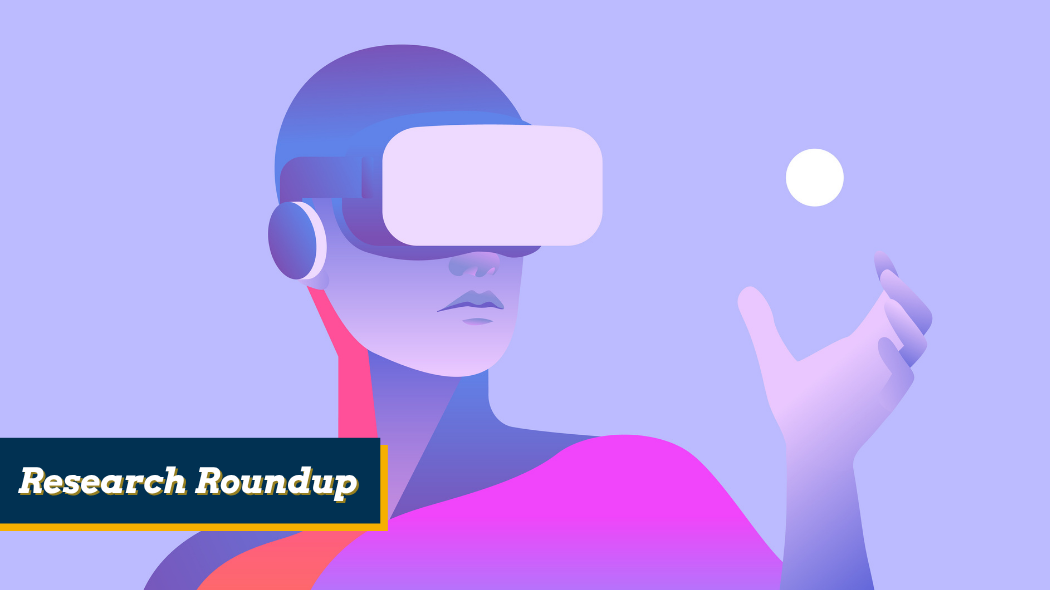
A stylized graphic depicting a person in a virtual reality headset holding their hand up to grasp at a floating orb.

Article

June 29, 2026

Written by Duard Headley

Research Roundup: The Mind and the Machine

Joanna Lewis, Ph.D., is researching how emerging technologies interact with the human brain and the behaviors it drives

Research Roundup is a series that features Q&As with UNC faculty to share insights about their research in an approachable, bite-sized format. Each installment highlights the questions driving their work, why it matters and how it connects to broader issues in our community and beyond.


It’s no secret that the field of technology is advancing at an ever-increasing pace.  

In the last decade alone, innovations like artificial intelligence (AI), self-driving cars, virtual reality (VR), augmented reality and more have developed by leaps and bounds, becoming almost unrecognizable when compared to what they were at their inception.  

The advancement of technology is everywhere — sometimes providing a major benefit to people’s lives and sometimes…less so

But there’s no doubt that technology is enabling humanity to do things previously impossible — or, at least, unfeasible. That’s certainly the case for Joanna Lewis, Ph.D., associate professor of Psychological Sciences in the College of Education and Behavioral Sciences

Portrait of Joanna Lewis

“Not only does technology allow us to conduct research in psychology in ways that are far more immersive and realistic than we’ve ever been able to before, it also enables us to do it in an ethical way.”

-Joanna Lewis, Ph.D.  

From AI to VR, in this month’s Research Roundup, Lewis dives into how she’s leveraging emerging technologies to gain further insight into the workings of the human mind.  
I’m particularly interested in how people interact with technology on a mechanitic level, especially when it comes to cognition and distraction as a result of technology.

I’m also interested in examining how and why people struggle with technology and looking at the reasons why it might not click for that person, be that the usability of the technology itself or an individual trait of that person. Specifically, one of the main determiners I’m interested in is age — how older people engage with technology versus younger people.

I’m very interested in how technology can impact our minds, especially the ways that emerging technologies like artificial intelligence (AI) and virtual reality (VR) are going to impact human behavior.

In my research looking into VR, I focused on cognitive load theory and how people learn. We had people do various procedural learning tasks in VR and then manipulated various elements of the instructional environment to see if those things improved or hurt the learning ability of participants.

In a similar vein of research, I also introduced a treadmill to the VR experience with the goal of increasing that immersion even further and allowing participants to more easily and naturally conduct their tasks.

The benefit of doing this kind of research in virtual reality is that we’re able to control the learning environment in more ways and with more precision. It also increases the immersion of participants compared to having them repeat the same exercises while sitting in a lab room.

The idea is that certain objects are inherently more likely to capture our attention than others. Intuitively, you’d imagine that something like a bright red object would stand out among a group of black and white ones. While that’s mostly true, our attention is far more captured by dynamic objects — things that change over time, like a baseball being thrown towards you.

My aim with the research was to simulate the experience of going on a hike while inserting elements that would be considered threatening (think spiders and snakes) and see if people noticed them, as well as how their attention changed throughout the simulation.

The goal of the VR hike exercise is to translate that test into a real-world environment (or close to one) and see if the threat response is maintained or potentially even heightened.

I’ve recently transitioned to examining if these same types of results can be captured in a top-down fashion — instead of noticing a baseball in response to a direct, impending threat because it’s coming right at you, can we get someone to notice a spider because cognitively, they know what a spider is and understand that it is potentially threatening?

The focus of my AI research is on measuring individuals’ ability to categorize images as being real or AI-generated and what factors influence that ability. We predominantly looked at age as a factor because of the assumption that older people are more likely to fall for AI images.

We also measured things like impulsivity, previous AI use and opinions on AI. We first studied over 200 people and found that age does very much impact the outcome, but not in the way we expected.

We assumed older participants would be more prone to flagging AI-generated images as real, but what we found was that they tend to be more conservative in their judgements in the other direction — labeling more real images as AI than vice versa.

This is consistent with the kind of overcompensation we’ve seen in the past when it comes to older adults interacting with technology. We saw a similar trend with phishing scam emails — they’re more likely to say more emails are phishing scams, and they also tend to take longer when examining them.

Humans assume that we can multitask, when in reality, that’s actually a huge fallacy. Almost 98% of the population can’t multitask; instead, we do what is called task switching. That said, we do know that if the two tasks being attempted are in different modalities — think reading and listening to something — a little bit of cross-sharing of information is possible.

Another one is how elderly people engage with technology. Everybody has a story about a time they helped an elderly person with technology — we know that cognitive slowing happens as you age, but it isn’t uniform across the brain when we talk about people slowing down.

But as we’ve seen in the research on AI, the ways older people engage with technology aren’t always what we expect. It isn’t as simple as a younger person being more tech-savvy while an older individual will always struggle. Like anything, it’s a spectrum and it’s constantly changing.

So many ways.

In my research with VR, we saw that we weren’t able to generate authentic results when people were just sitting in a lab room looking at pictures of potentially-threatening objects — it just isn’t the same as being in an actual room with a spider.

Through VR, we can put people in a convincing approximation of the real world. It’s the next best thing to actually making people take a hike and then throwing spiders at them.

I’m also collaborating with Stephanie Linley, assistant professor of Psychological Sciences, to use the treadmill to examine fear as it’s associated with navigation. In that experiment, people are put into a simulated environment where they must walk out onto a ledge and make decisions about where they need to go.

Not only does technology allow us to conduct research in the field of psychology in ways that are far more immersive and realistic than we’ve ever been able to before, but it also enables us to do it in an ethical way. We could never have someone actually walk out on a ledge ten stories in the air, even in a harness. But with technology, we can recreate those environments to a pretty convincing degree.

The most clear-cut way my research relates to things in people’s lives is how it pertains to understanding emerging technologies and their effects on people’s brains. To that end, one thing that has come up time and again is how quickly new technologies are being implemented in almost every part of people’s lives.

Just because a technology is available doesn’t mean people should use it — at least not without thought and consideration. For example, heads-up displays in modern vehicles actually block certain parts of peoples’ fields of vision while driving. Another one is self-driving cars. We simply do not have the research out there right now to guarantee that those are safe.

It’s almost impossible to keep up with how fast technology is advancing, so it’s important to be as aware as possible of how we interact with it and how it can impact us.