

Applied Psychology Counselor Education
Academic Department
Want to become a professional counselor psychologist, move into counselor education and supervision, or build a career in counseling psychology? Our programs are APA and CACREP accredited, designed to help you reach your goals and stand out in the field.
Make a Difference with Applied Psychology and Counseling
At UNC, you’ll get the knowledge, skills, and support you need to succeed in your career and your life. Want to become a professional counselor, move into counselor education and supervision, or build a career in counseling psychology? Our programs are American Psychological Association (APA) accredited and CACREP accredited, designed to help you reach your goals and stand out in the field.
Choose Your Degree Path
Professional Counseling Master Degree Programs
Our Professional Counseling programs help students get ready for jobs as counselors. Our graduates work in schools, health centers, and private offices. We offer programs in School Counseling, Mental Health Counseling, and Marriage and Family Counseling.

Counselor Education and Supervision
Our Counseling Education and Supervision programs train students to become leaders and teachers in counseling. Graduates can teach in colleges, support new counselors, and help improve mental health care. Students will gain the skills to guide others and make a difference in their communities.
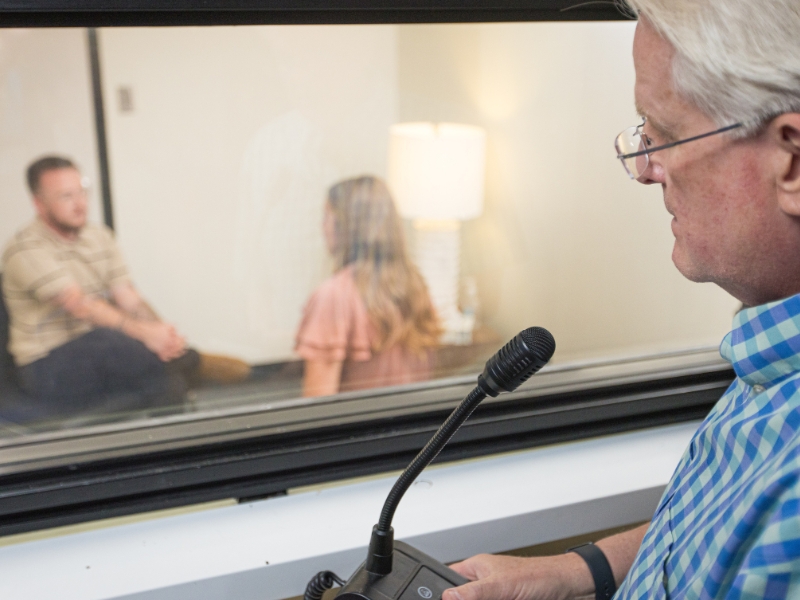
Counseling Psychology
Our Counseling Psychology doctoral program gives students strong training in both classes and real-world practice. Students spend at least three years taking courses, doing supervised counseling work, and writing a dissertation. This program prepares students to become licensed psychologists.
Graduate students collaborate on completing client assessment forms, gaining hands-on experience in counseling practice.

Our History
Graduate education in psychology at UNC began in the early 1900s. In 1908, the Psychological Clinic was started to give physical and mental exams to school children. In 1913, UNC offered its first master’s degree in Psychology.
Our programs have always focused on high standards and national accreditation. The Council for the Accreditation of Counseling and Related Educational Programs (CACREP) started accrediting programs in 1981. UNC’s programs in Clinical Counseling, School Counseling, and the Counselor Education Ph.D. were accredited in 1982. In 1994, CACREP began accrediting Couples and Family programs, and UNC’s program was the second in the U.S. to earn this accreditation. The Counseling Psychology program at UNC has been in existence since 1984. It became accredited by the American Psychological Association (APA) in 1995.
The Counselor Education and Supervision Ph.D. program trains students to become counselor educators and supervisors. Graduates can teach and supervise in programs for school counseling, clinical counseling, couples and family therapy, counseling with children and teens, and gerontology. They are also eligible for licensure as professional counselors and can work in schools, counseling centers, community agencies, employee assistance programs, or private practice.
The program focuses on preparing students to meet the needs of a diverse society. Students are encouraged to take part in their education through active learning, working closely with faculty, and engaging in the profession. Courses and experiences are designed to challenge and support students’ personal and professional growth. Students also participate in leadership, mentoring, and service activities that go beyond the classroom and clinic into the community.
The Counseling Psychology Ph.D. program is designed to develop counseling psychologists in health service psychology who can independently apply psychological principles to improve the well-being of individuals across the lifespan. The program focuses on developing profession wide competencies in health service psychology. At our on-site psychological services clinic, students are provided the opportunity to be trained in the application of three treatment modalities: individual, group, and couples and family therapy. The doctoral program emphasizes training in research and evidence-based practice in psychology to work with diverse populations. Graduates obtain employment in a variety of settings (e.g., university counseling centers, academic, VA settings, hospital and health care, private practice, community). The program meets APA accreditation standards, which leads to eligibility for licensure as a doctoral level psychologist.
Questions? Contact Us!
Jennifer Murdock-Bishop
Interim Chair and Professor
Questions about APA accreditation?
For more information, contact the American Psychological Association (APA) Office of Program Consultation and Accreditation.
American Psychological Association (APA)
Office of Program Consultation and Accreditation
750 1st Street, NE
Washington, DC 20002-424
Questions about CACREP accreditation?
For more information, contact the Council for Accreditation of Counseling and Related Educational Programs (CACREP).
(703) 535-5990
Council for Accreditation of Counseling and Related Educational Programs
500 Montgomery Street, Suite 350
Alexandria, VA 22314