

English
Academic Department
The English Department gives students a chance to explore how language, culture, and stories mold the world. Our programs teach students critical thinking, how to ask questions, and develop skills for a wide range of careers.

Shape Your Passion for English
Classes Taught by Experts
Our faculty are active researchers who are dedicated to teaching students fresh approaches to the study of literature and education. Students are also taught how to build professional and technological skills they need to succeed.

Our Students Are Our Priority
Students in the English Department can always rely on faculty mentors for guidance. With smaller class sizes, students get plenty of direct attention from their professors. This allows professors to get to know their students throughout their time in the program.

Written Communication
Our Mission
This mission of the UNC writing program is aligned with the core values and mission of the university striving to prepare students to think, act, and communicate effectively in our diverse and global society. Instructors in our writing program focus on enhancing student’s rhetorical knowledge, their genre awareness, and their ability to identify, adapt, and employ various conventions and dispositions across contexts and disciplines. Students in the writing program are provided with formative feedback throughout their process of writing and research, and instructors emphasize the social nature of writing and the value of revision.
Our Courses
The Writing Program at UNC offers 5 courses through the Department of English.
- ENG 122 College Composition (3 credit hours, LAW1, GtP CO-1)
- ENG 132 Composition Enrichment (1 credit hour, supplemental academic instruction course)
- ENG 123 Writing and Research Methods (3 credit hours, LAW2, GtP CO-2)
- ENG 323 Advanced Argument (3 credit hours, LAW3, Gtp CO-3)
The Department of English offers numerous sections of ENG 122 and ENG 123 in both fall and spring semesters. ENG 122 and 123 are typically available as only offerings in summer sessions. ENG 132 is typically offered only in the fall semester, and ENG 323 is most often offered in spring semesters. Class sizes are small so that students can be sure of receiving individualized attention from faculty.
ENG 122 – College Composition (3)
extensive practice in writing clear and effective academic prose with special attention to purpose, audience, organization, and style. Instruction in critical analysis and revision. (LAC, gtP)
ENG 132 – College Composition Enrichment (1)
Co-requisite: ENG 122. The one-hour composition enrichment provides supplemental academic instruction with an emphasis on the relationship of reading and grammar to writing. Students who have scored below 18 on ACT in English, below 470 on SAT in English, and/or have below a 2.75 cumulative high school GPA are encouraged to enroll in this course.
ENG 123 – Writing and Research Methods (3)
Instruction in research writing techniques and process.
Prerequisite: ENG 122 with a minimum grade of D- or ACT score of 30.0 or higher in English or SAT Evidence-Based Reading and Writing score of 630 or higher or a recommendation from the Directed Self-Placement survey. (LAC, gtP)
ENG 323 – Advanced Argument (3)
Prerequisite: GtC02, LAC1b, an ACT score of 30.0 or higher in English, or an SAT verbal score of 630 or higher prior to March 2016, or SAT Reading score of 34 or higher after March 2016. Instruction in advanced analysis and production of upper-level college arguments, including extend application of rhetorical and discourse theory. This course emphasizes revision and reflective writing. (LAC, GtP)
Information on Placement Procedures for the Writing Program
The Liberal Arts Curriculum at UNC requires 6 credit hours in Written Communication. To complete this requirement, there are three options available to you:
- OPTION A: Introductory Composition (with co-requisite support course) + Intermediate Composition
- OPTION B: Introductory Composition + Intermediate Composition
- OPTION C: Intermediate Composition + Advanced Composition
There are many factors that influence what option is right for each student. Your top two resource for making this decision are 1) your academic advisor and 2) the Writing Program Administrator (Tara Wood, tara.wood@unco.edu).
Below you will find some information to help you understand writing program placement at UNC.
Option A: Introductory Composition (with co-requisite support course) + Intermediate Composition
In Option A, a student is taking Intro Comp + Intermediate Comp, but they have decided to ad co-requisite support course to their intro Comp. This support course is 1 credit hour that students take alongside ENG 122. This course – ENG 132: Composition Enrichment -is capped at 15 students and provides enhanced support for successfully completing optional; students receive a recommendation to consider the course. Students who take ENG 132 have an 87% pass rate for ENG 122, so the evidence shows the course is very helpful!
In Option A, after the student completes ENG 122/ ENG 132 (4 credit hours total), they will choose an intermediate composition course (e.g., ENG 123) to complete the LAC Written Communication requirement.
Option B: Introductory Composition + Intermediate Composition
In Option B, a student is taking Intro Comp + Intermediate Comp, totaling 6 credit hours to complete the LAC Written Communication requirement. They will take ENG 122: College Composition to fulfill their intro course, and they can choose from a list of options to complete their Intermediate Composition course (e..g., ENG 123).
In Option C: Intermediate Composition + Advanced Composition
In Option C, a student is taking Intermediate Composition + Advanced Composition, totaling 6 credit hours to complete the LAC Written Communication requirement. Students can choose from a list of options to complete their Intermediate Composition course (e.g. ENG 123). To fulfill the Advanced Composition requirement, students will take 323: Advanced Argument.
Note: In order to place into Option C, students must meet the pre-requisites for ENG 123 or receive a recommendation from the Directed Self-Placement Survey.
Frequently Asked Questions
When should I take these classes?
Students who place into ENG 122 should take the course in their freshman year. If students place into ENG 123, we strongly recommend they complete that course by their sophomore year at the very latest.
What if I bring in credit for a CO2 Course?
You would have 3 credit hours of your Written Communication LAC fulfilled and would only need to take the 3 credit hours in Advanced Writing. If you have questions about transfer of courses, place visit the UNC’s Transferology page.
What if I am unhappy with my placement options?
You can always reach out to the Writing Program Administrator (writingprogram@unco.edu). You might also consider the Composition Challenge Exam as an option.
If I receive a recommendation to take the SAI, do I have to do it?
No, the co-requisite support is always optional and is a decision you should make alongside your academic advisor. That said, if you received the recommendation, keep in mind that recommendation is based on your own answer to the survey. Plus, we have a really high pass rate for ENG 122 among students who opt for this co-requisite support!
Department News and Announcements


Check Out Scholarship Opportunities
The English Department awards several scholarships. To find out more about scholarships, please contact the Office of Financial Aid.
Forrest “Frost” Frease was a faculty member in the Department of English at UNC from 1949 to 1980. After he retired, Frosty and his wife Cynthia set up these scholarships to help a strong English student in their last year of college. Students are chosen based on how well they do in their English classes and how much potential they show.
To apply for the scholarships, students must fill out the UNC Universal Scholarship Application by March 1 each year.
Students are not required to show financial need or complete the Free Application for Federal Student Aid (FAFSA). They also don’t need to write a long essay – a short response to the essay question is enough. The scholarship amount may vary, but it is at least $500.
Forrest “Frosty” Frease taught in the UNC Department of English from 1949 to 1980. After he retired, Frost and his wife Cynthia started the Frease/Colwell Honors Program Award to honor a top senior English major.
Students are selected based on their academic potential and the skills they show in their English classes. Preference is given to those who are also a part of the honors program.
To apply for the scholarships, student must fill out the UNC Universal Scholarship Application by March 1 each year.
Students are not required to show financial need or complete the Free Application for Federal Student Aid (FAFSA). They also don’t need to write a long essay to be considered, a brief response to the essay question is enough.
Celebrating Our Department

HSS Honors Convocation 2026
Congratulations to the following students: Avery Jones, Emaleigh Mondragon, Gabe Thornber, Ruthie Loomis Goltl, Megan Klein, Brendan Scruggs, Wyatt Lindell, Diego Lopez, and Rose Terrill.
Alumni Highlights
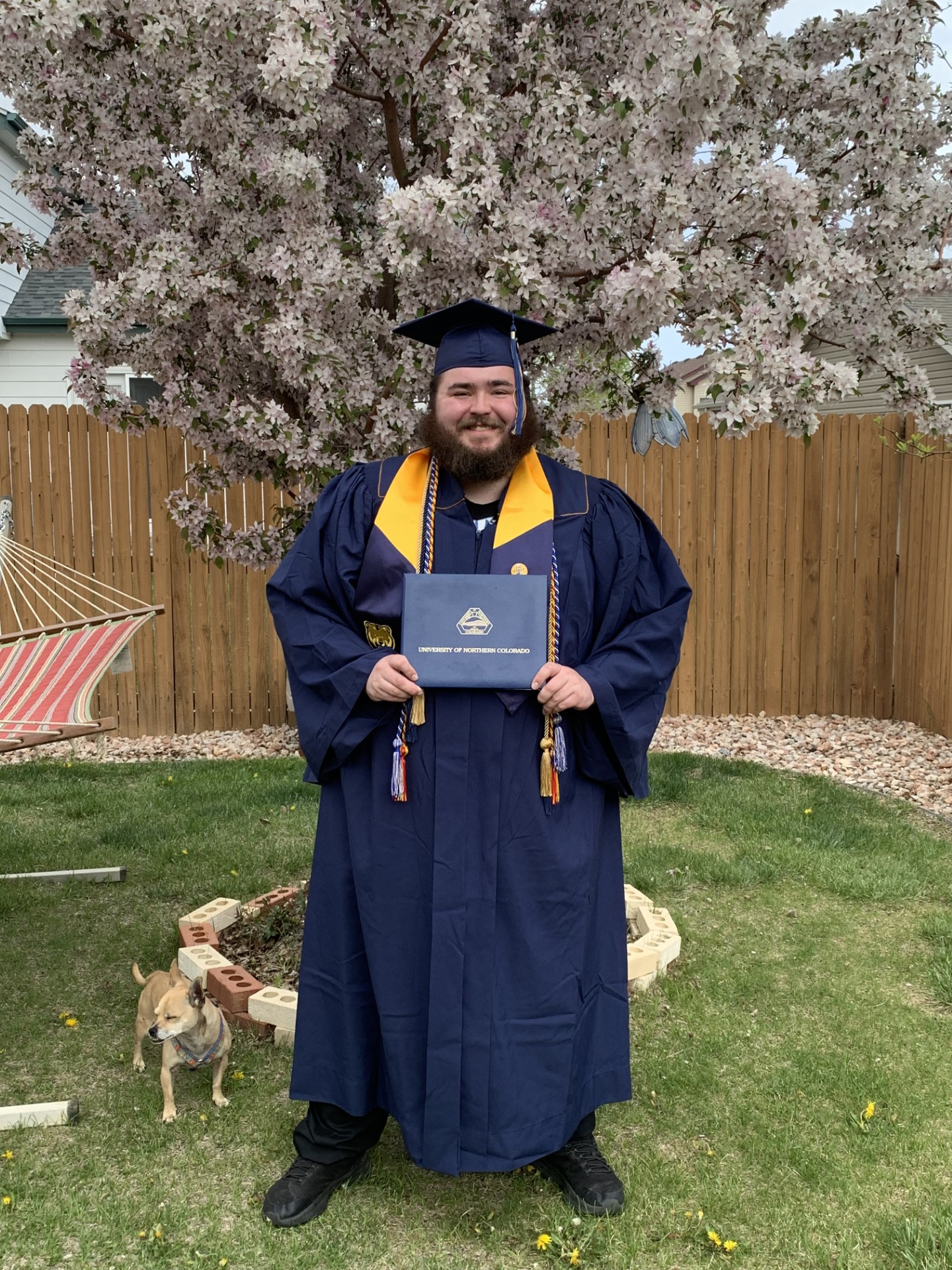
Class of 2023
The EED program at UNC was hands down the best experience I have had with college courses. The adaptability and knowledge of the professors, combined with the ability to comfortably and sadly make mistakes and try crazy/weird ideas allowed me to become the educator I am today.
Ajay Nelson
English Secondary Education w/ emphasis on Special Education
7th Grade Literature and Composition Teacher at Frontier Charter Academy

Class of 2023
This program introduced me to voices from diverse backgrounds and cultures, helping me approach others on and beyond the page with greater empathy and understanding. The unwavering support of the faculty also gave me both the confidence and the opportunities to pursue and share research that is relevant and meaningful.
Angie Brown
Top of Funnel Content Curator at the Augustine Institute Campus Ministers at UMSL

Careers in English
English majors understand people, cultures, and history in a deep way. This helps them think clearly, solve problems, and learn from the past to help build a better future. Most importantly, English majors get a broad education, not just training for one specific job.
Media and Communication
Many UNC graduates get jobs in media and communication. They work as writers, news reporters, and public relation workers.
Education
Many alumni with education jobs become teachers, but some use their degree in other ways, like helping design lessons and working in schools in different roles.
Leadership and Management
UNC graduates are ready to be leaders and managers in non-profit groups, schools, and both private and public companies.
Learn Beyond the Classroom
Once the program director approves the internship application, the student gets in touch with the company to set up an interview. After students get an internship, they work with the English program and the company to make a plan for what they will learn. Later, the company sets up formal terms of the internship to be approved by the internship program director.
Student majoring in English or minoring in writing. Applicants must:
- Have a minimum grade-point averages of at least 2.6 in their majors
- Have completed a minimum of 12 hours of English classes (excluding English 122 and English 123) at UNC
- Have an academic status of junior or senior
To apply for an internship, contact the Writing, Editing, and Publishing Concentration Director to learn more.
When Should Students Apply?
Summer internships are ideal because they don’t get in the way of regular classes. After the internship, a student should still have at least one semester of classes before they graduate.
Students make a list of what they want to learn, and the internship supervisor must agree to it before the internship begins. During the internship, the student turns in weekly notes, a midterm report, and a final report to their faculty internship supervisor. At the end of the internship, the supervisor turns in an evaluation that helps decide the student’s final grade. Students who get hired as interns sign up for the internship as an elective class. The internship program faculty supervisor decides how many credits a student will get, depending on the kind and level of the internship.