

Legal Interpreter Training Program
Project CLIMB Legal Interpreter Training Program
Legal Interpreter Training Program
In a facilitated community of learning, the Legal Interpreter Training (LIT) participants worked through a dynamic, interactive, and bilingual (ASL & English) online training curriculum. The curriculum provided a nine-month legal foundation needed for ASL/English interpreters in the legal specialty. The training included a structure and approach to talking about the work and supporting colleagues in their professional growth. The curriculum was broken down into modules that covered a wide range of topics, that resulted in a comprehensive training for program participants.
Program Information
This innovative LIT program served to increase the number and quality of interpreters in legal settings. Career paths for practitioners from the following underrepresented communities in the specialization in legal interpreting were increased.
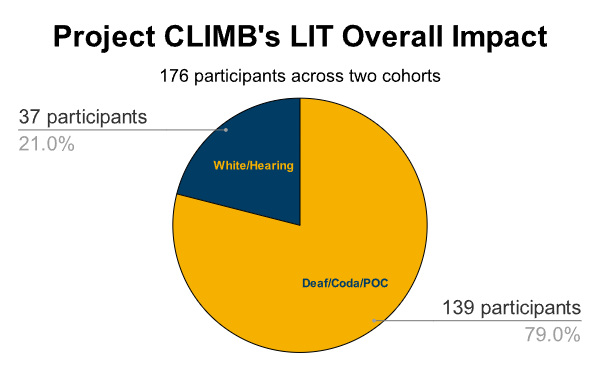
Of the 176 participants across two cohorts, 139 participants (79%) were Project CLIMB’s target audience of Deaf, Coda, & POC.
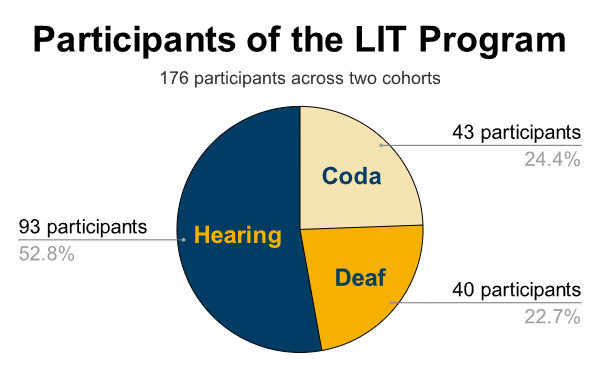
Of the 176 participants, 83 participants (47.1%) were Project CLIMB’s target audience of Deaf & Coda.
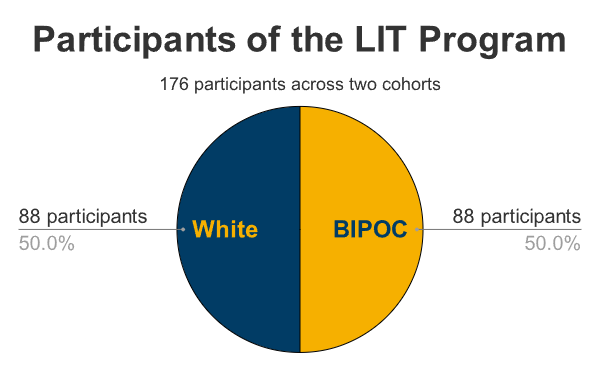
Of the 176 participants, 88 participants (50%) were Project CLIMB’s target audience of BIPOC.
Participation was open to any interpreter that met the minimum criteria. Applications were accepted to ensure that communities of learning (COL) included individuals with diverse backgrounds. Project CLIMB’s communities of learning focused on individuals who were prepared and ready to commit to an intensive online training program.
The LIT program covered a wide range of topics that resulted in a comprehensive training for interpreters working in legal and court settings. The curriculum focused on foundational knowledge of legal systems, interpreting in the legal system, and techniques and approaches to talking about the work with colleagues.
The curriculum consisted of 19 modules. The Legal Interpreter Training modules are:
- Module 1: Overview of the American Judicial System
- Module 2: Systems Thinking for Legal Interpreters
- Module 3: Introduction to Criminal Law
- Module 4: Introduction to Civil Law
- Module 5: Roles, Responsibilities, Principles, and Protocols of Legal Interpreters
- Module 6: Domestic Violence
- Module 7: Family Court
- Module 8: Juvenile Court
- Module 9: Probate Court
- Module 10: Adult Mental Health and Forensic Interpreting
- Module 11: Note-taking
- Module 12: Consecutive Interpreting
- Module 13: Interpreting for Law Enforcement Investigations and Interrogations
- Module 14: Interpreting for Client-Attorney Interactions
- Module 15: Interpreting for Deaf Juveniles
- Module 16: Interpreting Lines of Questioning
- Module 17: Interpreting Depositions
- Module 18: Interpreting for Deaf Jurors
- Module 19: Engaging in Observation of Legal Proceedings
The Program Map for the LIT program served as an “at-a-glance” reference guide that participants used to see the overall flow for program’s modules.
The 19 module curriculum totaled 285 hours of training and took participants an average of 15-20 hours per week over the nine-month training.
Program Cohorts
Project CLIMB recognizes the hard work and dedication of the participants who have successfully completed* the 2020-2021 (Cohort Two) and 2019-2020 (Cohort One) Legal Interpreter Training program. To search for qualified interpreters, visit the Registry of Interpreters for the Deaf (RID) website.
*Successful completion of this training does not provide endorsement of the participant’s language fluency or skills as an interpreter.
Cohort Two (2020-2021)
by first name; NOTE: 1st column are first names starting with A-D, 2nd column is E-J, 3rd column is K-P, and 4th column is R-Z.
- Amanda Wittman
- Amie Pease
- Amy Bourque
- Amy Dawson
- Amy Hermansen
- Anita Buitrago
- Antonio Goodwin
- Apollonia Moriarty
- April Jackson Woodward
- Bob Barker
- Bryan Davis
- Caroline Greene
- Celina Salloum
- Charley Thorn
- Christina McDaniel
- Chrystal Honorable
- Colleen Doyle
- Corinna Cozart
- Danielle Strom
- Darlene Warren
- David Krueger
- Donna Walker
- Elizabeth Rangel
- Ellen Catapano
- Eloisa Williams
- Erin Sanders Sigmon
- Ernest Willman
- Gina Alvarado
- Heather Benjamin
- Heather Edwards
- Heidi Woelbling
- Jenni Mosiman
- Jennifer Flaggs
- Jennifer Furlano
- Jennifer Gibbons
- Jerrin George
- Jesse Martinez
- Jesus Candelaria
- Joanna Hughes
- Jonathan Sánchez
- Josh Evans
- Joslene Gomez
- Juliana Apfel
- Julie Peters
- Justin Jackerson
- Kathleen Bodolay
- Katie Ardizzone
- Kendra Timko Hochkeppel
- Kristaline Williams
- Kristina Arellano
- Latoya Jordan
- Laurielle ‘Lo’ Aviles
- Linda Lugo
- Lorena Ramirez
- Mah-rya Proper
- Māla Arkin
- Marlowe Wilson
- Megan Pray
- Melissa Klindtworth
- Michael Barrios
- Michael Sinclair
- MJ Jones
- Monica McGee
- Nicole Manuel
- Orel Barajas
- Pamela D’Occhio
- Pamela Taylor
- Phillip Brown
- Rachel Newbury
- Randee Pascall Speights
- Raylene Lotz
- Rebecca Quigley
- Robin Olson
- Rossio Zavala Perez
- Ruth de Jesus
- Sam Oie
- Santiago Galvan
- Sarah Brown
- Sarah Himmelmann
- Sarah LaBella
- Sharon Lake
- Sherly Jacob
- Sophia Nelson
- Stephanie Walker
- Susan Gonzalez
- Suzanne Lightbourn
- Tamara Gastelum
- Torrey Mansager Aiken
- Travis Nguyen
- Veronica “Roni” Lepore
- Walter Mathews
- Zina Egbe
Cohort One (2019-2020)
by first name; NOTE: 1st column are first names starting with A-C, 2nd column is D-J, 3rd column is J-N, and 4th column is P-T.
- Alicia McClurkan
- Alyssa Kurth
- Amber Bahler
- Angela Emerson
- Angela Moody
- Ariana Saccente
- Armando Garza
- Audrey Ramirez-Loudenback
- Austin Andrews
- Beatrice Amaro
- Belinda De Paz
- Bella Munoz
- Brenda Lee
- Brent Tracy
- Carie Barrett
- Carla Shird
- Catherine Donnalley
- Catie Eller
- Christine West
- Churyl Zeviar
- Connor Gillis
- Crystal Rojas
- Denise Green
- Derrick Cainion
- D’Lisa Robinson
- Donna Lou Bennett
- Dora Rifkin
- Earnestine Lowe
- Eboni Gaytan
- Ellen Corpora
- Elsie Stecker
- Emily Arriaga
- Erissa Porter
- Gale DeArmin
- Hannah Hayes
- Heather Schmerman
- Jaclyn Terrio
- Jamie De Armas
- Janice Devore-Evans
- Janina Witteborg
- Jennifer Gates
- Jenny Buechner
- Jet Griffin
- Joanne Malinka
- Joe Toledo
- John Izaguirre
- Joshua Lane
- Katrina Watton
- Kelly Dillard
- Keturah Holiday
- Kevin Harrer
- Kris Courson
- LaShawnda Lowe
- Leticia Moran
- Letitia Bynoe
- Lily Riley
- Lisa Bolding Ballenger
- Malcolm Reed
- Maurita Villarreal
- Melissa Sanchez
- Meredith Kaplan
- Mona Mehrpour
- Naomi Sheneman
- Nicole Shambourger
- Nixo Lanning
- Pamela Collins
- Pamela Duncan
- Pamela Jones
- Patricia Haskins
- Patrick Harris
- Pauline Ballentine
- Rachel Kleist
- Robin Babb
- Saamanta Serna
- Scottie Allen
- Shana Gibbs
- Shawn Vriezen
- Steven Smith
- Susan Elizabeth Rangel
- Tara Roth
- Tia Ivanko
- Tiffany Green
- Tracy Cummins
Grant Recognition
As of December 31, 2021, this grant project is no longer active or soliciting applications.
This website will remain available as a resource.
The National Clearinghouse of Rehabilitation Training Materials (NCRTM) website is a central portal for accessing archived and new rehabilitation training resources offering search capabilities, a quality rating system, as well as enhanced usability and accessibility.