
UNC Magazine
June 25, 2026
Written by Dan England
Transformative Tenure
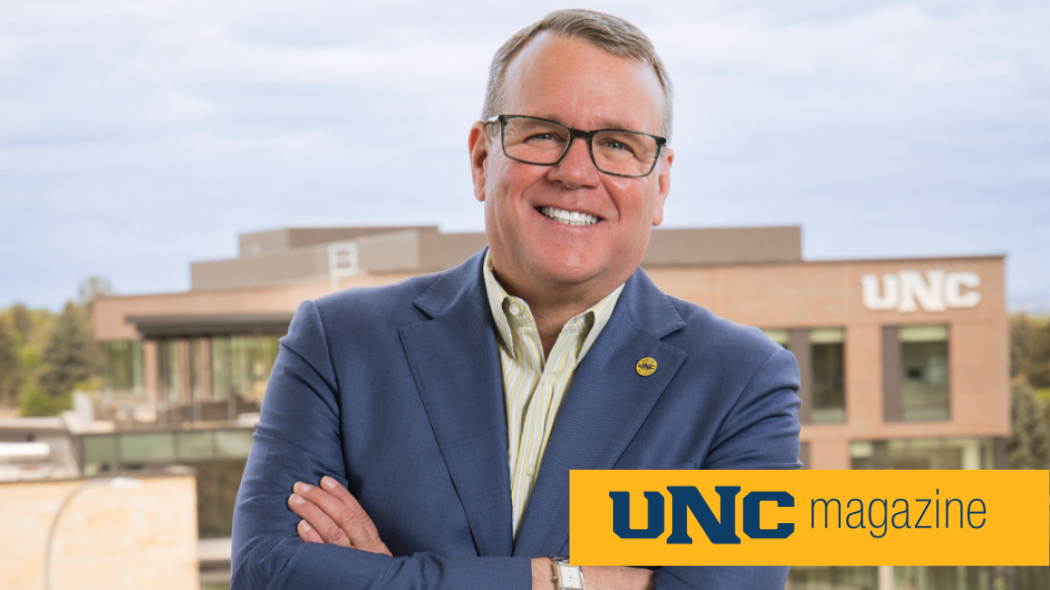
From vision to execution, Andy Feinstein’s eight-year presidency delivered measurable progress for students, the university and the state
In 2020, deep in the throes of the pandemic, Nick Feinstein turned to his father and asked a question: “Dad, why aren’t we bagging the 14ers?”
It’s a question that has stayed with UNC President Andy Feinstein for some time, one that reminds him what his son, who tragically passed away in 2022, taught him: Keep a sense of adventure in your heart and push beyond what seems possible.
During his tenure as UNC’s 13th president, that sense of adventure has shown up in both how he lives and how he leads — from his first steps on campus in 2018 playing disc golf with alumni, to climbing all of Colorado’s 14ers, (mountains higher than 14,000 feet), to launching the university’s new College of Osteopathic Medicine.
When he announced in February that he would step down as president on Aug. 1, Andy invoked that sense of adventure again. This time though, it wasn’t through the lens of choosing the next peak to conquer, but in recognizing it was time to take a different trail.
After eight years at the helm, Andy is leaving at a time when the institution is clearly rowing in the right direction — successfully six years through a robust 10-year strategic plan, with stable enrollment, record-high persistence, retention and graduation rates and a new medical college set to welcome its first class of future physicians this summer.
In reflection though, Feinstein speaks with a note of candor about what it has taken to get here. “I’m tired,” he says.
His decision to leave is less about waning stamina and more about seizing the moment. Acknowledging how difficult it is to step away as momentum is climbing, he’s at peace and incredibly proud he can look back on a tenure that has guided the university to a place of strength and stability, well-positioned for its next chapter.
“It’s time for someone who has the same excitement and energy I had to take it to the next level,” Andy says.
“His hospitality shined from the start”
In 2018, when Andy was announced as the sole finalist to become UNC’s next president, Allie Steg Haskett, ’03, sent him an email saying, essentially, “nice to meet you and welcome to UNC.” This is what Steg Haskett does: She is the vice president for University Advancement, and an alumna. It’s both her job and her passion to connect people to the university.
Less than five minutes after she sent the email, her phone rang.
“Hi,” Andy said.
“Right out of the gate,” Steg Haskett said, “his focus on hospitality shined through.”
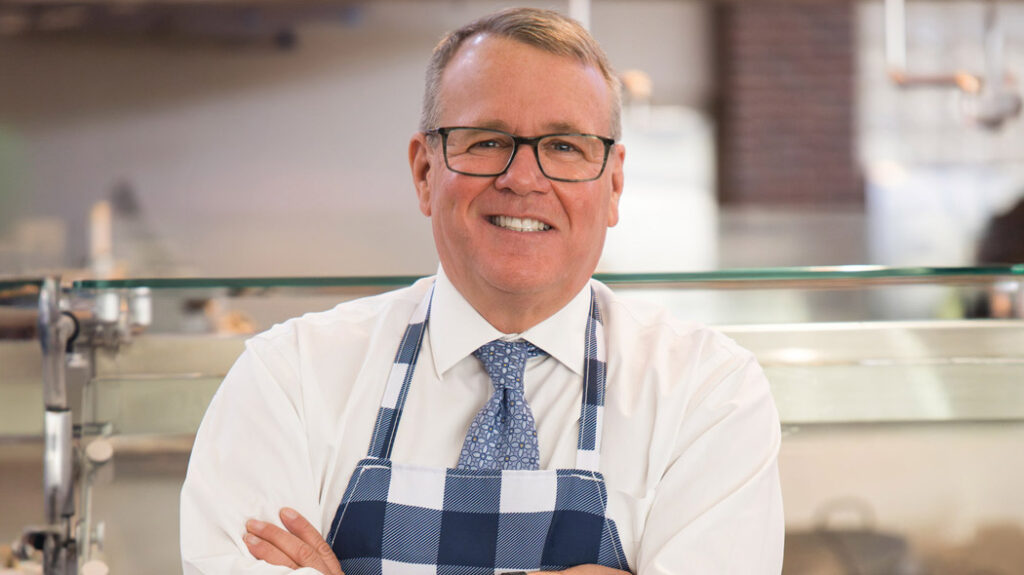
Hospitality is, after all, where Andy got his start in higher education. A year after he graduated high school in 1985 — when he decided he’d rather run a ski resort instead of just visit one — Andy visited the University of Nevada, Las Vegas to check out their hospitality program. The dean came out of his office, showed him around and, by the end of the day, offered to mentor him. After enrolling, the two would meet regularly as Andy went on to earn both a bachelor’s and a master’s degree in hotel administration.
That personal investment always stuck with Andy: It’s how he decided he would lead if he ever got the chance — and that’s exactly what he’s done. When he arrived at UNC, he met with students, and only students, for a few days, signaling where his priorities would begin. Under his leadership, Students First became the cornerstone of the university’s 10-year strategic plan, Rowing, Not Drifting 2030.
Armed with a shared vision and carefully mapped strategy, Andy worked across the university to steadily advance initiatives to promote student success, including creating faculty- and staff-led college advising centers to provide customized student support. He also helped expand access and affordability through programs like the UNC Tuition Promise, the First-Year Admissions Guarantee and the District 6 Direct Admissions Program, while achieving ambitious institutional goals, including designation as a Hispanic-Serving Institution and advancing to Carnegie’s Research 2 classification.
That strategic vision also extended beyond campus. Recognizing the importance of a strong relationship between the university and the city, he worked to close the divide between UNC and Greeley. He began by reaching out to the Downtown Development Authority (DDA) and quickly rose to serve as chairman of their board.
“That wasn’t just to shake hands and kiss babies,” said Bianca Fisher, executive director of the DDA. “He wanted to be involved in the community.”
He also served on the executive committee of the Greeley Chamber of Commerce and met regularly with commissioners from Weld County.
When he called John Gates, Greeley’s former longtime mayor, to start what would become a regular monthly breakfast meeting, he chose a local diner, because Andy, a self-described foodie, loves gourmet meals and dive restaurants equally. Gates found it refreshing, especially later, when he could call Andy on his cell any time, even late at night, to work out a problem. The two remain close friends: Andy went to Sturgis last year with him.
“When I got back from that first breakfast,” Gates said, “I told Patty [his wife] that he was one of the most genuine people I’d ever met.”
Andy immersed himself in the university community in the same way. He’s allergic to any kind of ostentation, which is why it’s OK to use his first name in this story: He wouldn’t want to be called anything else.
Harmony Newman, UNC’s Faculty Senate chair, said it was jarring at first to see Andy at every senate meeting, happy to answer any questions, even cynical ones. The only thing more jarring, she said, was when he decided to include the faculty senate chair position in his cabinet, an “incredibly rare thing,” she said, that gave faculty a direct pipeline to decisions that guide UNC.
“He authentically wants to be the guy who people are happy to come up and talk to,” Newman said. “The faculty recognizes that there are limits to that. He can’t make a decision that makes everyone happy. Frankly, I think that troubles him.”
That tension was most evident during periods of significant financial pressures and budget shortfalls. Inheriting a structural deficit at the start of his presidency and facing continued pressures with the pandemic, decreasing nationwide enrollment and shrinking state funding, Andy was forced more than once to make hard choices about how to sustain the university’s operations. Rather than shift the financial burden to students through tuition increases, he made the difficult decision to reduce staffing levels. Newman calls it an incredibly difficult time. Andy calls it heartbreaking, even when, today, he stands by those decisions.
The time he invested in building relationships was equally as important as all his other responsibilities as president. But it meant, many times, spending less time doing things he loved, like climbing, disc golf, skiing or spending time with his family.
“It’s a battle,” Andy said, “and sometimes I lose that battle.”
Sometimes, though, he could multitask. He loved to bring his wife Kerry and the kids to UNC’s games. Kerry loved sports, and Andy, of course, went to as many games as he could from basketball to football to softball, baseball, soccer and volleyball.
“It is rare to have a president and his wife courtside for almost every match,” said Lyndsey Oates, UNC’s head Volleyball coach. “I loved it when out of the corner of my eye I would see the double fist-pump in the air after a big point.”
Spending time with others was time well spent, Andy said, and made what at times could be a crushing job more enjoyable.
“What brings me great joy and energy is the people part,” Andy said. “That doesn’t feel like work.”
Building a unified front
Nine years ago, when Janine Davidson was the newly anointed president of Metropolitan State University, she began attending meetings with Colorado’s other university presidents.
“People would show up,” Davidson said, “and not say anything. It was like we weren’t supposed to take these meetings seriously.”
Until Andy arrived a year later.
Not only did he take that mandatory monthly meeting seriously, he organized more of them because he knew Colorado’s higher education voice would be stronger together.
“They came into a new normal,” Davidson said, “that Andy helped create.”
Because Colorado consistently ranks near the bottom in the nation for per capita funding for public higher education, the state’s public institutions often lack the funding necessary to sustain operations from year-to-year, let alone strategically expand them.
Despite that, Davidson said presidents were often hesitant to press state legislators for additional funding, concerned about jeopardizing those relationships. With Andy’s help, the presidents became a unified voice. Steg Haskett said legislators came to respect Andy’s steady, consistent advocacy for higher education.
Andy says now that dealing with the limited funding was the hardest problem he faced at UNC, other than the layoffs, which were, of course, related. The state is so far behind, he said, that even if Colorado universities were funded at the national per student average — just the average — it would bolster UNC’s budget by $50 million, a quarter of its budget. He calls the current level “unsustainable.”
Yet Andy and Davidson believe Colorado’s colleges and universities received hundreds of millions of dollars in additional funding as a result of their collective advocacy efforts.
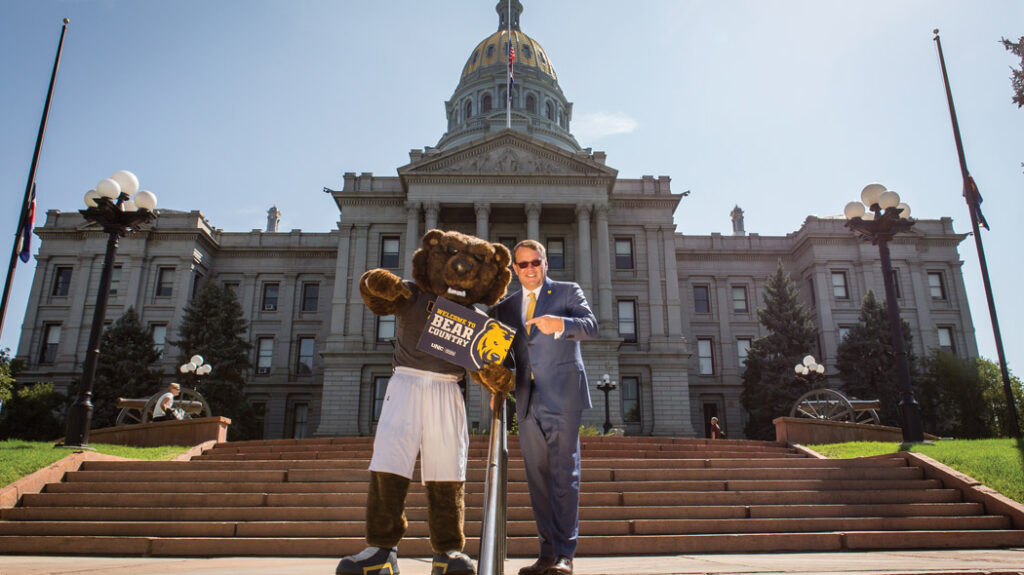
That spirit of collaboration is a hallmark of Andy’s leadership.
Gates and Fisher said Andy’s support has been invaluable at a time when the city is looking to invest hundreds of millions into downtown for a refresh. His partnership has helped strengthen the connection between campus and community, and his work, Steg Haskett said, already makes downtown Greeley feel more like a university town. More than ideas alone, Steg Haskett said it’s Andy’s drive, desire and determination that were crucial to turning vision into progress.
This was especially true in the creation of UNC’s College of Osteopathic Medicine (COM), an idea explored by previous administrations but never realized.
“He doesn’t just dream about big ideas,” Steg Haskett said. “The gift he has is seeing a big idea and inspiring people to find a way to get it done.”
A transformational undertaking to answer Colorado’s call
About a year after Andy arrived at UNC, Margo Karsten, a senior vice president with Banner Health, called Andy to see if he could help with a problem: The state needed fresh blood.
Young blood, to be precise: Banner’s doctors were aging out or close to retirement age. There weren’t enough new doctors to replace them. Could he help? Andy was excited, especially after a 2021 feasibility study identified a critical need for doctors in the state and across the nation, and after receiving overwhelming support from UNC’s community, stakeholders and healthcare systems.
But the hurdles that needed to be cleared to see this project through seemed more like mountains. UNC would have to change a state statute just to be able to offer medical education. And there was perhaps the biggest hurdle of all: Raising more than $200 million to meet the minimum financial requirement to open a college of medicine. A fundraising goal unprecedented in the university’s history.
Andy, unafraid of mountains, started by securing the assurance from other Colorado university presidents that they wouldn’t stand in his way, something that may not have happened if he hadn’t built good relationships with them. The pandemic was still fresh in everyone’s minds. No one, Andy said, took him seriously.
With early support from the Richardsons, a local family that is passionate about UNC and Greeley and heavily invested in the growth of the community, he hired the dean, Dr. Beth Longenecker, and went about raising the rest of the money for the project — which included a transformational $25 million gift from The Weld Trust in 2023, the largest single gift in university history.
But the path to funding the COM really came together after Andy spoke with Henry Sobanet, who was CFO at Colorado State University (CSU), and is now Andy’s executive coach. Sobanet found a way to pay for CSU’s $250-million Spur campus by convincing the state to help fund it through certificates of participation (COPs). With guidance from Sobanet and UNC’s Vice President for Finance and Administration, Dale Pratt, Andy decided UNC could take a similar approach. Andy credits Kayla Tibbals, UNC’s lobbyist, with helping to secure $247 million in COPs for medical education projects across Colorado through House Bill 24-1231, of which $128 million went to UNC. The university also received an additional $41 million from the state’s statutory reserves to meet the escrow needs for the project.
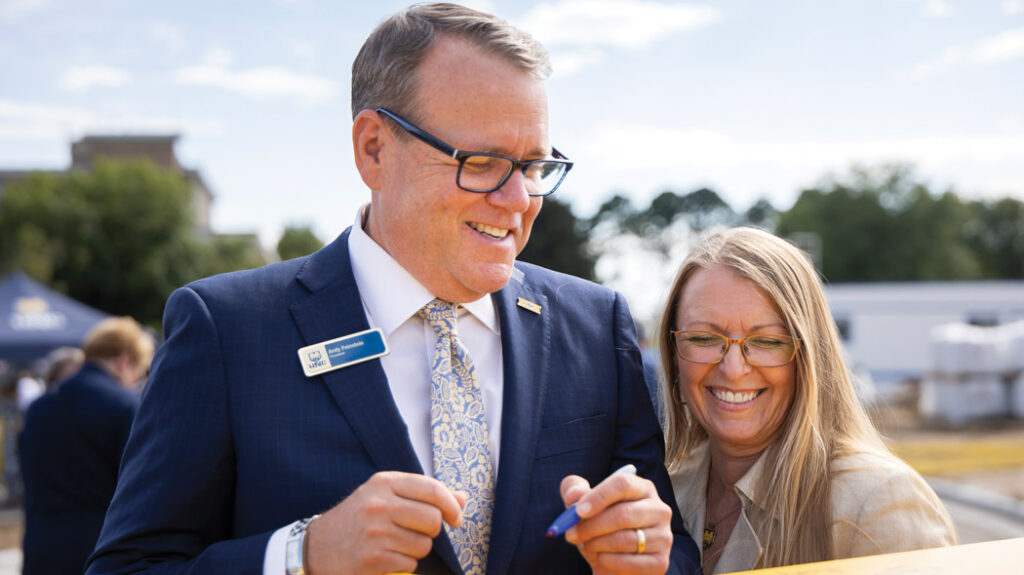
“The state made a huge investment in us,” Andy said.
Alongside what were already tremendous efforts to create new legislation and raise the necessary funding, the university was also navigating an arduous accreditation process through the Commission on Osteopathic College Accreditation.
“The accreditation process was ….well, it was one of the toughest parts of my job,” Andy said and laughed.
As just one example, the work of building clinical partnerships required finding 600 physicians to oversee clinical rotations for UNC’s medical students. Led by Dr. Longenecker and her team, the effort involved countless phone calls to build those relationships. Some physicians were skeptical at first, which was fair, given that UNC didn’t have a medical college yet. But Andy helped set the pace and direction, including the suggestion of tracking potential partners on a whiteboard, like a coach preparing for the NFL draft.
“We found many from Colorado and neighboring states,” Andy said, “but we had to go all over the country to get them. It was harrowing.”
The medical school likely remains Andy’s greatest achievement, many say.
More than a bold expansion of the university’s academic portfolio, it’s a continuation of the university’s mission to meet critical workforce needs in the region. It will also serve as a powerful economic driver — projected to contribute $1.4 billion to the state’s economy over the next 18 years, with over $500 million of that impact remaining in Weld County.
A better place
Dick Monfort, chair of UNC’s Board of Trustees, acknowledged the challenges Andy faced when he assumed the presidency.
“When Andy arrived eight years ago, higher education was facing headwinds,” said Monfort. “But his message from day one was clear — we are rowing, not drifting. Andy understood that leadership is about stewardship. He made difficult decisions when they were needed, always with the long-term health of the university in mind.”
Monfort said because of Andy’s courage and conviction, UNC is in a place of real strength and opportunity.
“The role of president at UNC is certainly more desirable now thanks to Andy’s tenure,” Steg Haskett said. “He’s shown that UNC can do big things. We can be more. But now there’s not just hope. There’s proof.”
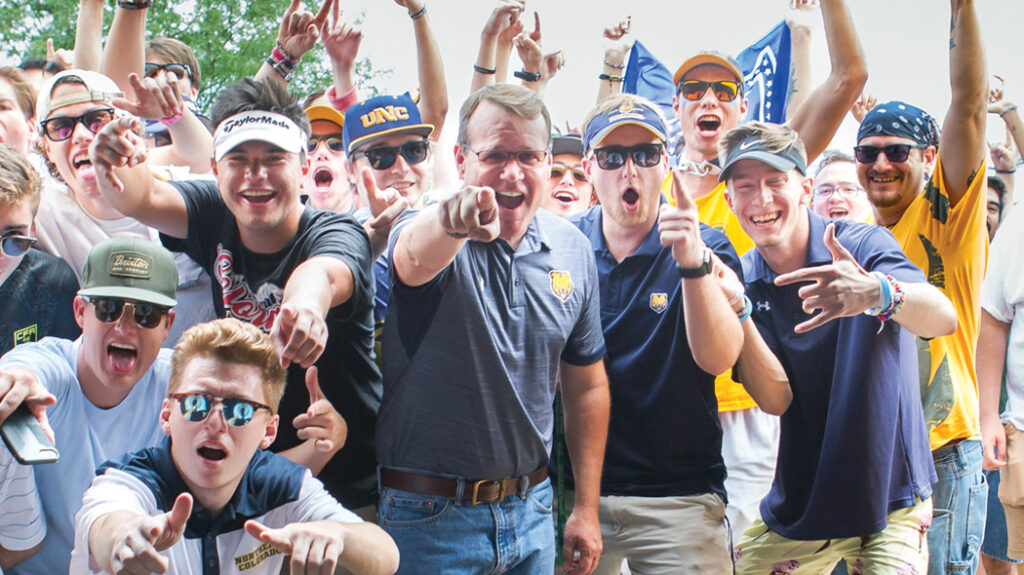
Andy created that transformation with a personable, empowering style that made UNC more fun. College students, for instance, can rarely name their presidents, and it’s doubtful they’d ever interact with them. Yet Ethan Blair, who graduated last December, said Andy was “pretty involved on campus.”
“You feel like there’s less separation between him and students that you’d normally have with a president,” Blair said.
Blair received the Nicholas Isadore Feinstein Memorial Scholarship, established by Eugene Park, a friend of the Feinstein family, and the Nicholas Feinstein Technology Internship Scholarship, set up by Andy and Kerry.
Because of these scholarships, Blair met with Andy every couple months to have lunch. Blair was intimidated at first to meet with the president, but Andy knew Blair had climbed a few 14ers, and they talked about hiking. That connection left a lasting impression. While Blair had other job offers after graduation, he chose to stay at UNC, taking a job in the Information Management and Technology department.
“A lot of students think he’s pretty awesome,” Blair said. “I do too.”
A new path
When Andy received word last November that the medical college received pre-accreditation status and could begin to admit students, it signaled the accomplishment of what is arguably one of the university’s most ambitious initiatives in its 137-year history.
“It was like …” Andy said and he took a deep, long breath.
When he let it out, he felt, well, a little tired.
Climbing any mountain means you’re halfway when you reach the summit. The idea of winding down his final adventure at UNC with a long, comfortable descent sounded good.
Andy’s not sure what his long-term plans are, and he’s OK with that. He still has work to do, even after he leaves the presidency in August. He’s committed to helping create a smooth transition for the next president and making sure they are successful from the start.
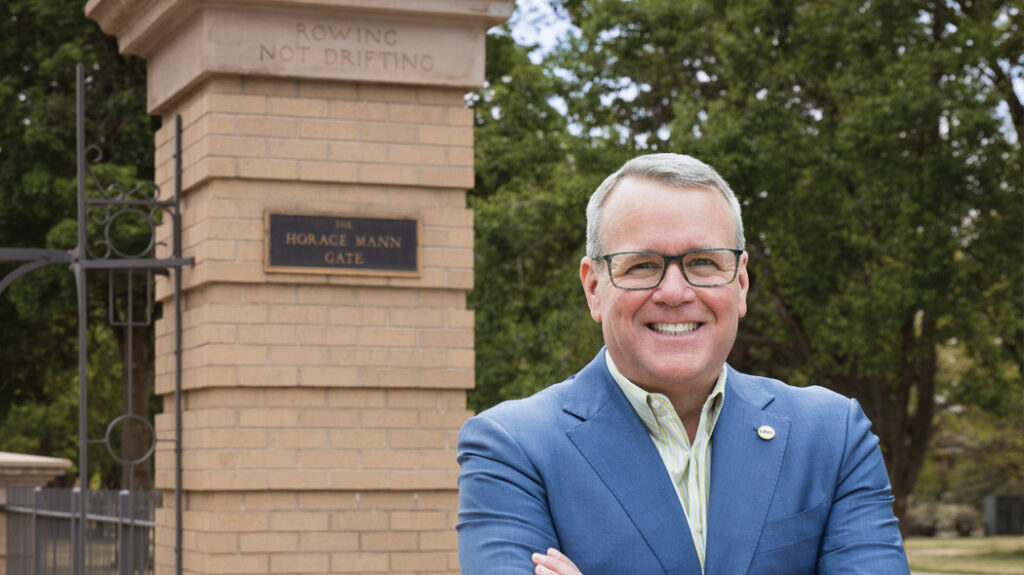
He plans to take some time off to recharge, but he knows he wants to stay in Greeley.
“I’ve built a really good network of people,” Andy said. “I’ve got friends here. I’d also like to see what’s in store for me. I’ve had offers and never taken them seriously.”
Greeley also is a good base camp for all kinds of adventures all over Colorado. It doesn’t take long to reach a good place to climb or ski.
Andy keeps a photo on his desk to remind him to follow that sense of adventure.
It’s a scene from his last 14er, Sneffels, which he climbed with Kerry and one of Nick’s closest friends. in July 2025. It was 6 a.m., and black clouds were gathering the power that would later blast them like a car wash. But right then, the sun pierced through them, revealing two of the brightest rainbows Andy had ever seen. It gave them a moment of peace. It felt like Nick’s spirit was there with them.
“All I could think about,” Andy says through heavy tears, “was that Nick would have loved that.”
Andy always felt a little rushed in the mountains. Moments of peace, after all, were a luxury for a man who didn’t see 2 a.m. phone calls as an intrusion but simply part of the job.
Now, soon, he can linger a bit more — taking pride and confidence in the foundation he helped build and the future it will support.
Key Achievements
$350 Million
______________________________
Raised in combined philanthropic and public support for UNC’s mission.
78%
______________________________
The most recent fall-to-fall, first-year retention rate, up from 69% in 2022; on track toward meeting the Rowing, Not Drifting 2030 goal of 80%.
47%
______________________________
The most recent four-year graduation rate, up from 37% in 2022; exceeding the Rowing, Not Drifting 2030 goal of 45%.
First-Year Guarantee
Fall 2023 — Created the Colorado First-Year Guarantee, expanding access through a clear, guaranteed pathway to college admission for qualified high school students and reducing barriers in the application process.
UNC Tuition Promise
Spring 2024 — Launched the UNC Tuition Promise, increasing affordability by covering 100% of standard tuition and mandatory fees for eligible Colorado residents with the greatest financial need.
Hispanic-Serving Institution Designation
Spring 2024 — Achieved federal Hispanic-Serving Institution designation more than 18 months ahead of schedule, affirming UNC’s proud support for Hispanic and Latine students and their families, and creating opportunities and pathways that lead to success for all students.
R2 Designation
Spring 2025 — Earned Carnegie’s 2025 Research Activity Designation for high research activity, elevating UNC’s national standing and advancing its commitment to research, critical inquiry and creative work.
District 6 Direct Admission Program
Fall 2025 — Launched the District 6 Direct Admission Program, expanding access and removing barriers to higher education by allowing local students to be considered for admission after their junior year of high school — without a formal application — and proactively connecting them early to scholarship and financial aid opportunities.
College of Osteopathic Medicine
Fall 2026 — Established Colorado’s first public college of osteopathic medicine, strengthening the state’s physician workforce and generating a projected $1.4 billion in economic impact for the state over 20 years.