
Article
January 27, 2026
Written by Student Writer Austin Watts
New Artificial Intelligence in Media Production Course Prepares the Next Generation of Journalists
New course teaches students to experiment with AI tools, navigate ethical challenges and prepare for rapidly evolving careers in journalism and media
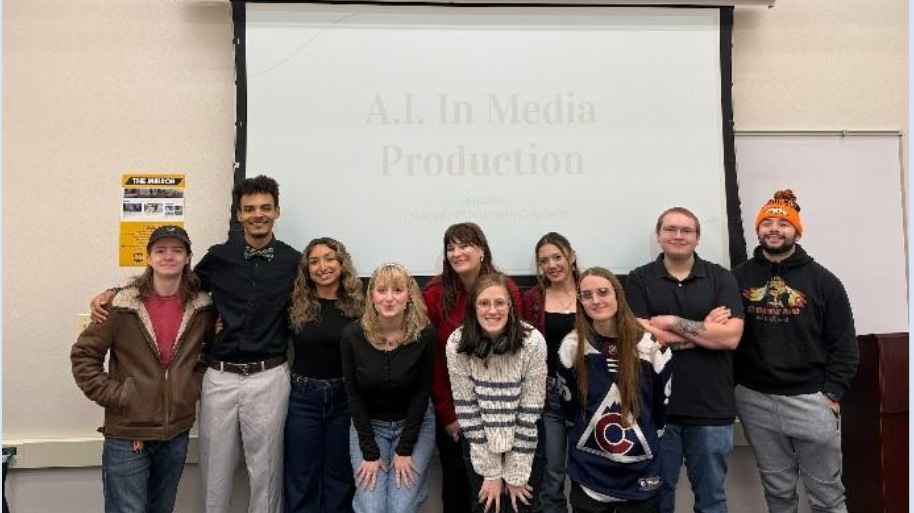
Artificial intelligence (AI) is reshaping how news and media are produced, and students at the University of Northern Colorado (UNC) are learning to navigate that shift in real time. Shawn Montano, assistant professor of Journalism and Media Studies, has introduced a new project-based course that adapts as quickly as the technology itself.
Montano’s Artificial Intelligence in Media Production course immerses students in the rapidly changing landscape of AI tools used across journalism and media, asking students to experiment with emerging technologies to create multimedia work with AI support. Inspired by new developments in the rapidly growing AI job market, Montano developed the course with career readiness in mind. Yet, with subject matter that is evolving as quickly as AI is today, Montano’s syllabus underwent more than a few changes before the beginning of the semester.
“I probably revamped this course 10 times before I even started, because things kept changing,” said Montano.
After so many adjustments, Montano reached a new conclusion: he couldn’t plan a full syllabus without flexibility built in.
“At the beginning of the class, I had about seven weeks of the ideal syllabus plan,” Montano commented, “New AI tools are being published weekly and even daily, so I just pivot the whole course. I’m being as responsive as possible.”
In addition to his innovative teaching style, Montano also regularly integrates project-based learning in the classroom. Instead of traditional assignments, students work in teams to create visual projects that integrate AI tools directly into their storytelling. This approach allows them to both test AI tools hands-on and demonstrate their work in tangible formats they can carry beyond the classroom.
AI integration raises numerous questions regarding fair and ethical use. In this course, Montano asks students to consider both their own boundaries and the constraints of the media industry while justifying every AI choice they make. Understanding ethics, he said, is crucial for journalists who must navigate both the possibilities and the pitfalls of AI.
“It’s a question we have every day,” Montano said, “Students make decisions based on three layers: their own comfort level, industry standards for the type of media they’re creating and what their audience deserves in terms of transparency.”
One example of generative AI in use was the students’ multimedia news project. Working in groups, they were assigned to produce an entire fictitious video using only generative AI tools. Beyond assigning team roles and engineering prompts that were efficient and stylistically consistent, they also had to consider the ethical implications of relying solely on generative AI for broadcast journalism. As with the multimedia news project, most assignments in the class are visual in nature. Rather than writing papers, students create and share visual presentations that integrate and/or are presented within AI tools such as Gemini, ChatGPT and LTX. Students also utilize AI to write headlines, captions, scripts, outlines and more related to the press. Many have even trained AI chatbots to replicate their writing style and tone. Montano is looking forward to seeing the practical applications of these uses when the students take his News Production course in the spring.
Beyond technical skills, Montano added that the course is opening students’ eyes to emerging roles in a changing media landscape. He cited developing careers in the fields of AI prompt engineering and ethics consulting, neither of which were on the map even two short years ago. Despite rising concerns that AI is going to create unemployment by replacing human jobs, Montano believes that this phase of technological advancement is a natural part of the cycle of industrialization.
“[Artificial intelligence] is going to create jobs,” Montano asserted, “For example, people used to sew with their hands, and then they created a machine. So, people got replaced, but then they needed somebody to maintain the machine, to load the machine’s fabrics, et cetera, so they created different jobs. I think the same thing will happen in AI. Certain jobs are going to be rewritten or become non-existent, but then there’s going to be new jobs that are created.”
Montano believes that UNC students gain an advantage by engaging directly with AI rather than avoiding it. By treating AI as something to explore rather than fear, Montano’s students develop a more informed approach to the tools that are already shaping modern journalism.
For Journalism and Media Studies student Kinsley Walker, her relationship with AI remains nuanced. Walker stated that, at the beginning of the course, she strongly disagreed with AI use due to its environmental impacts. However, as the world of journalism expands and changes with AI, Walker feared being left behind without it.
“Journalism is moving on, whether you know how to use AI or not,” Walker said, “I think that the basic understanding of AI is essential to grow as a storyteller. This course has made me feel like I can move with the rapid change.”
Walker, along with Journalism and Media Studies peers Greg Egbert, Jaylen Lee and Alesea Evangelista-Flores, will be presenting findings from the course at the Broadcast Educators Association conference in Las Vegas in April 2026, with the presentation having been curated by the entire class as their final exam. Walker shared that integrating the research and experiments of all students into a concise presentation has been a challenging but ultimately rewarding process. Montano, who brings a group of students to the conference annually, is excited to give students the opportunity to present in a traditionally faculty-dominated setting.
“I think [it’s important to] have the student who actually did it share their experience, what their takeaways are, how it’s going to help their careers, help their learning or help their critical thinking,” Montano commented, “That’s more powerful: to hear from the actual people who are impacted.”
As AI continues to reshape the media landscape, Montano’s Artificial Intelligence in Media Production course positions UNC students to enter the industry with clarity and practical experience. For him and his students, the goal is simple: understand the technology shaping the future of storytelling and be ready to meet that future head-on.