Written by Sydney Kern | Translated by Carlos José Pérez Sámano
Mission: Innovation — UNC Students Take NASA Technology to New Frontiers
Misión: Innovación — Los estudiantes de la UNC llevan la tecnología de la NASA a nuevas fronteras
Two courses in the Monfort College of Business will offer students hands-on experience with NASA technology and learn how to apply it to everyday life
Dos cursos de la Facultad de Negocios Monfort ofrecerán a los estudiantes experiencia práctica con la tecnología de la NASA y les enseñarán a aplicarla a la vida cotidiana.
This spring, students in a variety of majors from across campus will launch into the world of NASA innovation, gaining access to space-age technologies and transforming them into real-world commercial applications. The program is called NASA Technology Transfer University (T2U) and will be incorporated into two classes offered by the Monfort College of Business (MCB) – Managing New Business Ventures (BAMG 451) and Fundamentals of Project Management (BACS 385).
“This program will give our students a significant leg up when they graduate and look to begin their careers,” said Steve Elias, Ph.D., dean of MCB.
Elias already knows the benefits of bringing NASA technology into the classroom. Similar to how he is spearheading this initiative at UNC, he did the same at Fort Lewis College, his former institution in Durango – the only other Colorado institution of higher education taking advantage of T2U.
“It is successful there, and I know we can be just as successful at UNC given the size of our business community and proximity to other businesses along the Front Range,” Elias said. “Business leaders will hopefully look at what we’re doing in the program and say, ‘wow, these are skills that we would want in the employees that we are recruiting.’”
The goal for NASA in partnering with colleges and universities is to find new ways to develop and use their technologies in the marketplace. Through the T2U program, students have access to 1,600 NASA patents across a massive span of technologies in categories like medicine, environment, screening, manufacturing and more.
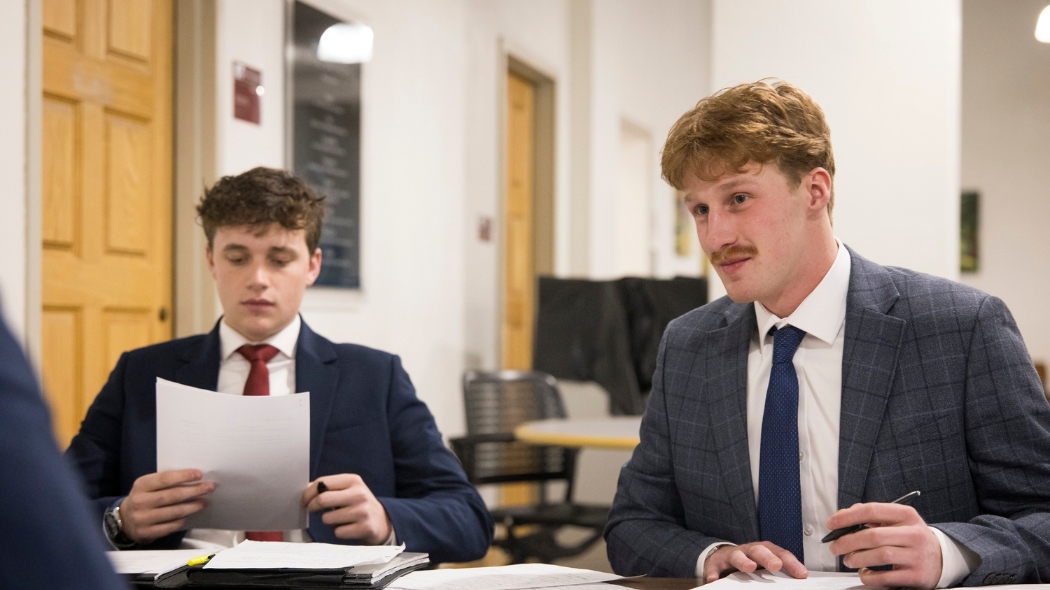
The students form teams, select a NASA technology early in the semester, and then work step-by-step toward developing a funding-ready business plan and commercialization strategy for their reimagined product. The course ends with a pitch presentation to audience members, including NASA representatives and local business professionals.
“We found that oftentimes, the students are more creative when it comes to ideating on translating intellectual property,” said Walt Ugalde, T2U industry and entrepreneurial engagement lead. “So, we get a lot out of it because the students come up with really, really, off-the-wall, novel ideas.”
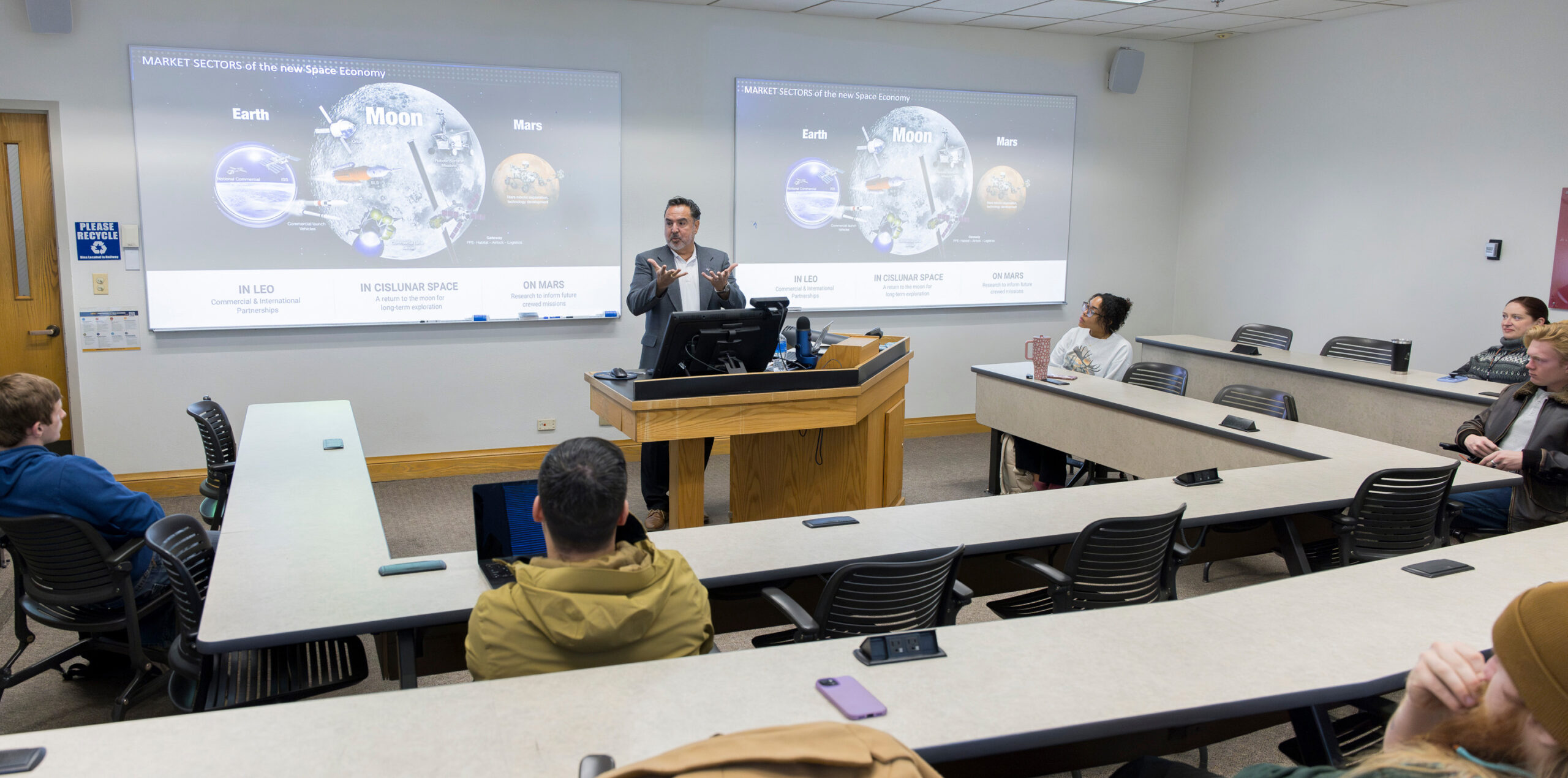
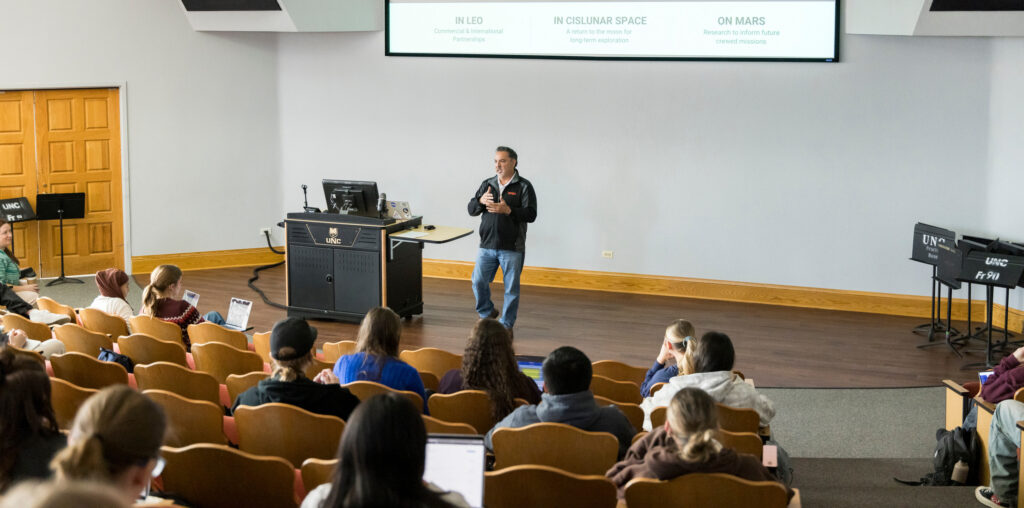
Walt Ugalde speaking to UNC students
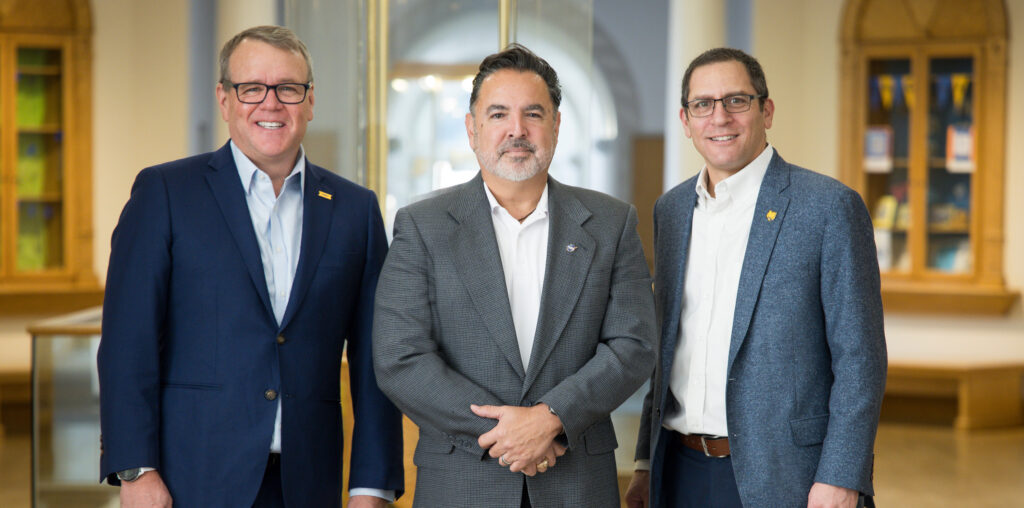
From left to right, President Andy Feinstein, Walt Ugalde and MCB Dean Steve Elias
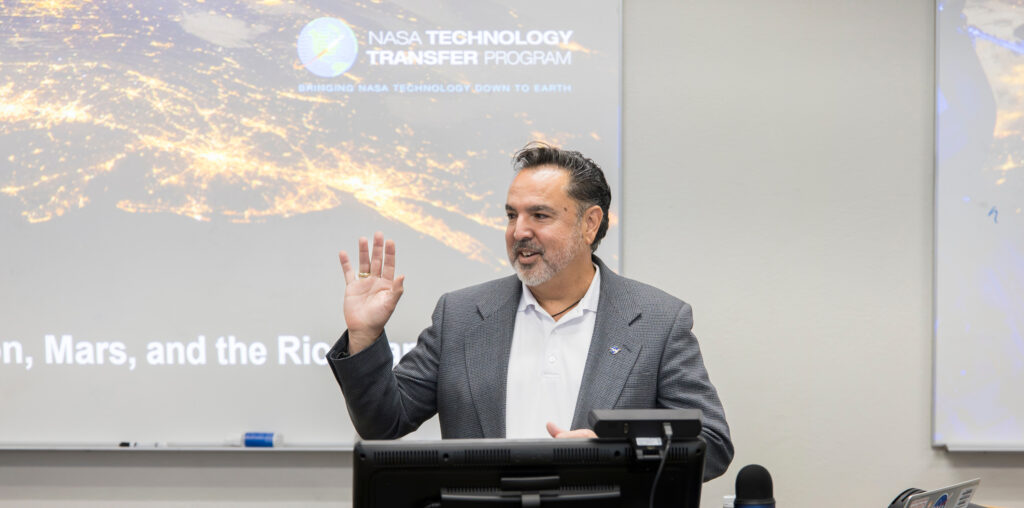
Walt Ugalde speaking to UNC students
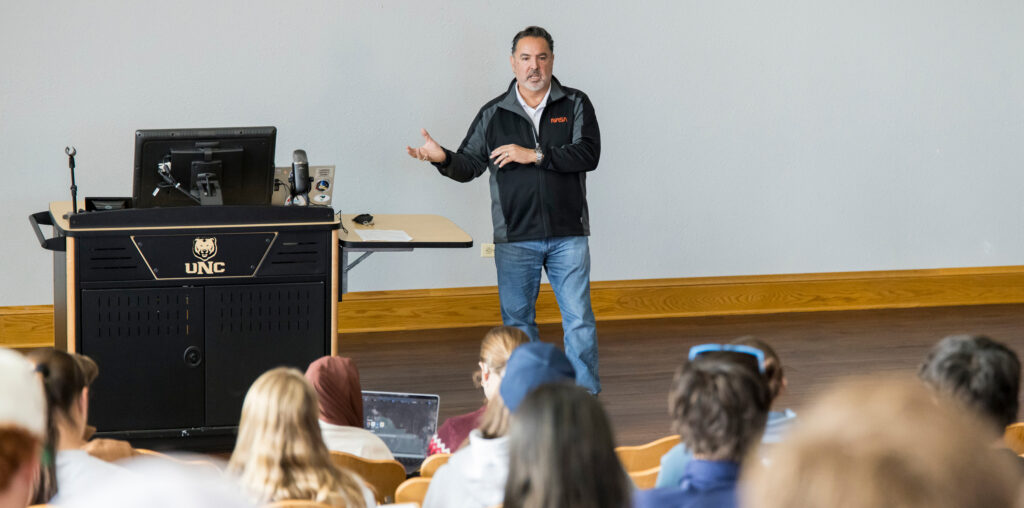
Walt Ugalde speaking to UNC students
Some examples of how NASA technology has made its way into everyday life include a material originally tested for spacesuits that is now used to keep people sweat-free in cushion covers and bedding; an air quality sensor built to fight moon dust is helping firefighters measure dangerous forest-fire emissions in real-time; and NASA research is being used to manufacture ski-goggle lenses to optimize visibility on the slopes.
“The opportunities are endless for our students given NASA will help them with licensing, and local business community members want to be involved in the program however they can,” Elias said. “I have no doubt T2U will help our students grow their skill portfolio to help kickstart their careers or even launch a business of their own based on a technology spinoff.”
Associate Professor of Entrepreneurship Dalong Ma, Ph.D., teaches Managing New Business Ventures, which is one of the two courses participating in the T2U program. It’s a smaller, capstone-style course with 10 students enrolled.
“I’m super excited for my students to get this experience,” Ma said. “The T2U program is a rare opportunity for students to work with real, federally developed technologies rather than hypothetical ideas. The T2U program turns the class into a true incubator experience, which aligns perfectly with how entrepreneurship should be taught.”
During the course, Ma says his students will gain hands-on experience in technology evaluation, customer discovery, business model development, IP strategy and commercialization planning. His students are already expressing enthusiasm for the upcoming coursework, and Ma says this course will dramatically shorten the gap between classroom learning and real-world innovation.
“My students will be able to interact directly with NASA experts and learn how licensing works, which is a skill that is highly transferable whether they pursue startups, corporate innovation or consulting,” Ma said. “I believe this will increase motivation, engagement and creativity in the classroom.”
Similarly, Associate Professor of Computer Information Systems, Moe Manshad, Ph.D., noticed a shift in his 30 students when he told them they would be one of two courses using NASA technologies.
“They know the job market is tough, and this will give them an edge,” Manshad said.
In his management class, he is going to have his students use the NASA patents and transform them into an AI-powered concept.
“We are living through a massive shift in the technology industry, and AI is transforming how software gets built, making the job market for IT professionals tighten significantly,” Manshad said. “Our students are entering a more competitive landscape than any graduating class before them. So, when an opportunity like this comes along, you grab it.”
“When one of our graduates sits across from a hiring manager and says, ‘I worked on a NASA patent,’ that is a differentiator. That is the kind of experience that makes employers pay attention.” – Moe Manshad, Ph.D.
While this is the first semester students are exploring the out-of-this-world advancements, Elias hopes the program will continue to grow each year. Not only in the varieties of students enrolling in the courses — from graphic design to accounting and engineering — but also in discovering ways the community can get involved.
“I would love it if we could have industry folks interact with our students at some level a couple of times during the semester to have students bounce ideas off of them, make a pitch at the end and get their thoughts on their product,” Elias said.
Economic Development Director for the City of Greeley, Derrek Jerred, echoes that this program provides the opportunity to engage local manufacturers and businesses in Greeley to help solve challenges in various industries.
“Whether it’s taking a NASA solution and applying it to agriculture, energy extraction or even medical uses, especially with the new UNC College of Osteopathic Medicine, there’s a lot of potential when you bring the right people to the table,” Jerred said.
In the end, alongside the students, Jerred says Greeley business owners will be the ones benefiting from the collaboration.
“Greeley has a strong mix of companies with real capabilities that are worth tapping into to help students turn ideas into solutions, especially when it comes to manufacturing, technical expertise and supply chain support,” Jerred said. “It’s a win-win for everyone involved.”
Esta primavera, estudiantes de diversas especialidades de todo el campus se adentrarán en el mundo de la innovación de la NASA, accediendo a tecnologías de la era espacial y transformándolas en aplicaciones comerciales del mundo real. El programa se llama NASA Technology Transfer University (T2U) y se incorporará a dos clases que ofrece la Facultad de Negocios Monfort (MCB): Gestión de nuevas empresas (BAMG 451) y Fundamentos de la gestión de proyectos (BACS 385).
«Este programa dará a nuestros estudiantes una ventaja significativa cuando se gradúen y busquen comenzar sus carreras», dijo Steve Elias, Ph.D., decano de la MCB.
Elias ya conoce los beneficios de llevar la tecnología de la NASA al aula. Al igual que está impulsando esta iniciativa en la UNC, hizo lo mismo en el Fort Lewis College, su antigua institución enDurango, la única otra institución de educación superior de Colorado que aprovecha la T2U.
«Allí ha tenido éxito, y sé que podemos tener el mismo éxito en la UNC, dado el tamaño de nuestra comunidad empresarial y la proximidad a otras empresas a lo largo de la cordillera Frontal», afirmó Elias. «Esperamos que los líderes empresariales vean lo que estamos haciendo en el programa y digan: “Vaya, estas son las habilidades que queremos en los empleados que estamos contratando”».
El objetivo de la NASA al asociarse con colegios y universidades es encontrar nuevas formas de desarrollar y utilizar sus tecnologías en el mercado. A través del programa T2U, los estudiantes tienen acceso a 1600 patentes de la NASA en una amplia gama de tecnologías en categorías como medicina, medio ambiente, detección, fabricación y más.
Los estudiantes forman equipos, seleccionan una tecnología de la NASA al principio del semestre y luego trabajan paso a paso para desarrollar un plan de negocios listo para su financiación y una estrategia de comercialización para su producto rediseñado. El curso termina con una presentación ante el público, que incluye a representantes de la NASA y profesionales de empresas locales.
«Hemos descubierto que, a menudo, los estudiantes son más creativos a la hora de idear formas de traducir la propiedad intelectual», afirma Walt Ugalde, responsable de industria y emprendimiento de T2U. «Así que sacamos mucho provecho de ello, porque los estudiantes proponen ideas realmente novedosas y fuera de lo común».
Walt Ugalde en conferencia con los estudiantes de UNC
De izquierda a derecha, el presidente Andy Feinstein, Walt Ugalde y el decano de la facultad de negocios MCB Steve Elias
Walt Ugalde hablando con los estudiantes de UNC
Walt Ugalde en charla con los estudiantes de UNC
Algunos ejemplos de cómo la tecnología de la NASA se ha incorporado a la vida cotidiana incluyen un material originalmente probado para trajes espaciales que ahora se utiliza para mantener a las personas libres de sudor en fundas de cojines y ropa de cama; un sensor de calidad del aire construido para combatir el polvo lunar que ayuda a los bomberos a medir en tiempo real las peligrosas emisiones de los incendios forestales; y la investigación de la NASA que se utiliza para fabricar lentes para gafas de esquí que optimizan la visibilidad en las pistas.
«Las oportunidades son infinitas para nuestros estudiantes, ya que la NASA les ayudará con las licencias y los miembros de la comunidad empresarial local quieren participar en el programa en todo lo que puedan», dijo Elias. «No tengo ninguna duda de que T2U ayudará a nuestros estudiantes a ampliar su cartera de habilidades para impulsar sus carreras o incluso lanzar su propio negocio basado en una tecnología derivada».
El profesor asociado de Emprendimiento Dalong Ma, Ph.D., imparte la asignatura Gestión de nuevas empresas, que es uno de los dos cursos que participan en el programa T2U. Se trata de un curso más reducido, de tipo culminante, en el que se han matriculado 10 estudiantes.
«Estoy muy emocionado por que mis alumnos puedan vivir esta experiencia», afirma Ma. «El programa T2U es una oportunidad única para que los alumnos trabajen con tecnologías reales desarrolladas a nivel federal, en lugar de con ideas hipotéticas. El programa T2U convierte la clase en una auténtica experiencia de incubadora, lo que encaja perfectamente con la forma en que se debe enseñar el espíritu emprendedor».
Durante el curso, Ma afirma que sus alumnos adquirirán experiencia práctica en evaluación tecnológica, descubrimiento de clientes, desarrollo de modelos de negocio, estrategia de propiedad intelectual y planificación de la comercialización. Sus alumnos ya están mostrando su entusiasmo por el próximo curso, y Ma afirma que este curso reducirá drásticamente la brecha entre el aprendizaje en el aula y la innovación en el mundo real.
«Mis alumnos podrán interactuar directamente con expertos de la NASA y aprender cómo funciona la concesión de licencias, una habilidad muy transferible tanto si se dedican a la creación de empresas emergentes como a la innovación corporativa o la consultoría», afirma Ma. «Creo que esto aumentará la motivación, el compromiso y la creatividad en el aula».
Del mismo modo, el profesor asociado de Sistemas Informáticos, Moe Manshad, Ph.D., notó un cambio en sus 30 alumnos cuando les dijo que su curso sería uno de los dos que utilizarían tecnologías de la NASA.
«Saben que el mercado laboral es difícil y esto les dará una ventaja», afirmó Manshad.
En su clase de gestión, va a pedir a sus alumnos que utilicen las patentes de la NASA y las transformen en un concepto basado en la inteligencia artificial.
«Estamos viviendo un cambio enorme en la industria tecnológica, y la inteligencia artificial está transformando la forma en que se crea el software, lo que hace que el mercado laboral para los profesionales de TI se vuelva mucho más competitivo», dijo Manshad. «Nuestros alumnos se enfrentan a un panorama más competitivo que cualquier otra promoción anterior. Por eso, cuando surge una oportunidad como esta, hay que aprovecharla».
«Cuando uno de nuestros graduados se sienta frente a un director de recursos humanos y le dice: “He trabajado en una patente de la NASA”, eso marca la diferencia. Ese es el tipo de experiencia que llama la atención de los empleadores». – Moe Manshad, Ph.D.
Aunque este es el primer semestre en el que los estudiantes exploran estos avances extraordinarios, Elias espera que el programa siga creciendo cada año. No solo en cuanto a la variedad de estudiantes que se matriculan en los cursos, desde diseño gráfico hasta contabilidad e ingeniería, sino también en cuanto al descubrimiento de formas en que la comunidad puede participar.
«Me encantaría que pudiéramos contar con la participación de profesionales del sector para que interactuaran con nuestros estudiantes en algún momento del semestre, con el fin de que estos pudieran intercambiar ideas con ellos, presentarles sus proyectos al final y conocer su opinión sobre sus productos», afirma Elias.
El director de Desarrollo Económico de la ciudad de Greeley, Derrek Jerred, se hace eco de que este programa ofrece la oportunidad de involucrar a los fabricantes y empresas locales de Greeley para ayudar a resolver los retos de diversas industrias.
«Ya sea aplicando una solución de la NASA a la agricultura, la extracción de energía o incluso a usos médicos, especialmente con la nueva Facultad de Medicina Osteopática de la UNC, hay mucho potencial cuando se reúne a las personas adecuadas», afirma Jerred.
Al final, junto con los estudiantes, Jerred dice que los empresarios de Greeley serán los que se beneficien de la colaboración.
«Greeley cuenta con una sólida combinación de empresas con capacidades reales que vale la pena aprovechar para ayudar a los estudiantes a convertir sus ideas en soluciones, especialmente en lo que se refiere a la fabricación, los conocimientos técnicos y el apoyo a la cadena de suministro», dijo Jerred. «Es beneficioso para todos los involucrados».