Written by Tamsin Flemming | Translated by Carlos José Pérez Sámano
Helping Cancer Patients Exercise Their Way to Longer, Better Lives
Gracias al ejercicio físico, ayudamos a los enfermos de cáncer a vivir mejor y durante más tiempo
Once known as a hidden gem, UNC’s student and staff-led Cancer Rehabilitation Institute now has a long waiting list for patients
El Instituto de Rehabilitación del Cáncer de la UNC, antes conocido como una joya oculta, dirigido por estudiantes y personal, tiene ahora una larga lista de espera de pacientes.
“If it weren’t for this place, I’d be dead,” said a man wearing a baseball cap and a black T-shirt.
He’s sitting in a chair at the front of the exercise room, his blood pressure being taken by a student. “I would just sit at home, depressed.”
Another woman wearing gray leggings and a long sleeve T-shirt arrived, visibly upset. But within 20 minutes, she was working out on an exercise bike, laughing with two students.
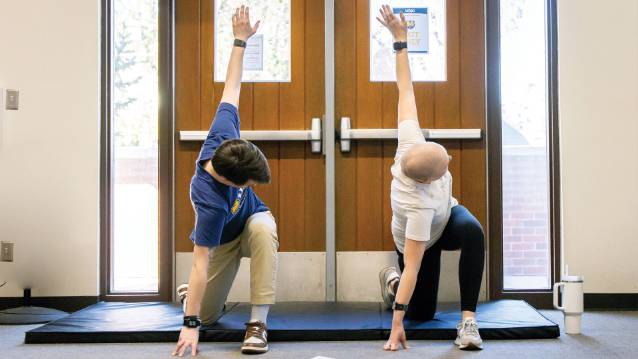
This is a normal Friday morning at the Ben Nighthorse Campbell Center, the one-story brick building home to the UNC Cancer Rehabilitation Institute (UNCCRI). The sound of interns and practicum students encouraging their patients could easily be mistaken for the upbeat chatter of friends as they get to work on that day’s exercises. Their treatment is based on extensive medical training and best practices. Their goals are both lofty and weighty — help cancer patients live better, longer lives.
However, watching the smiles widen on the faces of patients, students and staff, it’s clear that the work done here is powerful in ways not fully explained by science, at least not yet.
The Power of Exercise
When Carole Schneider, Ph.D., a UNC professor of Sport and Exercise Science, was diagnosed with cancer in 1995, her treatments left her struggling with side effects like fatigue and muscular weakness. Then, there was little research on the effect of exercise on cancer survivors. But she and her doctor saw how the benefit of exercise directly counteracted the toxicities of her cancer treatment.
Schneider quickly realized this area of study had the potential to greatly improve lives. So, she enlisted the help of her colleagues Cad Dennehy, Ph.D., and Dr. Sue Carter. With their help, they established UNCCRI in 1996 to study the role of exercise in cancer survivors’ rehabilitation.
Today, the institute is recognized as a frontrunner in exercise-based cancer rehabilitation and is the only facility of its kind. UNCCRI has served over 1,000 adult cancer survivors with all types of cancer in various stages of treatment. More than 500 students participated in this experiential learning, conducting clinical and basic research in cancer rehabilitation.
In fact, researchers at Memorial Sloan Kettering Cancer Center published a study in 2023 in the Journal of Clinical Oncology that found people diagnosed with cancer who regularly exercise reduced their risk of dying from all causes by 25% compared with people with cancer who did not exercise.
Exercise Oncology: Extending Life
Students at UNCCRI work directly with patients during their rehabilitation work. Buck Covington is the current graduate assistant at the institute and a doctoral candidate in the Exercise Physiology program. When Covington learned about the work UNC was doing in exercise oncology, the use of exercise in addition to cancer treatments to help patients, his entire career trajectory shifted.
“[My advisor] was telling us about [UNCCRI] and the field of exercise oncology in general, and immediately I was enamored with the idea,” said Covington, who before that, planned to go into a physical therapy program.
In August of 2020 when Covington first arrived at UNC, he was a doctoral student intern at UNCCRI working with individual patients on their rehabilitation plans. Both then and now, the institute opens bright and early at 7 a.m., with patients coming in every hour for hour-long appointments. Students chat informally with their patients to see how they’re feeling that day before starting their session.
Students are right there with their patients every step of the way. Students take a completely hands-on approach in every session, from taking vitals to leading the patients in aerobic activity and resistance training.
Patients participate in a four-phase program, with the first three phases lasting 12 weeks and the last phase lasting as long as they like. Each phase is fully customized to each patient by their student intern. At the beginning of each phase, patients undergo an extensive evaluation to establish their fitness baseline, which students and researchers use to gauge fitness maintenance and progress.
Giving Hope, Gaining Wisdom
While patients reap the many benefits of exercise and a student intern to keep them accountable, the students benefit from their patients as well.
“There does seem to be some sort of effect between having a younger population of students who are learning and looking forward in life and more hopeful about the future, [work] with someone who’s maybe at the end of life, or at least not looking forward the same way we are,” said Covington.
“I think it causes a synergistic effect where we’re imparting hope on them, and they’re imparting wisdom and guidance on us.”
Covington has personally gone above and beyond for his patients. At one point, a patient’s health deteriorated to the point that they were no longer able to come into UNCCRI for their treatment. Rather than allowing that to be the end of the patient’s relationship with UNCCRI, Covington and another student went to the patient’s house multiple times a day, five days a week for nearly a year.
“They were there up until the day he died. That’s the kind of commitment that a lot of these kids have. It means that much to them,” said Reid Hayward, Ph.D., director of UNCCRI.
For Clay Drake, ’90, UNCCRI has been a game changer in his cancer treatment.
When Drake was diagnosed with multiple myeloma, a type of cancer affecting the white blood cells that produce disease- and infection-fighting antibodies, in 2016, he was given five years to live based on the aggressiveness of the cancer. Despite that, Drake didn’t focus on the timeframe. Instead, he decided to do everything he could to improve his health.
Even at points when Drake’s treatment wasn’t working, or he had to spend multiple months in the hospital, he never stopped trying to get ahead of his diagnosis. He underwent experimental procedures, including two different stem cell transplants using both his and a donor’s stem cells.
It wasn’t until about a year after undergoing the stem cell transplant that Drake found out about UNCCRI, and it ended up making all the difference.
“When I first started going [to UNCCRI], I couldn’t use my left leg, but it changed everything. We were at a point where we didn’t know what we were going to do. And here I am, nine years later, talking about this place,” said Drake.
Drake has been a patient at UNCCRI for about eight years now and has full use of his left leg.
He credits the structure of UNCCRI’s program with holding him accountable to exercise. Drake and other patients know that when they don’t go into UNCCRI it doesn’t just affect them, it affects their student interns too. Throughout their course of rehabilitation, they develop a mutually beneficial relationship where patients gain strength and improve their health, and the students gain hands-on experience working with patients.
Each relationship is different, with some developing a deeper bond than others. The relationships Drake has fostered with his student interns have each been distinct. One student, with whom he trained for two and a half years, had a particularly significant impact on him.
“He just got a job with UCHealth in Denver. He’s going to be doing some rehab-related stuff … and he’s going to find his way. That’s the kind of stuff that’s more powerful to me than just the exercise piece. Certainly, the exercise is why we do it, but it’s also about the relationships,” said Drake.
To this day, Drake and that former student keep in touch, golfing together at least once every summer. Drake even tried helping their partner find a job when he learned they were trying to move closer.
“I’ll do whatever I can if that’s the direction they want to go and I can help them,” said Drake, “I will absolutely do it.”
The Science Behind the Exercise
The strength and depth of the relationships built at UNCCRI are a testament to the culture that’s been developed from the very beginning.
Hayward has poured his heart and soul into the institute since 1998. Schnieder was Hayward’s advisor while pursuing his master’s degree at the University of Kansas. He was almost immediately recruited to work at UNCCRI after its inception.
Hayward’s background in cardiovascular pathophysiology, the study of disorders affecting the heart and blood vessels, was a natural match for the institute. Many of the chemotherapy drugs and radiation drugs cause damage to heart tissue, called cardiotoxicities. Hayward’s expertise in that area, coupled with his understanding of the healing properties of exercise, made him the perfect addition to the small but mighty team.
From the beginning, UNCCRI studied the effects of exercise on the cardiotoxicities of chemotherapeutic drugs. Some of their findings show that exercise does protect the heart from the negative effects of chemotherapy.
Exercising allows the heart to create proteins that pump the toxic drugs out of the heart, reducing the damage they can cause. Hayward and his team found that those toxicity-fighting proteins are not created inside tumors, but instead they add protection to the heart without affecting the drugs’ ability to fight the cancer.
The research conducted at UNCCRI today is examining new ways to understand the correlation between exercise and cancer recovery.
For example, one study looks at lactate, a naturally occurring chemical compound produced by the body when cells break down carbohydrates for energy. Lactate is produced at higher rates when oxygen levels are low, such as during exercise.
UNCCRI students are evaluating whether there is a difference in how quickly patients break down lactate before and after their 12-week session at the institute. Finding a difference would allow researchers and practitioners to better understand how the program affects metabolism and how it can improve different health markers related to cancer.
Another study is evaluating whether exercising at certain times of day impacts the body’s ability to maximize the benefits of exercise therapy.
Since its founding, UNCCRI has produced more than 150 national presentations, journal articles and manuscripts culminating in a published textbook. International and national educational programs in addition to public and private consulting firms that teach others how to implement and manage cancer rehabilitation centers have recognized UNCCRI as a leader in the field.
Every patient who comes through UNCCRI’s program has their data, such as their cancer treatment history and vitals, saved in the institute’s database. Saving current patient data for future use allows students to look back and evaluate whether a certain variable might have an impact on patient outcomes before they actually design a study around it.
A Culture Built on Personal Care
While UNCCRI is doing incredible work on the quantifiable aspects of cancer rehabilitation, the interpersonal aspect that so many patients emphasize has its own profound effects.
“There’s something that happens between the students and the patients. It’s something that I can’t describe because it’s more than the sum of its parts. There’s synergy there that happens with them,” said Hayward.
The hands-on work that students do with patients results in innumerable positive health outcomes. But it’s the relationships they build that keep patients coming back.
The community fostered at UNCCRI has a profound impact on the lives of both students and patients, giving students invaluable career experience and patients the ability to take aspects of their health into their own hands, literally. The powerful connection and care patients experience from students and staff at UNCCRI plays a vital role in forging a transformative rehabilitation experience.
«Si no fuera por este lugar, estaría muerto», dice un hombre con gorra de béisbol y camiseta negra.
Está sentado en una silla delante de la sala de ejercicios, mientras un estudiante le toma la presión. «Me hubiera quedado en casa, deprimido».
Otra mujer con leggings grises y camiseta de manga larga llegó, visiblemente alterada. Pero a los 20 minutos ya estaba haciendo ejercicio en una bicicleta estática, riendo con dos estudiantes.
Esta es una mañana de viernes normal en el Centro Ben Nighthorse Campbell, el edificio de ladrillo de una sola planta que alberga el Instituto de Rehabilitación Oncológica de la UNC (UNCCRI). El sonido de los internos y los estudiantes de prácticas animando a sus pacientes podría confundirse fácilmente con la animada charla de unos amigos mientras se ponen manos a la obra con los ejercicios del día. Su tratamiento se basa en una amplia formación médica y en las mejores prácticas. Sus objetivos son importantes: ayudar a los pacientes de cáncer a vivir mejor y más tiempo.
Sin embargo, al observar las sonrisas que se dibujan en los rostros de los pacientes, los estudiantes y el personal, queda claro que el trabajo que se realiza aquí tiene un poder que la ciencia no puede explicar del todo, al menos de momento.
El poder del ejercicio
Cuando a Carole Schneider, doctora y profesora de Ciencias del Deporte y el Ejercicio de la UNC, le diagnosticaron un cáncer en 1995, los tratamientos que recibió la dejaron luchando contra efectos secundarios como la fatiga y la debilidad muscular. Por aquel entonces, había pocos estudios sobre el efecto del ejercicio en los supervivientes de cáncer. Pero ella y su médico vieron cómo el beneficio del ejercicio contrarrestaba directamente las toxicidades de su tratamiento contra el cáncer.
Schneider no tardó en darse cuenta de que este campo de estudio podía mejorar muchas vidas. Así que solicitó la ayuda de sus colegas Cad Dennehy, Ph.D., y la Dra. Sue Carter. Con su ayuda, crearon el UNCCRI en 1996 para estudiar el papel del ejercicio en la rehabilitación de los sobrevivientes de cáncer.
Hoy en día, el instituto está reconocido como pionero en la rehabilitación del cáncer basada en el ejercicio y es la única instalación de este tipo. El UNCCRI ha atendido a más de 1,000 sobrevivientes adultos de todo tipo de cáncer en diversas fases de tratamiento. Más de 500 estudiantes han participado en este aprendizaje experimental, realizando investigación clínica y básica en rehabilitación del cáncer.
De hecho, investigadores del Memorial Sloan Kettering Cancer Center publicaron un estudio en 2023 en la revista Journal of Clinical Oncology que descubrió que las personas diagnosticadas de cáncer que hacían ejercicio regularmente reducían su riesgo de morir por todas las causas en un 25% en comparación con las personas con cáncer que no hacían ejercicio.
Ejercicio oncológico: Prolongar la vida
Los estudiantes del UNCCRI trabajan directamente con los pacientes durante sus tareas de rehabilitación. Buck Covington es el actual asistente graduado en el instituto y candidato al doctorado en el programa de Fisiología del Ejercicio. Cuando Covington se enteró del trabajo que estaba haciendo la UNC en oncología del ejercicio, el uso del ejercicio además de los tratamientos contra el cáncer para ayudar a los pacientes, toda su trayectoria profesional cambió.
«[Mi asesor] nos hablaba de [UNCCRI] y del campo de la oncología del ejercicio en general, e inmediatamente me enamoré de la idea», dijo Covington, que antes de eso, planeaba entrar en un programa de fisioterapia.
En agosto de 2020, cuando Covington llegó por primera vez a la UNC, era estudiante de doctorado en prácticas en el UNCCRI y trabajaba con pacientes individuales en sus planes de rehabilitación. Tanto entonces como ahora, el instituto abre puntualmente a las 7 de la mañana, con pacientes que llegan cada hora para citas que duran una hora. Los estudiantes charlan informalmente con sus pacientes para ver cómo se sienten ese día antes de empezar la sesión.
Los estudiantes acompañan a sus pacientes en todo momento. Los estudiantes adoptan un enfoque totalmente práctico en cada sesión, desde la toma de signos vitales hasta la dirección de los pacientes en la actividad aeróbica y el entrenamiento de resistencia. Los pacientes participan en un programa de cuatro fases: las tres primeras duran 12 semanas y la última dura el tiempo ellos que deseen. Cada fase está totalmente adaptada a cada paciente por su estudiante en prácticas. Al principio de cada fase, los pacientes se someten a una evaluación exhaustiva para establecer su estado físico de referencia, que los estudiantes y los investigadores utilizan para medir el mantenimiento y los progresos.
Dar esperanza, recibir sabiduría
Mientras que los pacientes se benefician de las numerosas ventajas del ejercicio y de un becario para motivarlos a que sigan viniendo, los estudiantes también se benefician de sus pacientes.
«Parece haber algún tipo de efecto entre tener una población de estudiantes más jóvenes que están aprendiendo y mirando hacia adelante en la vida y más esperanzados sobre el futuro, [trabajar] con alguien que está tal vez al final de la vida, o al menos no mirando hacia adelante de la misma manera que nosotros», dijo Covington.
«Creo que se produce un efecto sinérgico: nosotros les transmitimos esperanza y ellos nos transmiten sabiduría y orientación». Covington se ha desvivido personalmente por sus pacientes. En una ocasión, la salud de un paciente se deterioró hasta el punto de que ya no podía acudir al UNCCRI para su tratamiento. En lugar de permitir que eso fuera el final de la relación del paciente con UNCCRI, Covington y otro estudiante fueron a casa del paciente varias veces al día, cinco días a la semana durante casi un año.
«Estuvieron allí hasta el día de su muerte. Ese es el tipo de compromiso que tienen muchos de estos chicos. Significa mucho para ellos», afirma el doctor Reid Hayward, director del UNCCRI.
Para Clay Drake, ‘90, el UNCCRI ha supuesto un cambio radical en su tratamiento contra el cáncer.
Cuando a Drake le diagnosticaron mieloma múltiple, un tipo de cáncer que afecta a los glóbulos blancos que producen anticuerpos que combaten enfermedades e infecciones, en 2016, le dieron cinco años de vida basándose en la agresividad del cáncer. A pesar de ello, Drake no se centró en el plazo. En su lugar, decidió hacer todo lo posible para mejorar su salud.
Incluso en los momentos en que el tratamiento de Drake no funcionaba, o tenía que pasar varios meses en el hospital, nunca dejó de intentar adelantarse a su diagnóstico. Se sometió a procedimientos experimentales, incluidos dos trasplantes diferentes de células madre, utilizando tanto sus células madre como las de un donante. Fue hasta un año después de someterse al trasplante de células madre, que Drake conoció el UNCCRI, lo que acabó marcando una gran diferencia para él.
«Cuando empecé a ir [al UNCCRI], no podía usar la pierna izquierda, pero lo cambió todo. Estábamos en un punto en el que no sabíamos qué íbamos a hacer. Y aquí estoy, nueve años después, hablando de este lugar», dijo Drake.
Drake es paciente del UNCCRI desde hace unos ocho años y ahora puede utilizar completamente su pierna izquierda.
Atribuye el mérito a la estructura del programa del UNCCRI, que le obliga a hacer ejercicio. Drake y otros pacientes saben que cuando no acuden al UNCCRI no sólo les afecta a ellos, sino también a sus estudiantes becarios. A lo largo del curso de rehabilitación, desarrollan una relación mutuamente beneficiosa en la que los pacientes ganan fuerza y mejoran su salud, y los estudiantes adquieren experiencia práctica trabajando con pacientes.
Cada relación es diferente, y algunas desarrollan un vínculo más profundo que otras. Las relaciones que Drake ha fomentado con sus estudiantes en prácticas han sido distintas. Un estudiante, con el que se formó durante dos años y medio, tuvo un impacto especialmente significativo en él. «Acaba de conseguir un trabajo en UCHealth, en Denver. Va a hacer algunas cosas relacionadas con la rehabilitación… y va a encontrar su camino. Ese es el tipo de cosas que son más poderosas para mí que el ejercicio. Ciertamente, el ejercicio es la razón por la que lo hacemos, pero también se trata de las relaciones», dijo Drake.
A la fecha Drake y ese exalumno con el que estuvo recibiendo su terapia, siguen en contacto y juegan juntos al golf al menos una vez cada verano. Drake incluso intentó ayudar a encontrar trabajo a la pareja de ese exalumno cuando se enteró de que se querían mudar más cerca.
«Haré todo lo que pueda si esa es la dirección que quieren tomar y puedo ayudarles», dijo Drake, “seguro que lo haré”.
La ciencia detrás del ejercicio
La fuerza y la profundidad de las relaciones que se han forjado en el UNCCRI son testimonio de la cultura que se ha desarrollado desde el principio.
Hayward se ha volcado en cuerpo y alma en el instituto desde 1998. Schnieder fue asesor de Hayward mientras cursaba su máster en la Universidad de Kansas. Fue contratado casi inmediatamente para trabajar en el UNCCRI tras su creación.
La formación de Hayward en fisiopatología cardiovascular, el estudio de los trastornos que afectan al corazón y los vasos sanguíneos, era un complemento natural para el instituto. Muchos de los fármacos de quimioterapia y radiación causan daños en el tejido cardíaco, denominados cardiotoxicidades. La experiencia de Hayward en ese campo, unida a su conocimiento de las propiedades curativas del ejercicio, lo convirtieron en la incorporación perfecta al pequeño pero poderoso equipo. Desde el principio, el UNCCRI estudió los efectos del ejercicio sobre las cardiotoxicidades de los fármacos quimioterapéuticos. Algunos de sus hallazgos demuestran que el ejercicio sí protege al corazón de los efectos negativos de la quimioterapia.
El ejercicio permite al corazón crear proteínas que bombean los fármacos tóxicos fuera del corazón, reduciendo el daño que pueden causar. Hayward y su equipo descubrieron que esas proteínas que combaten la toxicidad no se crean en el interior de los tumores, sino que añaden protección al corazón sin afectar a la capacidad de los fármacos para combatir el cáncer.
Las investigaciones que se llevan a cabo actualmente en el UNCCRI examinan nuevas formas de entender la correlación entre el ejercicio y la recuperación del cáncer.
Por ejemplo, un estudio analiza el lactato, un compuesto químico natural producido por el organismo cuando las células descomponen los carbohidratos para obtener energía. El lactato se produce en mayor proporción cuando los niveles de oxígeno son bajos, como ocurre durante el ejercicio.
Los estudiantes del UNCCRI están evaluando si hay diferencias en la rapidez con que los pacientes descomponen el lactato antes y después de su sesión de 12 semanas en el instituto. Descubrir una diferencia permitiría a investigadores y profesionales comprender mejor cómo afecta el programa al metabolismo y cómo puede mejorar distintos marcadores de salud relacionados con el cáncer. Otro estudio está evaluando si hacer ejercicio a determinadas horas del día influye en la capacidad del organismo para maximizar los beneficios de la terapia de ejercicio.
Desde su fundación, el UNCCRI ha realizado más de 150 presentaciones nacionales, artículos en revistas y manuscritos que han culminado en la publicación de un libro de texto. Los programas educativos internacionales y nacionales, además de las empresas de consultoría públicas y privadas que enseñan a otros cómo poner en marcha y gestionar centros de rehabilitación oncológica, han reconocido al UNCCRI como líder en este campo.
Todos los pacientes que pasan por el programa del UNCCRI tienen sus datos, como su historial de tratamiento del cáncer y sus constantes vitales, guardados en la base de datos del instituto. El almacenamiento de los datos actuales de los pacientes para su uso futuro permite a los estudiantes evaluar si una determinada variable puede tener un impacto en los resultados del paciente antes de diseñar un estudio en torno a ella.
Una cultura basada en el cuidado personal
Aunque el UNCCRI está realizando un trabajo increíble en los aspectos cuantificables de la rehabilitación oncológica, el aspecto interpersonal que tantos pacientes destacan tiene sus propios efectos profundos.
«Hay algo que sucede entre los estudiantes y los pacientes. Es algo que no puedo describir porque es más que la suma de sus partes. Hay una sinergia que se produce con ellos», dice Hayward.
El trabajo práctico que los estudiantes realizan con los pacientes se traduce en innumerables resultados positivos para la salud. Pero son las relaciones que establecen las que hacen que los pacientes vuelvan. La comunidad que se ha formado en el UNCCRI tiene un profundo impacto en las vidas tanto de los estudiantes como de los pacientes, proporcionando a los estudiantes una experiencia profesional invaluable y a los pacientes la capacidad de tomar en sus manos, literalmente, aspectos de su salud. La poderosa conexión y la atención que los pacientes experimentan por parte de los estudiantes y el personal del UNCCRI desempeñan un papel vital a la hora de forjar una experiencia de rehabilitación transformadora.