
Article
January 12, 2026
Written by Student Writer Austin Watts
Ethics of True Crime: Survivor and Advocate Teaches Students to “Start by Believing”
Kimberly Corban Rourke returns to UNC to teach students about guaranteeing fair and accurate representation for victims and their families in the media
Criminal Justice Adjunct Instructor Kimberly Corban Rourke ‘10, M.A. ‘13, knows firsthand the power of storytelling, as well as the harm it can cause when mishandled.
In her True Crime: Ethics and Impacts course, launched last fall at the University of Northern Colorado (UNC), she draws on her own personal history, as well as years of advocacy and public speaking experience to challenge students to think critically about how crime stories are told, consumed and remembered. In the course, through discussions, case studies and media analysis, students learn to recognize bias, question narratives and understand the real-world consequences of how true crime is portrayed.
The alumnus’ guiding principle for the class? “Start by believing.”
The Road to Advocacy
In 2006, while attending UNC, Corban’s life was permanently altered when a stranger broke into her apartment, held her captive for two hours and sexually assaulted her. Corban immediately reported the crime, and after a three-week investigation, the perpetrator was arrested and later convicted in court, with Corban bravely serving as the key witness in the trial. After the verdict, she made the courageous choice to share her name publicly, hoping that her story might inspire other survivors to come forward.
Since then, Corban has dedicated her life to advocating for survivors of sexual assault and is considered a nationally recognized expert in gender-based violence advocacy, frequently featured on outlets such as CNN, Fox News, MSNBC, Cosmopolitan and The New York Times. Her TED Talk, “How My Sexual Assault Was Hijacked by Politicians and Lobbies,” has been widely acclaimed for inspiring ongoing conversations about how society can better support survivors of abuse.
Her work has ramped up during a time when true crime has become increasingly more popular. In recent years, psychologists have started to unpack why audiences, especially women, are drawn to true crime stories. In 2022, the Pew Research Center reported that women are almost twice as likely as men to regularly listen to true crime podcasts (44% vs. 23%). A 2025 study in the British Journal of Psychology linked the fascination to “morbid curiosity,” the instinct to seek out unsettling information as a way of understanding potential danger and preparing for real-world threats.
These fears are nowhere near unfounded: per the National Organization for Women of New York City, someone in the US is sexually assaulted every 98 seconds, with 91% of victims being female. Psychologists and criminologists alike observe a clear correlation between the prevalence of sexual violence today and recent upticks in true crime consumption.
For Corban, this connection between true crime and survivor psychology is a personal one. Having experienced her own story circulating through the media, she brings lived experience into the curriculum she designed, finding her purpose in shaping students who will one day influence how stories like hers are told.
“All of my students are going into the criminal justice profession in some way, shape or form, and they have to keep it survivor-centered while also making sure that they aren’t burning out,” Corban said. “They have to take care of themselves. Consuming true crime, people don’t realize how much they’re actually taking on.”
Long before crimes receive mass media coverage, however, those working in criminal justice and journalism are given the opportunity to “start by believing.”
According to Corban, “start by believing” is a survivor-centered philosophy that encourages people to respond to disclosures of sexual assault and other violent crimes with empathy and trust, rather than skepticism or blame.
As Corban emphasizes, believing survivors first can make a critical difference in whether they seek help or pursue justice, as ethical reporting and investigation begin with compassion and respect for those who have experienced trauma. It’s a philosophy that not only shapes Corban’s advocacy, but also her teaching.
From Student to Professor
Corban’s journey to the head of the classroom wasn’t an easy one. She completed her bachelor’s degree in Psychology in 2010, and the coursework for her master’s degree in Criminal Justice in 2013. She came just short of having the degree conferred, however, as mental health challenges prevented her from completing the required thesis.
“I got all the way through it, had it written… and I couldn’t publish it. I didn’t know why,” Corban said. “So, it sat there, and then I would need to reapply to the grad school, and then my credits were going to lapse and then I just felt like that had passed me by.”
However, in 2024, with the help of updated Title IX provisions and Brian Iannacchione, Ph.D., professor and chair of the Department of Criminology and Criminal Justice, she was able to have her degree conferred. Little did she know, this would result in an extraordinary opportunity.
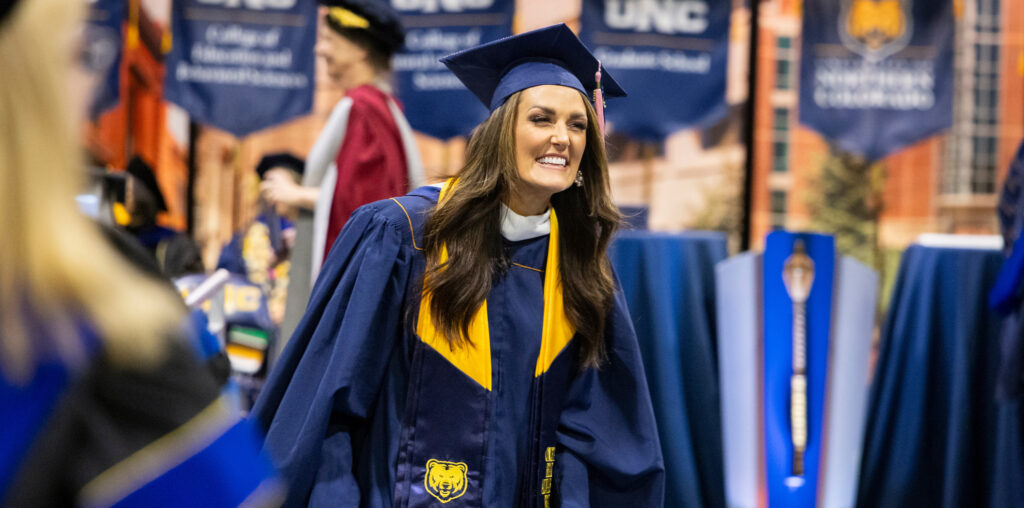
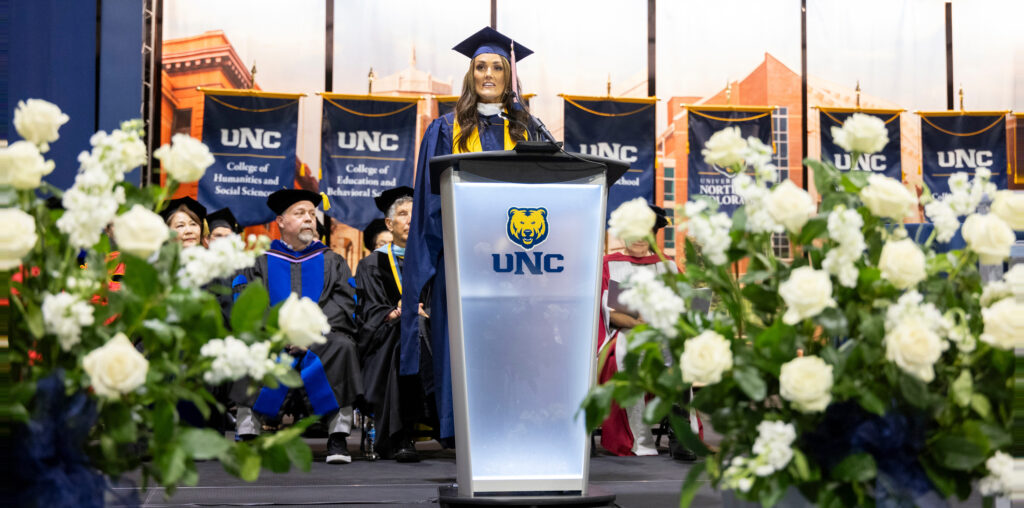

“Jokingly, through one of those conversations, Dr. Iannacchione said to me, ‘You should be teaching here. You have all this breadth of knowledge outside of just the classroom,’ Corban said. “At first, I thought of doing a victim studies class, but then he mentioned doing something that I’m passionate about – guaranteeing fair and accurate representation for victims and their families in the media.”
According to Iannacchione, the connection Corban draws between justice and the role of true crime in today’s media is critical.
“It’s a culturally relevant course,” Iannacchione said, “Streaming services are pushing out this programming at a rapid rate, and our students are consuming it. Having in-depth discussions on the ethics of this is a great opportunity.”
Iannacchione believes that the influence of crime in media is one of the key reasons that Corban’s course stands out as a strong addition to the Criminology curriculum.
“It’s important for students to understand the impact these documentaries can have on the people who lived through them,” said Iannacchione.“I know our students watch them, and I do too, but many of the shows deal with tragic, horrific crimes and it’s really important to take a step back and consider the toll they may take on the subjects.”
With that perspective in mind, he began considering how to translate this awareness into the classroom in a way that balanced student interest with ethical responsibility. The goal was to build a course that didn’t just analyze true crime media, but also encouraged students to think critically about representation, trauma and the real people at the center of these stories.
“Kimberly is an expert in this area, even hosting a successful podcast on it,” said Iannacchione. “Having her turn this into an academic course just seemed like a wonderful idea.”
For Corban, the real value of the course is not just in the subject matter, but in what students learn from it.
“You learn so much in college, but I can’t remember a lot of the facts,” Corban said. “I can’t remember the bullet points that I stayed up and wrote down on notecards, trying to memorize. What I do remember and use every day is my ability to think critically; to seek out credible sources, and either confirm or question what I am being told. A lot of my questions don’t have a black and white answer. I simply want my students to establish the critical thinking skills to decide for themselves, and then to be able to pass that along.”
Shifting the Narrative
For Journalism and Media Studies student, Janna Vandever, taking Corban’s course has given her a new perspective on the relationship between crime and media, as well as how unethical journalism can result in unnecessary victimization. At a moment when she was facing career uncertainty, questioning how she could ensure ethical treatment of victims as a future reporter, Corban brought in guest speaker Krista Henery, Director of Community Relations for the Weld County District Attorney’s Office. For Vandever, hearing Henry present opened up new career pathways, as she explores the potential to further intersect her passions for both criminal justice and journalism. However, her favorite part of the course has, without a doubt, been learning from Corban.
“Kim is one of my favorite professors, and this class is one of my favorite classes,” Vandever said, “The space that she has created has felt safe. I’ve been able to go to her with things that I myself have gone through. She has been super welcoming, and she encourages the class to be interactive. So, when we’re sitting next to each other and we talk about these things, it helps to process it all out loud. It’s a fun way to learn. Teaching a course for the first time, Kim is doing a phenomenal job.”
Similarly, for Criminology and Criminal Justice student, Alyssa Aguilar, learning under Corban has completely changed her perspective on true crime. Before taking the course, she used to watch true crime shows weekly. But as the class challenged her assumptions, she began to notice how much of that content encouraged judgment toward victims.
“When you have this instilled narrative from previous things, seeing other cases… sometimes, yeah, you are victim-blaming without even realizing it,” Aguilar said. “If somebody gets followed in their car by their strange husband, many people ask ‘Why don’t you just drive to a police station? Why’d you pull over? Why’d you get out of the car?’ The things that you think you would do differently. To victim-blame, it’s not something that you always think you’re consciously doing. But a lot of the time you unconsciously are.”
This shift in judgment is exactly what Corban hopes her “start by believing” philosophy helps students unlearn: those quiet biases that shift blame away from perpetrators and onto survivors. As a survivor herself, Corban highlights the lasting impacts of her own case, and the pride that she feels toward having been able to turn a traumatic event into a force for good.
“I love this part of the ripple effect,” said Corban, “We talk about this a lot with different cases and who is impacted, from the primary victim, the secondary victim, offenders and their families and communities. This [course] is also part of that ripple. That really awful thing happened to me, but I get to choose how it goes out into the world now. Impacting 35 future criminal justice and journalism careers moving forward, if all they take away from this is that they have the ability to impact a victim’s life in a positive way, then I would say that my work here is done. That’s good enough.”
Full Circle Journey
One of many UNC alumni who have since returned to teach the types of courses that they once took themselves, Corban added that walking into her classroom in Candelaria Hall is always a pinch-me moment.
“To be in front of the classroom and passing along the expertise that I learned when I was sitting right in the same chairs is pretty cool,” she said. “I would not be here and doing what I’m doing if I hadn’t found a home at UNC. All of the things that they provided to me, not just as a victim of crime, but as a student and then as a graduate student and now as an instructor… it’s pretty cool. So, I get a little misty when I hear ‘Once a Bear, always a Bear,’ because it’s true.”
Corban will continue to teach True Crime: Ethics and Impacts during the 26-27 school year, which she describes as one of the most meaningful intersections of her lived experience, academic work, and survivor advocacy. In the meantime, she is continuing to focus her work on her own backyard as Director of Development and Marketing at the Sexual Assault Victim Advocate Center (SAVA), Northern Colorado’s only dedicated, community-based sexual assault crisis center. There, she supports efforts to support survivors as young as three years old, provide a 24/7 crisis hotline, offer no-cost therapy and advocacy and lead prevention education across Larimer and Weld Counties.
“There’s something powerful about doing this work back in the same place where I grew up,” said Corban. “It’s where my husband, Michael, and I live, raise our four children, and work. And to me, SAVA is not just a job; it’s been a homecoming. Being able to pair that passion with UNC’s classroom feels like kismet.”