

Environmental Earth Sciences BS
- Major
- BS
- In-Person
- Greeley
- Geology Concentration
- Licensure: Science (Grades 6-12)
4 Years
Program Overview
At UNC you won’t just study earth sciences, you’ll actively practice them. The Environmental Earth Sciences BS blends geology, ecology, chemistry, meteorology and environmental studies. Giving you a broad and flexible foundation for careers in science, sustainability or teaching.
With two tracks to choose from, the Geology concentration or the Science Licensure for grades 6–12, you can tailor your degree to your goals. No matter which path you take, you’ll graduate with the knowledge, perspective and practical training to make a difference in the classroom, the field or the lab.
What You’ll Study
You’ll learn in small classes taught by faculty who bring real-world experience from research, fieldwork and professional practice. Our location in northern Colorado places you in one of the world’s most environmentally dynamic regions, providing access to the Great Plains, Rocky Mountains and desert Southwest. You may find faculty and students locally at the Poudre River, chasing storms in neighboring states, or investigating volcanoes and weather abroad.
All majors of UNC’s Environmental Earth Sciences BS program complete a shared foundation in geology, ecology, chemistry, meteorology, physics and mathematics. From there, you’ll choose one of three tracks: Environmental Earth Sciences, Geology, or Science Licensure (Grades 6–12).
The Environmental Earth Sciences BS at UNC requires 120 credits, including:
- Liberal Arts Curriculum (31 credits):
General education courses in writing, math, arts and humanities, social sciences and natural sciences. Many science courses also count toward the major. - Required Major (61–80 credits):
- Environmental Earth Sciences (80 credits):
Focuses on environmental monitoring, regulation and management. Includes coursework in geology, ecology, chemistry, meteorology, hydrology and GIS/GPS. Students gain field, lab and research experience preparing them for careers or graduate study in environmental science. - Geology Concentration (74–75 credits):
Emphasizes the physical processes that shape the earth and includes coursework in mineralogy, paleontology, sedimentology, stratigraphy, structural geology and geologic field techniques. Students gain extensive field and lab experience for careers in energy, mining, natural resources or graduate programs in geology. - Science Licensure Grades 6–12 (61 credits + 38 credits of teacher preparation):
Combines earth and environmental science coursework with teacher preparation and student teaching. Students develop skills in lesson planning, classroom management and instructional strategies to become certified secondary science teachers. Includes observation, clinical experience and student teaching practicum.
- Environmental Earth Sciences (80 credits):
- University-Wide Credits (0–15 credits):
Additional courses to reach the minimum 120-credit requirement. Students who apply recommended courses to both the Liberal Arts Curriculum and major requirements may have extra electives.
Students work closely with an assigned major advisor each semester to plan their coursework. View full degree requirements in the academic catalog buttons below.
Degree Requirements – Environmental Earth Sciences
Earth Sciences Minor
Add depth to your degree with 20 credits in earth sciences. Courses cover astronomy, earth science, geology, meteorology and oceanography and are selected in consultation with an advisor. No more than 8 credits of 100-level courses may count toward the minor, and coursework more than 10 years old generally cannot be used without special approval. This flexible option complements a wide range of majors and prepares you for careers or graduate study in science, sustainability, research and environmental fields.
This plan is a recommended schedule to complete this bachelor’s degree in 4 years. Courses are subject to availability. Students must consult with their major advisor to receive information on any additional graduation requirements and course sequence guidance.
Four-Year Plan – Environmental Earth Sciences
Concentrations & Licensures
Tailor your degree with one of two tracks: Secondary Licensure, K-12 concentration or the Geology concentration.
Our Secondary Education concentration gives you the tools to inspire the next generation of earth science enthusiasts. You’ll build a strong foundation across all four earth science disciplines—astronomy, geology, meteorology, and oceanography—while developing expertise in the supporting sciences: biology, chemistry, physics, and mathematics.
In your final year, you’ll move from theory to practice, applying what you’ve learned in real classroom settings. By graduation, you’ll be fully prepared and certified to teach earth science to students in grades 6-12.
You’ll learn to:
- Deliver effective science lessons for grades 6–12
- Develop scientifically literate students in earth and environmental sciences
- Apply instructional strategies for diverse learners
- Plan and assess learning activities that meet state standards
- Gain hands-on classroom experience through student teaching
Ready to make an impact? This is where your love of science meets your calling to teach.
Explore degree requirements for a Secondary Education Licensure, K-12 Concentration
Interested in understanding the forces that shape the earth and preparing for careers in energy, mining, natural resources or graduate study in geology? The Geology concentration provides a broad background in earth sciences with a focus on field and laboratory study.
You’ll gain experience with advanced instrumentation, analytical techniques and geoscience research, preparing you for professional roles in geoscience, consulting, government agencies or graduate programs.
You’ll learn to:
- Analyze the physical structure, composition and processes of the earth
- Conduct field mapping, sampling and laboratory analysis
- Apply geoscience methods to energy, mining and natural resource challenges
- Use GIS, GPS and other analytical tools for environmental and geological research
- Participate in hands-on fieldwork and research projects with faculty
Why Study Earth Sciences at UNC?
Prime Location to Study the Environment
Northern Colorado offers access to the Great Plains, Rocky Mountains and desert Southwest, as well as some of the most complex water diversions in the country, including the Poudre River. Students can study real-world environmental challenges while gaining hands-on field experience in a variety of ecosystems.
Faculty Mentorship and Research Opportunities
Learn from faculty who are active researchers and field scientists. Small class sizes provide personalized mentorship and opportunities to collaborate on faculty research projects. Undergraduate students can gain experience that is often reserved for graduate programs.
Career Versatility
Launch a career that fits your passion. Graduates work in water resource management, land management, environmental monitoring and remediation, restoration, consulting, or environmental education. Many continue on to graduate programs in environmental science, sustainability or public policy.
What is Licensure?
A teaching license is Colorado’s way of certifying that you’re qualified to teach. It shows you’ve completed the required coursework, passed state exams and gained classroom experience. Think of it like a driver’s license, but for teaching.
With UNC’s Environmental Earth Sciences Science Licensure track, you’ll complete the Professional Teacher Education Program alongside your science coursework. This includes hands-on classroom experiences in UNC partner schools, methods courses and student teaching during your final year.
When you graduate, you’ll be prepared to apply for your Colorado Initial Teacher License in Science (Grades 6–12), qualifying you to teach middle and high school students across earth science disciplines, including geology, meteorology, oceanography and environmental science.
If you have questions about Licensure, email us at Licensure@unco.edu.
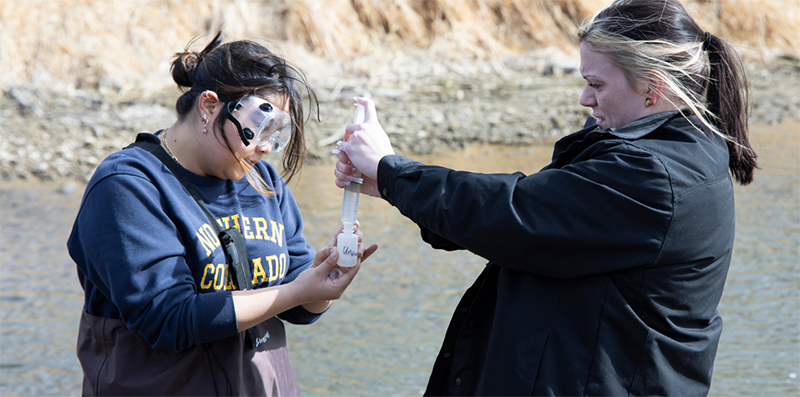
UNC faculty members and students, in partnership with the River Management Society, came together to restore and restart Greeley’s River Watch water quality monitoring site, which had been defunct since 1998.
Make Real Change on Campus
Get Involved with Student LEAF
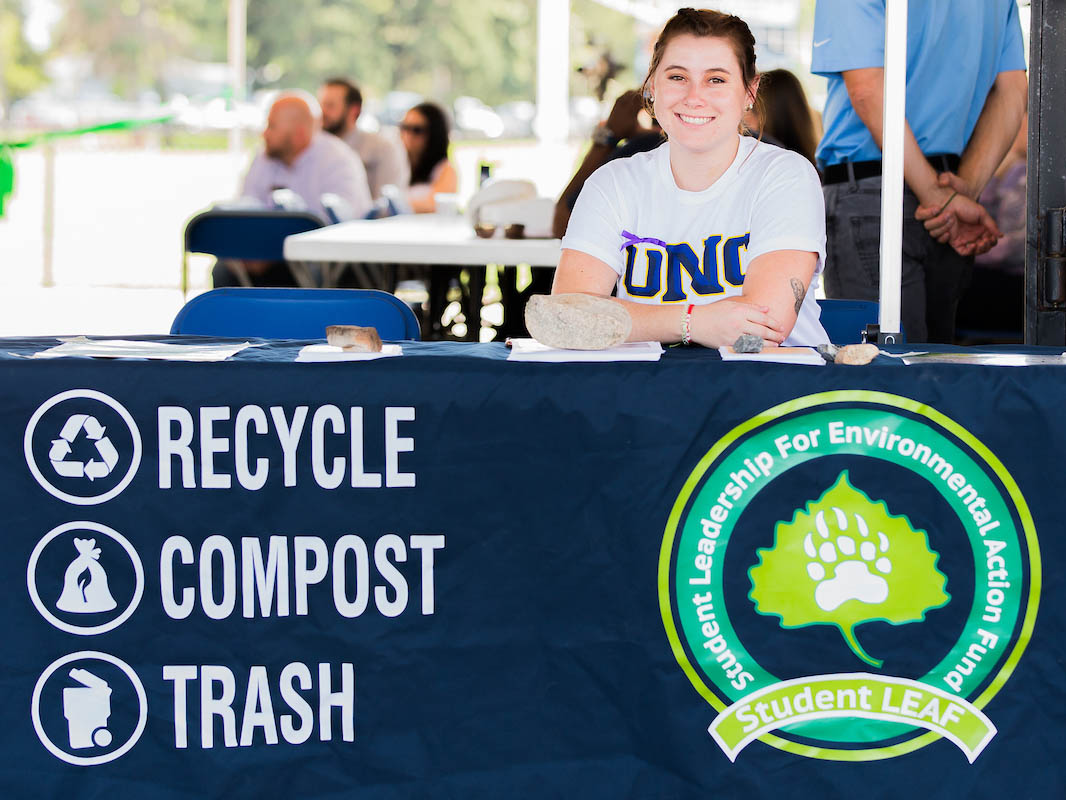
Student LEAF (Student Leadership for Environmental Action Fund) is a student-run organization that funds sustainable campus projects. Since 2012, we’ve transformed UNC’s campus through water bottle filling stations, solar installations and recycling initiatives.
By joining Student LEAF, you can work with other students to help make our campus more sustainable. Submit your own project or get involved with a current one! Recently, Student Leaf worked with UNC Dining and Compost Queen to make food waste from Holmes Dining Hall into compost.
Have Questions? We’re Here to Help!
Earth and Atmospheric Sciences
Understanding how the Earth works is key to protecting it. Our programs prepare students for careers in environmental science, geology, meteorology, and climate studies. You’ll benefit from small class sizes, dedicated instructors and engaging, hands-on science activities. With the Rocky Mountains and Colorado’s unique weather nearby, you’ll have an incredible outdoor classroom to explore and learn from daily.
- eas@unco.edu
- 970-351-2398
- Ross Hall 3235