

Pullen Lab
Learn about inflammation here at UNC!
Inflammation Lab
Greetings! We study:
- Mast cell biology: their general functions, contributions to disease states, trained immunity, and as a therapeutic target
- Inflammation: particularly in the context of autoimmunity and cancer
- Immune system responses to cancer: changes in cell functions, evaluating cost effective complementary & integrative therapies
- Immunology education & curriculum: see the work of the AAI Education Committee, which Dr. Pullen currently chairs.
The lab supports the education and research training of students across all levels in the School of Biological Sciences and from other programs such as Exercise Physiology, Chemistry, and Nutrition.
Prospective Graduate Students.
There are NO OPEN graduate positions in the lab at this time (updated Spring 2025).
M.S. (thesis track) and Ph.D. applications are continually reviewed by faculty of the School of Biological Sciences. Please contact other faculty if interested in the UNC biology graduate programs.
Undergraduate Opportunities
We welcome new undergraduate researchers through several paths:
- If you are interested in bench lab research, the Inflammation Lab accepts students who will commit at least two semesters of scheduled research through BIO 422. This requires contractual agreement of responsibilities, and a research product turned in each semester.
- If you are willing to commit to one semester then you are welcome to assist us with literature research for that semester, and you can get some practice with lab techniques through BIO 422. The expected finished product will be a polished review and annotated bibliography on a topic of interest to the lab.
- Longer contractual agreements through programs like McNair and Honors (Upper Division).
Some preparation that will help you with doing research in the Inflammation Lab:
- Completing courses like BIO 110 (Biology: Atoms to Cells), 210 (Cell Biology), and 220 (Genetics). For majors outside biology the A&P course series (BIO 245 & 246) is useful.
- Some familiarity with and curiosity for learning about the immune system.
- Taking advanced cell & molecular biology courses while working in the lab is recommended.
Inflammation Lab Research
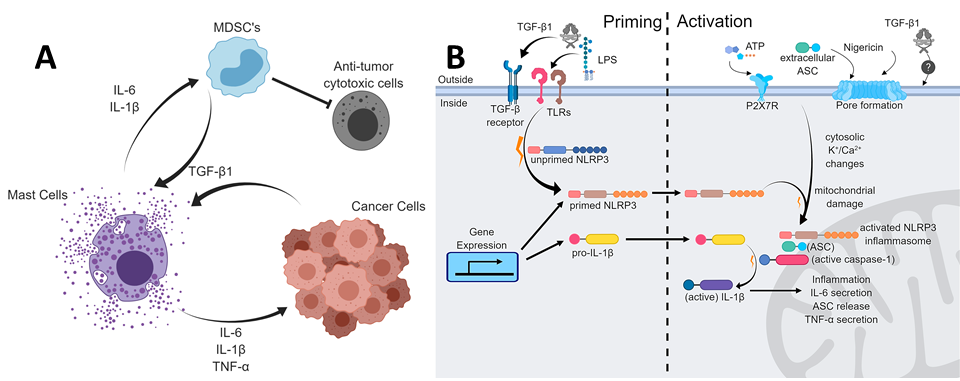
Model of mast cell training in the tumor microenvironment. A. Malignant cancer cells produce high concentrations of TGF-β1, recruiting mast cells and causing production of inflammatory cytokines such as IL-6, IL-1β, and TNF-α. These cytokines initiate a suppressive effect on natural anti-cancer immunity mediated through cells such as myeloid-derived suppressor cells (MDSCs) by inhibiting tumor-killing cell types (e.g., cytotoxic T-cells, Natural Killer cells, etc.). The result is progression of the cancer. B. Zoom-in of the mast cell interior showing the proposed molecular mechanism for training through the NLRP3 inflammasome.
We are interested questions that have translational importance for disease and medicine, especially for complementary and integrative health practices already in use by many people. Our main areas of research are:
- Mast cell biology: their general functions, contributions to disease states, trained immunity, and as a therapeutic target
- Inflammation: particularly in the context of autoimmunity and cancer
- Immune system responses to cancer: changes in cell functions, evaluating cost effective complementary & integrative therapies
- Immunology education & curriculum: see the work of the AAI Education Committee, which Dr. Pullen currently chairs.
Some Example Projects:
- Trained Immunity (a.k.a. “innate memory”) in mast cells.
- Characterizing and then targeting the immune system cells affecting recovery from traumatic skeletal muscle injury.
- The effects of physical activity during recovery from cancer, specifically changes in cancer-induced immunosuppression and T cell polarization.
- The roles of Th22 cells and MDSCs in response to IL-6 in metastatic breast cancer.
- The molecular effects of plant-derived compounds (e.g., certain alkaloids and cannabinoids) potentially used for anti-inflammatory prophylaxis.
We are actively seeking collaboration on new projects involving plant-derived compounds and immune system cells:
- The effects of the alkaloid berberine on antigen presentation and Th cell programming, with the goal of assessing berberine’s prophylactic potential for autoimmune pathologies such as rheumatoid arthritis.
- The effects of various cannabinoids on myeloid and lymphoid cell biology to determine the antagonistic and agonistic uses of cannabinoids as potential anti-inflammatory supplements.
Inflammation Lab Protocols
The procedures below are common in our lab, and they are specific to our experiments and experiences. New applications should always be optimized.
- Bone Marrow Preparation
- FcεRI staining (fluorescent) for the Countess FLII
- FcεRI crosslinking of bone marrow-derived mast cells
- General immortalized mammalian cell culture (adherent)
- Preparation of cell cultures for surface target flow cytometry
- Preparation of cell cultures for intracellular target flow cytometry
- Protein isolation
- Protein concentration measurement
- Western Blotting
- Detecting Western blot chemiluminescence using a VersaDoc