
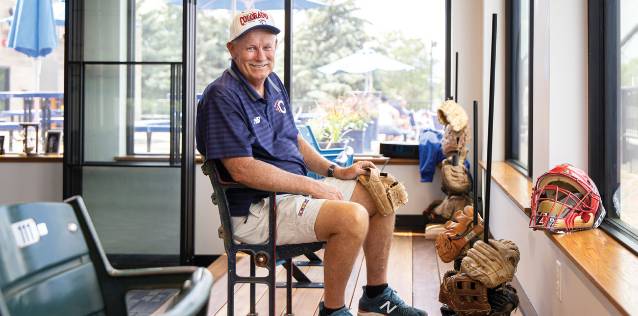
For over 40 years, Dave King, ’81, M.A. ’82, owned and operated Triple Crown Sports, turning a spur-of-the-moment idea into a multimillion-dollar business that has organized thousands of competitive sports tournaments nationally and internationally
From the time he was in first grade, Dave King knew how to organize a great event.
“When I was 6 years old, I invited 10 kids over to the house. I put together a mini
decathlon and a basketball game and we served graham crackers with chocolate icing
at halftime. From that moment on, I’ve been in the hospitality business,” King said
with a big smile. “I’ve always liked to create memories and put together competitions.”
That high standard of event management stuck with King throughout his childhood and
young adult years.
As a student at UNC, King was a standout track and field athlete, competing in the
decathlon and pole vault. Always looking for different ways to be active and involved
in competition, Dave and his then-girlfriend, now wife, Annette King, ’81, became
avid slow-pitch softball players.
One summer when playing in a tournament in Craig, Colorado, Dave was asked to leave
the tournament after getting into a disagreement with one of the organizers, voicing
his displeasure for how the tournament was run.
As Dave recalls, “The gentleman said to me, ‘King, if you think you can do it any
better, do it yourself.’ I took those words to heart. We had a long drive from Craig
to Grand Junction and in the car, I cooked up our own tournament and called it ‘Triple
Crown.’”
After a successful first trial run of the tournament in Dave’s hometown of Meeker,
the following summer, in 1983, Dave and Annette organized men’s, women’s and co-ed
softball tournaments in Steamboat, Breckenridge and Grand Junction — the three legs
of Triple Crown. In total, 195 teams competed Friday evening to Sunday evening. And
this time, everyone went home happy.
“I was the guy who always believed if something wasn’t right, fix it,” King said.
“I wanted to come up with something special.”
From 1983 to 1986, the Kings continued to organize Triple Crown tournaments in the
summer. While they enjoyed organizing and competing in the events, bringing dozens
of teams together at each location, they also recognized it was becoming a lot of
work with no financial benefit.
“It was time to either stop altogether or go all-in,” King said.
“We decided to do it all the way. I wrote a business plan, resigned from my job and
off we went.”
1988, Triple Crown Sports (TCS) purchased office space in downtown Fort Collins, and
as acting CEO, Dave hired 17 employees to get the company off the ground and running.
Four years later, the “Triple Crown Slow-Pitch Softball Series” expanded to 130 cities,
with ESPN televising the tournament championship of Triple Crown’s largest event in
Steamboat.
In 1992, TCS began expanding to host tournaments for additional sports, including
baseball, basketball, soccer, volleyball, roller hockey and fast-pitch softball. Adult,
collegiate and youth tournaments were organized. Major sponsors came on board, including
Nike, Louisville Slugger, Russell and Budweiser.
The business appeared to be doing great. More staff were hired as tournaments and
events began increasing at a rapid rate, leading to greater exposure and interest.
TCS hosted top-notch tournaments, providing fun and memorable experiences for the
athletes in a professional setting — ultimately what King had set out to do.
However, after years of having a bottom line with minimal profit, he knew something
needed to change.
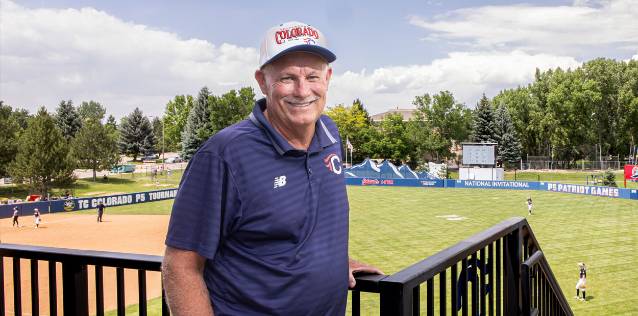
“I was proud of what we created, but it was a hard moment for me to accept that I
wasn’t the best at running a business in terms of generating enough revenue for sustainability,”
King said. “I knew we needed a refreshed business model.”
A self-proclaimed turning point for King and TCS, in 2007, he elected to enroll in
the Owner/President Management program at Harvard’s Business School, an educational
experience designed for business owners to help elevate their businesses to the next
level.
“We ultimately realized we were not charging enough for the product we were producing,”
King said. “After the price point changed, the consumer interest never wavered, and
that allowed us to grow at a much more sustainable rate.”
Patty Harsch, now a senior consultant for TCS, first started working for the company
32 years ago. After becoming friends with Dave and Annette in the early ’90s, Harsch,
a fellow sports fan herself, admired what the Kings were building and wanted to be
a part of it.
Since joining the staff in November of ’93, she’s worn many different hats, including
director of HR and chief culture officer. Outside of the Kings, her tenure with TCS
is among the longest of any employee. She believes that what has made Dave — and TCS — so
successful over the years, is the relationships that King and his staff have built.
They are not surface level, they are deep relationships,” Harsch said. “We truly care
about the people we’re serving.”
One of many examples of these strong relationships is that with Dedeann Pendelton-Helm,
current head Softball coach at UNC and former employee of TCS. Pendelton-Helm began
working for King in 1996, when she helped launch the fast-pitch softball division
of TCS.
Fast forward 29 years later — TCS’s Sparkler and Fireworks tournaments over the 4th
of July brought together over 1,000 teams from across the country to Colorado, with
games played along the Front Range, from Colorado Springs to Fort Collins. This past
summer, over 130 college softball coaches were in attendance to recruit participating
players.
“There is no doubt Triple Crown has impacted the world of softball statewide and throughout
the whole country,” Pendelton-Helm said. “Dave has such good relationships with countless
coaches and players — he is constantly trying to advance the game. It’s evident how
passionate he is about women’s sports, but softball in particular.”
One of those coaches King developed a strong relationship with is former Tennessee
softball coach Ralph Weekly, who coached the Lady Vols for 20 years. His teams won
949 games and reached the College World Series seven times. Weekly, who was recently
at the TCS facilities during one of their premier softball tournaments, compared the
complex to “softball’s version of the Field of Dreams.”
“When thinking about the pioneers of softball in the United States, Dave King is in
the top three — no question,” Weekly said.
King’s entrepreneurial spirit, passion for softball, and innovative ideas led TCS
to recently unveil the College Sports Evaluation (CSE) Performance Lab as part of
their facilities in Fort Collins. It’s a state-of-the-art indoor facility that provides
softball players with precise data points on their hitting and pitching efficiencies,
mirroring what Major League Baseball players have access to at many of their team’s
facilities.
“In this lab we are able to track the movement of the body and the movement of the
object,” King said. “Through that, we believe we can help players identify patterns
that will increase performance and decrease injuries.”
Force plates below the turf surface measure footwork and exertion levels throughout
the pitching motion while high-speed motion capture cameras record spin rates, arm
angles and pitch movement. When hitting, important metrics like exit velocity, swing
speed and ball flight are tracked.
“The tools used in this pitch and hitting lab are very similar to those seen in professional
settings, which is why a solid understanding of biomechanics is essential to fully
take advantage of data analysis,” said Jake Vassar, a graduate student in UNC’s Biomechanics
program who is completing an internship at TCS, specifically within the CSE lab.
“Unlike subjective assessments made with the naked eye, these tools allow us to quantify
performance and identify precise areas for improvement. Because the technology is
cutting-edge and expensive, it’s not typically accessible to most athletes — especially
at the youth or amateur level.”
Just this past year, King invited the UNC softball team to serve as the ‘beta testers’
for the CSE lab — a win-win for the Bears and TCS.
“We felt very lucky to be able to use the lab,” Pendelton-Helm said. “We’re a smaller
mid-major program but to have access to that, what some of these big P4 [power four
conference] programs are trying to use, it was really special and made us feel big-time.”
As a proud alumnus of UNC, King has given back to the university in many ways. He
served as an adjunct faculty member in the Kenneth W. Monfort College of Business,
was interim head softball coach at UNC over a decade ago and has given generously
to the UNC athletic department through TCS to help with their greatest areas of need.
King is a long-time supporter of UNC’s softball program, including supporting necessary
enhancements to Gloria Rodriguez Field.
“Dave is always willing to help — whether it’s philanthropic or just providing advice,
he really cares about UNC,” said Darren Dunn, director of Athletics at UNC.
“Oftentimes in college athletics, people do things for money. Dave once told me, ‘Do
things that can benefit people.’ That has stuck with me over the years, and is something
I remember when I’m making decisions,” said Dunn.
At 68 years old, King is still actively involved in TCS, but has proudly passed the
baton of CEO to his oldest son, Keri. His daughter, Kelly, is chief talent officer,
and the two now have majority ownership of the company.
Although Dave isn’t involved in the day-to-day operations quite as much as he used
to be, his impact is still felt in the building — and his legacy won’t be soon forgotten.
The success TCS has experienced is evidenced in numbers — it generates roughly
$35 million in revenue annually and has organized tournaments nationally and internationally
for over 330,000 teams.
What’s more difficult to measure are the memories created for hundreds of thousands
of athletes and their family members, friends and loved ones — and the relationships
that have blossomed with countless players, coaches, friends, sponsors and supporters.
While Dave may not be at the center of TCS for the next 40 years — his children intend
to be — ensuring that “King energy” will live on. UNC