
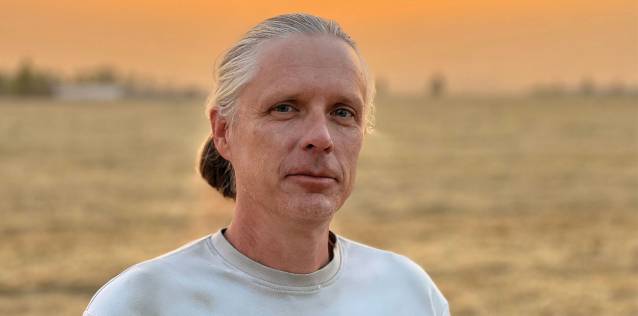
Andy Creekmore, professor of Anthropology, has spent the past decade in northern Iraq mapping out the underground ruins of a hidden Bronze Age city, contributing to the historical tapestry of one of humanity’s most influential civilizations.
Just outside of the city of Erbil in the Kurdistan region of northern Iraq, gently rolling plains stretch for miles. At a glance, the most prominent features in the area are a handful of hills, a few farm buildings nestled between sparse trees, fields of grass that glow amber in the evening sun and the occasional herd of goats marching dutifully across the countryside.
Thousands of years ago, those hills nurtured the birth of some of the world’s earliest cities and empires. History looks back on Mesopotamia as one of the most important, influential areas of early human history, colloquially dubbed the “cradle of civilization.”
Now, beneath the softly swaying grass and the hooves of passing livestock, an ancient city — a once-mighty Mesopotamian capital, now lost to history — lies buried, invisible to the naked eye.
Rising and readying well before dawn to beat the vicious heat of the day, a small team of anthropologists and archaeologists sets out onto the plains, toward the site of Kurd Qaburstan. The group, lugging pounds of scanners, sensors and other equipment with them, is focused on a single goal: uncovering the unseen.
The Magnetometric Man
Back in his office in Greeley, thousands of miles away from the site, Andy Creekmore, Ph.D., sits at his desk, pouring over subsurface maps he made of the excavation. It is February 2025, and Creekmore, professor and chair of the Anthropology department at UNC, is preparing to head back to Iraq in June.
“It’s really remarkable, you know?” Creekmore says, pointing to a line on his screen, one of many that make up a comprehensive map he has pieced together of the city that lies beneath the ground at Kurd Qaburstan. “There aren’t any Middle Bronze Age cities that I’m aware of where we have this degree of detail about their urban structure.”
The only reason the Kurd Qaburstan project team has so much data on the site in the first place is due to Creekmore’s magnetometry work. The team is made up of anthropologists and archaeologists from Johns Hopkins University (JHU), the University of Central Florida (UCF), UNC and several other national and international institutions.
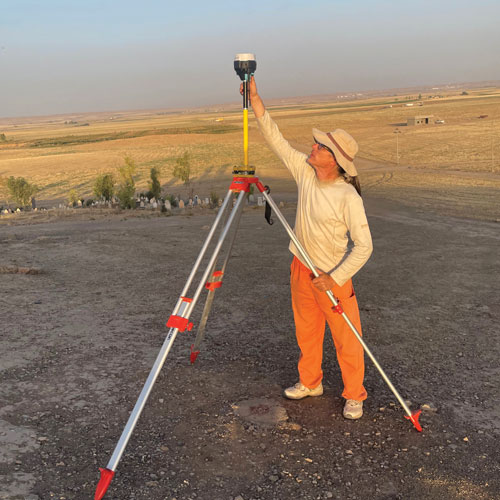
Creekmore serves as the team’s geophysicist, directing the sensing and mapping efforts at the site through a method known as magnetometry.
“Under the right conditions, you can see differences in the magnetism of what’s buried there,” Creekmore said. “With that, you can see walls and streets, map the structure of the city through street networks and tell where temples and palaces are all before you even need to break ground.”
Magnetometry is a method that involves using complex sensing equipment to measure variations in the Earth’s magnetic field, revealing the presence of buried objects and features made from soil, stone and other materials. Since the project began in 2013, Creekmore has spent five summers — field seasons in 2013, 2014, 2017, 2022 and 2024 — working to map the precise urban layout of a city buried entirely below the surface of the earth. Adding to the challenge, the site covers nearly 100 hectares of land, a space approximately the size of 200 football fields.
During that time, Creekmore and his team of assistants have been able to identify dozens of structures, including the city’s walls, a large temple and a palace, as well as countless roads, alleys and pathways. Most recently, in 2024, Creekmore discovered what the team suspects is a second palace, adding the structure to the city’s ever-growing map.
But what about the Kurd Qaburstan site is so significant as to make such a monumental undertaking worth the time and effort?
Although it hasn’t yet been fully confirmed, the team believes that the city sleeping beneath the ground may once have been the capital of a powerful region in the Middle Bronze Age (~2100-1600 BCE).
“We piece together a historical landscape by filling in the gaps with names of cities and other places when we find them,” Creekmore said. “For example, we might find documents that mention, say, ‘we sent an envoy to the city of Greeley’ or ‘we sent the army out for a battle with Loveland.’ And over time, you can sometimes figure out where these places were through excavation and comparison.”
One city in the Erbil Plain has been mentioned in artifacts found at other archaeological sites that tell of its conquest and destruction — two monumental stone slabs, one now in the Louvre Museum, the other in the Iraq Museum in Baghdad, commemorate the defeat and capture of this ancient city by the kings Shamshi-Adad of Assyria and Dadusha of Eshnunna.
But until now, experts have been unable to identify where this conquered city was buried.
“After researching it, the only site of an urban scale in the Erbil Plain that dates to the Middle Bronze Age is at Kurd Qaburstan, the one that we’ve discovered and are working at now,” Creekmore said. “And so, it was hypothesized by Harvard archaeologist Jason Ur that this site might be this ‘lost’ city.”
The city’s name? Qabra.
Discovering Qabra
Until just over a decade ago, archaeological excavations in northern Iraq — what was once northern Mesopotamia — have been scarce due to political unrest and conflict in the region. In recent years, however, that has largely changed. The region has become much more stable and open to outside visitors, allowing researchers to begin filling gaps in the historical record by examining sites in the area for the first time ever.
The city believed to be Qabra is one such site, according to Glenn Schwartz, Ph.D., Archaeology program director at JHU, and director of the Kurd Qaburstan project from 2013 to 2022.
“We know a lot about southern Mesopotamia, but not nearly as much about northern Mesopotamia, which is environmentally and culturally different,” Schwartz said. “We really didn’t have as much information, so [the project] is an opportunity to contribute to the pioneering efforts to learn about this important part of northern Mesopotamia.”
For the research team, working on this project serves as an incredible chance to contribute to the historical record and uncover knowledge that has lain dormant for millennia.
More specifically, under the direction of Tiffany Earley-Spadoni, Ph.D., associate professor of History at UCF, the focus of the Kurd Qaburstan project has shifted toward improving understanding about how Bronze Age cities formed, rose and fell, as well as piecing together a picture of how everyday people lived.
Earley-Spadoni took over the role of project director from Schwartz in 2022. Although new to the position of director, she has been working at the site since 2014 and spoke at length about the team’s goals.
“One of the things that had been previously supposed in these ancient cities was that there were the very rich and the very poor and no one in between,” Earley-Spadoni said. “One of the things that we’re finding in contrast is a glimpse of these relatively well off, ‘middle class’ neighborhoods — places where there are neither rich nor poor but still seem to have a relatively high quality of life.”
According to both Schwartz and Earley-Spadoni, the magnetometry work being led by Creekmore is essential to this goal because it allows the researchers to map out a complete picture of the city — not just areas of elite, higher class occupation like palaces and temples.
“There’s always a problem in archaeology of what we call a ‘top-down perspective,’” Schwartz said. “We tend to get information about the people at the highest ranks of society. And they share their perspective and are looking down at everybody else, which obviously leads to a skewed perspective for us.”
Among the excavation team’s findings are clay pots marked with seals of ownership, a game board for recreational activity, shards of intricate pottery and several tablets inscribed with cuneiform — the world’s earliest known writing system — that they hope to have translated in upcoming seasons.
“Dr. Creekmore’s work provides the foundation and the structure upon which we are able to build better research questions,” Earley-Spadoni said. “It allows us to guide our excavations in a way that is more ethical and responsible because of how we are able to target areas of interest rather than digging blindly.”
Through their work, the Kurd Qaburstan project team isn’t just uncovering artifacts and mapping the city — they’re helping to tell the story of what life was really like for the people that lived, loved and worked within the walls of this metropolis.
“Now we’re excavating there and finding all kinds of traces of everyday life, which is really touching,” Earley-Spadoni said. “We can now add some texture, some tangibility to the lives of these people we imagine in this bustling Bronze Age city.”
Uncovering the Past, Inspiring the Future
In addition to helping to uncover the history of a lost Mesopotamian metropolis, the Kurd Qaburstan project has had a second, more personal impact on the lives of a few of the team’s members.
Alongside the archaeologists, anthropologists, researchers and geophysicists, several college students have visited the site over the years. Coming to the project from universities across the world, these students are given the chance to participate in real field work and experience what it’s like to travel the world and contribute to the tapestry of history.
During his time working at the site, Creekmore has been able to bring six UNC students with him, with some accompanying him for multiple seasons.
Laura Sweatt, ’18, is one such student.
Sweatt graduated from UNC with her bachelor’s in Anthropology and had the chance to work with Creekmore and the rest of the project team at Kurd Qaburstan during the 2017 season.
“Working with Dr. Creekmore was just amazing,” Sweatt said. “Helping pull together the magnetometry work was just like seeing history — this massive city with temples and walls and houses — come to life right before your eyes.”
For Creekmore, giving students the opportunity to experience what it’s like to work on projects like this is one of the most important parts of getting out in the field in the first place.
“I’m a teacher at the end of the day,” Creekmore said. “I love seeing students get out and do the work they’ve been learning about. I want to be able to share that experience with as many of them as possible.”
Due to uncertainty surrounding the stability of the Kurd Qaburstan region, Creekmore has been unable to bring students with him to the site in recent years.
But looking ahead to future projects, he hopes to make the student component a high priority — a sentiment Sweatt shares.
“I think [trips like this] are just about the most valuable part of the student experience,” Sweatt said. “You get to see and do so much. We met locals — the kinds of people I’d only seen or heard about on TV — and it really opened my eyes as to what life can be like around the world. I can’t tell you how impactful the experience was. They were amazing.”
Over the summer of 2025, Creekmore returned to Kurd Qaburstan and completed mapping the ancient city below the ground, marking over 10 years of work toward uncovering the past.
And regardless of the discoveries made in future seasons at Kurd Qaburstan or what projects he ends up working on in the years to come, Creekmore remains committed to using geophysical methods to further our understanding of the past while inspiring and uplifting the next generation of anthropologists. His work at UNC and beyond is helping to patch the gaps and weave new threads into the complex, ever-changing tapestry that is human history.
The research at Kurd Qaburstan was funded by:
- American Schools of Overseas Research
- Arthur and Isadora Dellheim Foundation
- National Science Foundation
- National Geographic Society
- Johns Hopkins University
- Metropolitan Museum of Art
- University of Northern Colorado
- University of Central Florida
The team would like to thank their partners, the Directorate-General of Antiquities of the Kurdistan Regional Government, Director-General Kak Kaify Mustafa Ali and colleagues in the Erbil Department of Antiquities, Director Kak Nader Babakr.
UNC