
UNC’s jazz program dazzles over the decades
In 2004, Dana Landry’s third year as leader of UNC’s Jazz program, Lab Band I won the DownBeat Music Award as the top big band in the country. He felt proud of his students and his work. But mostly, he felt relief.
Stepping into UNC’s Jazz program was not unlike a football coach taking over Alabama or a basketball coach taking over the University of Kansas. Dana Landry, M.M. ’94 was replacing Gene Aitken, a legend in jazz education known for his innovative teaching methods and grace in even the hottest spotlight. National titles, or, in this case, DownBeat awards that recognize the country’s top students and the programs they attended, were assumed, not strived for.
“It was an unspoken expectation,” Landry said.
He is, of course, more relaxed these days, as he celebrates his 23rd year as director of Jazz Studies. But when he took the job, he felt a pressure he’d never experienced before.
He had found his footing as the director of Middle Tennessee’s Jazz program. He applied only out of respect because Aitken encouraged him to do so, Landry got his Master of Music at UNC under Aitken in 1994, and he didn’t want to let him down. He was apprehensive at best; he knew there would be big shoes to fill. But he also knew when UNC offered him the gig, he couldn’t turn it down.
He was the smaller college coach landing a once-in-a-lifetime opportunity to lead a legendary program. It doesn’t always work out. This time, it did.
During Landry’s tenure, UNC has won 95 DownBeat awards in many categories, for both student groups and soloists. Established in 1976, they are considered among the most prestigious awards in jazz education in the country. In total, UNC has claimed 172 awards dating back to 1980. Editor’s note: UNC’s Symphony Orchestra also deserves a nod for winning DownBeat awards for the top group 10 times from 1999-2013.
And yet, winning awards wasn’t Landry’s first priority. He wanted to get UNC a jazz degree.
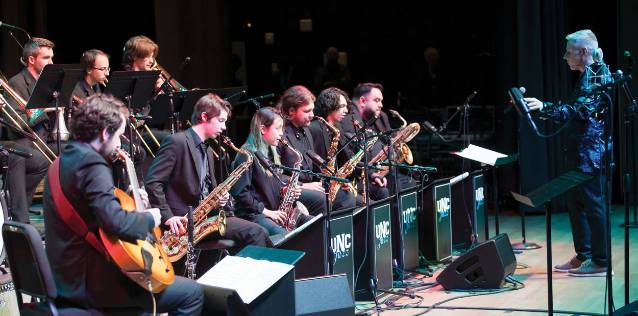
Buddy Baker started the program in 1965, and 11 years later, UNC hired Gene Aitken. Aitken did many things to build up UNC’s Jazz program, including starting the vocal jazz program and expanding the annual UNC • Greeley Jazz Festival from eight groups to more than 300 today, making it one of the best and largest in the country. In 1985, a CD released by his UNC student vocal jazz group was nominated for a Grammy. In 1995, Aitken was named into the International Association of Jazz Educators’ Hall of Fame. He did it all with a flair that resonated in his ferocious handshakes and the flashy outfits he wore at performances, some of them seemingly made from disco balls.
But Aitken didn’t want a jazz major. He wanted players to get better at their instruments, and they could do that, he reasoned, by learning from classical music teachers. Aitken was confident he could teach them a style of music, aka jazz, as they became terrific players.
Landry believed times were changing and that UNC needed a jazz major to stay competitive with other top schools. UNC now offers the degree at all levels — bachelor’s, master’s and doctoral — all with Aitkin’s support. The degree justified Landry hiring instructors specifically to teach jazz, including guitarist Steve Kovalcheck, M.M. ’09, drummer Jim White, bassist Erik Applegate, M.M. ’94, vocalists Kerry Marsh and, later, Marion Powers and composer Drew Zaremba. There are now more than 120 jazz majors who attend the school.
“We have a large number of jazz graduate students who mentor the undergraduates,” Landry said. “It’s worked out great.”
This is what Gavin Allen-Dunn, M.M. ’22, a pianist in the doctoral program, loved about UNC. He was only 21 when he entered the master’s program and was a little intimidated by UNC’s reputation. But Landry, he said, does a good job of encouraging the older students, some of them in their mid-30s, to mentor the underclassmen.
“Other schools can be cutthroat,” Allen-Dunn said, “but at UNC it wasn’t a constant breathing down your neck. Everyone is there to help each other.”
There are also many players who choose not to get a jazz degree but still love to play it, including those in music education and classical performance. Allison Young graduated with a degree in Music Business in 2022, a new concentration from the School of Music. Young used the degree to get marketing jobs while gigging as a jazz musician. She has since led her own group, toured with the Glenn Miller Orchestra as the baritone saxophonist and played with Randy Brecker, KNOWER and Lauryn Hill.
Young is now pursuing a master’s degree at the prestigious Eastman School of Music. She won two DownBeat awards with Lab Band I (2022) and a funk lab band (2021).
“There’s such a high level of playing happening in that program,” Young said. “Just being around all that excellence was really inspiring.”
There are others who don’t play jazz primarily once they graduate but appreciate the education the jazz school gave them. Connor Terrones, a guitarist and singer, has had a lot of success playing in Denver after graduating with a jazz degree in 2016. He plays with Americana groups, singer-songwriter Kaitlyn Williams, a jazz fusion group and a rock band he started called Questshun. The rock band is his top priority now: He plans to release an EP before the end of this year to coincide with a fall tour.
He’s been able to flirt with so many genres of music because of what Kovalcheck taught him about soloing over jazz chords.
“He taught me that there’s a contextual element to soloing,” Terrones said. “He used to tell me, ‘This is what jazz guitarists do,’ and at the time, that annoyed me, but as I get older, I have found that it’s really important. Improvisation can have a different context given the styles you play. I was taught to play in a jazz context, but the way he communicated it to me helped me transcend it.”
Going to the jazz program also helped him learn how to be a professional musician.
“I learned the process of work ethic and what it takes,” Terrones said. “What a practice routine looks like.”
You have to work hard, after all, to be recognized.
Winning more DownBeat awards was not Landry’s main goal, but they did provide validation that what he was doing was working.
“It’s hard to rank creativity,” Landry said. “But the awards are an acknowledgement that what we’re doing here is serving the students well.”
DownBeat picks the winners based on recordings, which can be live or in the studio. Landry prefers to record the top band in a studio but is flexible on other categories — sometimes students will use a solo recorded at a concert. Judges don’t know who is playing on the recordings, which adds legitimacy to UNC’s domination: UNC can’t rely on its reputation. Landry prefers to audition students for the top groups the same way: They play behind a screen, so he doesn’t know who is trying out.
Landry is especially proud that the recordings he sends to DownBeat typically feature student compositions instead of standards written by classics such as Duke Ellington. Some might consider that a handicap, but it shows the talent as well as the work ethic at the school.
He doesn’t know how many entries there are each year, but the lists are typically littered with the top schools, including Miami, Eastman and North Texas. The top programs care about the awards and winning them is prestigious enough that musicians will list them in their biographies.
Landry likes the fact that the system has changed. In the past, schools picked their entries, but now students can submit an entry on their own if they like, as long as faculty signs off on it.
“Sometimes students can believe they’re not good enough,” Landry said. “But you want to encourage as many as possible to give it a shot.”
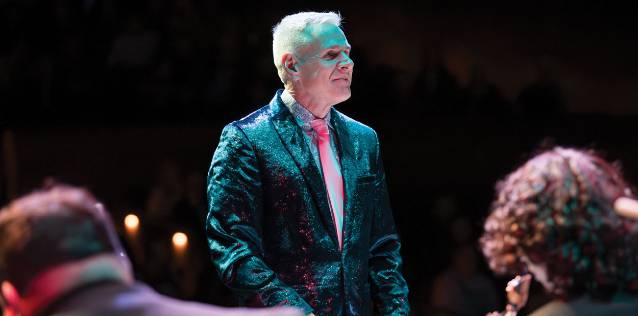
Landry said accepting the position at UNC over two decades ago is one of the best decisions he’s ever made. He brought a level of familiarity to performances, as he enjoys wearing the same kind of bright, flashy outfits favored by Aitken. But his high expectations are perhaps the best way he’s carried on the UNC tradition.
“I feel incredibly fortunate to teach and collaborate alongside a faculty of world-class artists and to mentor students who bring such remarkable talent and dedication to their craft. From freshmen to doctoral candidates, their creative energy makes it possible to pursue projects here at UNC that simply couldn’t happen anywhere else.” UNC
Alumni Spotlight
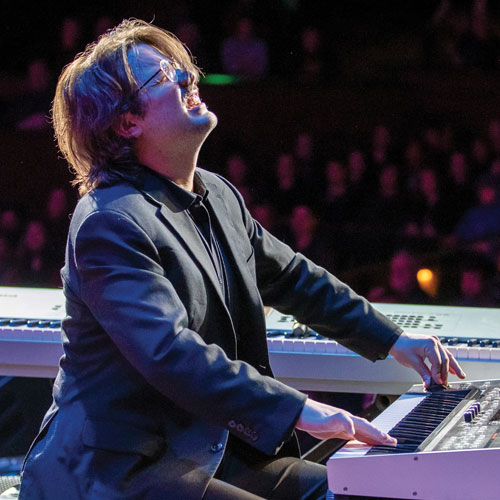
Player: Gavin Allen-Dunn
Instrument: Piano
Time at UNC: Graduated with a Master of Music in 2022.
DownBeat Awards: Won best soloist as well as awards with the top band.
What he’s doing now: Gigging and figuring out his next step.
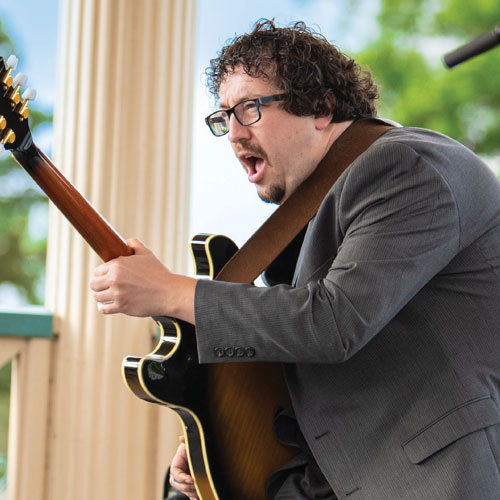
Player: Connor Terrones
Instrument: Guitar and singing
Time at UNC: Graduated with a Bachelor of Music in 2016.
DownBeat Awards: Won with the top vocal jazz group
What he’s doing now: Gigging in Denver as a well-known musician and playing with his
rock band, Questshun, that will release an EP in November.
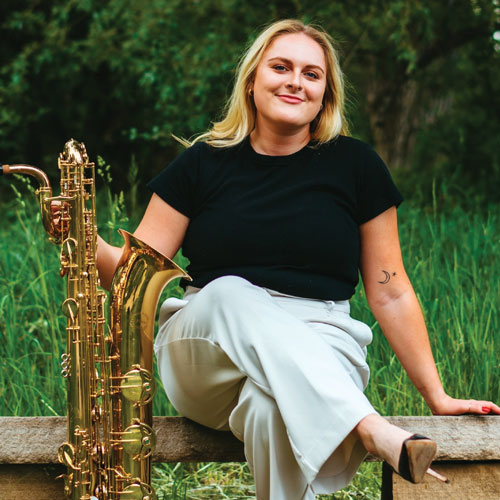
Player: Allison Young
Instrument: Baritone Saxophone
Time at UNC: Graduated with a Bachelor of Music in Music Business in 2022.
DownBeat Awards: Won with the top band as well as a funk band.
What she’s doing now: After a stint playing with the Glenn Miller Orchestra, she is
attending the Eastman School of Music.