
Future teachers, lasting impact: UNC students bring music and art into local classrooms
Creativity. Culture. Community.
Building a rich and vibrant society begins with inspiration — instilling passion and curiosity in the minds of the younger generation. It begins by planting seeds of artistic enjoyment that will bloom into a lifelong love of creating and an appreciation for what we can achieve with a little ingenuity.
At UNC, two programs, both providing hands-on experiences for future educators and bringing extracurricular artistic opportunities to the Greeley community, are doing just that.
After Hours Artistry
Learning through imaginative artistry and the use of different art materials is an iconic part of many children’s educational journeys.
But beyond adorning the fridges of proud parents or being tucked away in memory boxes for years to come, what impacts do these early artistic creations have on the children who made them?
For Connie Stewart, ’74, M.A. ’94, founder of the After School Arts Program (ASAP), the impact is both formative and long-lasting.
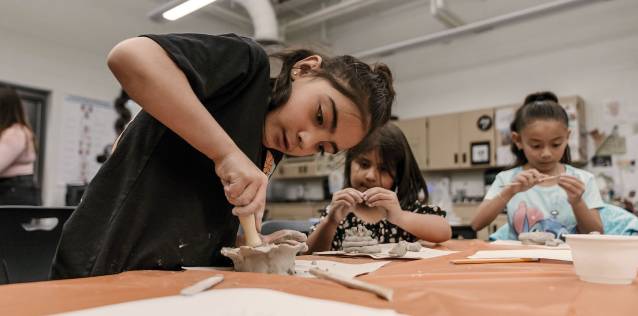
ASAP enables Arts and Music Education students from UNC to plan and teach a variety of extracurricular arts courses to students at Chappelow K-8 Arts Magnet School in Greeley.
“It’s my hope that the positive experiences these kids have with art reinforce the value of the arts within education,” Stewart said. “The experience and the growth don’t end when we stop being kids. We carry those experiences with us.”
Stewart, a professor emerita of Art Education, established ASAP nearly 25 years ago while teaching at UNC with the goal of providing students the chance to get hands-on teaching experience.
The program consists of seven to eight weeks of UNC student-taught classes each semester, held on Fridays at Chappelow. Participating students design their own lessons and offer a wide variety of artistic opportunities to the children they teach.
“One of the big values of the program is that our teacher candidates get to devise their own unit and actually teach it in the classroom,” Stewart said. “You can talk about it in methods classes all you want, but it just isn’t the same as getting out and doing it.”
Alison Myers, ’04, M.A. ’13, participated in the program as a UNC student. Now an adjunct faculty member in Arts Education while teaching at Chappelow, Myers supervises the program.
“It’s valuable in that it builds these fundamental connections. The Chappelow students get to learn from college students and vice versa,” Myers said. “It gives the kids this perspective on the future and where they can go from here.”
Rachel Brown, ’07, has a son in ASAP. According to her, the experience has been an amazing one for him — he signed up in kindergarten and is now in seventh grade.
“Up until last year, he’s been in every single session he could, except one, because he didn’t bring the paper home,” Brown said.
“With programs like this in a community, I think you’re going to see more kids engaged with their schooling and more success when it comes to graduation,” Brown said. “My son has special needs and isn’t a man of many words, so for him to be loving it and to want to keep doing it for this long definitely says something.”
The String’s the Thing
Although most K-12 students will craft, sketch and paint in school, not all of them will be given the opportunity to play an instrument.
School bands and orchestras aren’t uncommon, but their optional nature combined with the cost of instruments and time commitment means that some students will miss out on the chance to make music.
That’s where the String Project comes in.
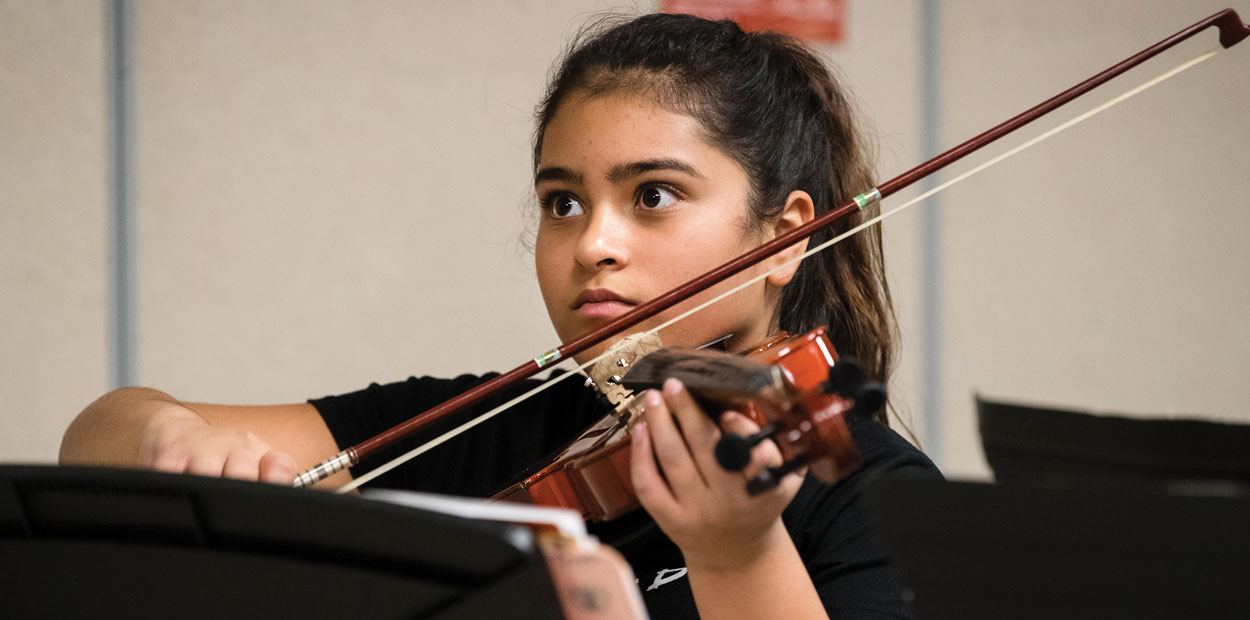
Part of the National String Consortium, the UNC String Project launched in 2017 with the goal of training tomorrow’s string educators while providing accessible instrumental opportunities for those in and around the Greeley community.
UNC students who join the program teach both group ensembles and private lessons. The elementary students who participate are primarily in the 4th and 5th grades.
Mary Baxter, a senior double major in Education and Violin Performance, joined the String Project during her freshman year and never looked back.
“I hadn’t really taught music before, and I remember being so scared coming into it,” Baxter said. “But everyone was so nice and so supportive. By the end, I felt more than comfortable being the only teacher in a classroom of students.”
Annette Haller, ’21, a String Project participant during her time at UNC and a current teacher at Chappelow, agreed wholeheartedly.
“Every second of teaching experience and relationship building that I did with String Project prepared me for my teaching career,” Haller said. “It was an invaluable connection between that theoretical learning and the reality of teaching actual young people.”
Beyond the personal and professional growth, Baxter emphasized that the program filled an impactful niche within the community.
“It brings music to so many students — whether it’s those wanting to connect with playing outside of school, those who aren’t able to afford traditional private lessons or the many homeschooled or remote students we’re able to work with,” Baxter said. “We’ve never turned away a kid who has wanted to do it.”
The connections the project strings together throughout the community are precisely what make it such an impactful program. In less than a decade, it has brought music into the lives of countless children, all while training future teachers for the road ahead.
—Duard Headley