Jump to main content

News Briefs - Fall 2025

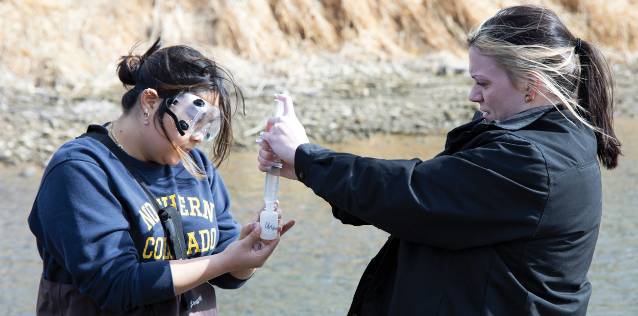
Professor and student water testing in river


November 07, 2025

  • (River) Watch and Learn

    From its source nestled high in the Rocky Mountains to where it meets the South Platte River just east of Greeley, the Cache la Poudre River flows down 6,155 ft. in elevation, across 126 miles of Colorado countryside and provides an average of 89 billion gallons of water annually — including drinking water for more than 400,000 residents in northern Colorado. 

    But in Greeley, for the past 25 years, the number of sites dedicated to monitoring the quality of all that water has been a resounding zero.  

    In 2024, that changed as faculty members and students from UNC, in partnership with the River Management Society (RMS), a national nonprofit organization that supports professionals who study, protect and manage North America’s rivers, came together to restore and restart Greeley’s River Watch water quality monitoring site, which had been out of commission since 1998.  

    Now, students interested in river science can earn a certificate in River Studies and Leadership, building hands-on experience in, on and around the Poudre River while helping preserve an important source of water in northern Colorado. 

    This certificate is a collaboration between the departments of Chemistry, Earth and Atmospheric Sciences, and Geography, GIS and Sustainability. Students who participate in this certificate program will have the chance to learn about the facets of water ecosystems, including the social impacts of water on communities, the economic influence bodies of water can have, the chemistry involved in monitoring water quality and more.

  • Sprouting New Landscape to Save Around 2 Million Gallons of Water Per Year

    On any given day, the sidewalks north of the University Center are filled with people navigating to and from Central and West Campus. Students walking single file often fill the concrete pathways that wrap around the center point of campus but rarely step on the gently sloping 3.4 acres of Kentucky bluegrass nearby.   

    According to Chris Bowers, UNC’s first-ever energy and sustainability manager, this is one of the most visible areas on campus, making it the perfect spot to create a showcase space that demonstrates thoughtful design and sustainable practice.  

    Bowers’ job is to advocate for and implement environmentally friendly practices on campus. His latest project, with the help from the state, City of Greeley and UNC students, is to transform the underutilized grass area near the 20th Street and 11th Avenue intersection, also known as the UC hill, into an accessible public park that will benefit around 22,000 people, including students and the neighboring community. 

    The transformation will result in huge water conservation benefits as it includes converting the existing bluegrass into natural grass, installing water-efficient irrigation and creating more walkways, seating areas, hammock spots and student art display areas.    

    “Right now, the site requires high amounts of water to keep the existing bluegrass green,” Bowers said. “With the slope of the hill, the high sunlight exposure and the older irrigation system, UNC is watering at a rate equal to a golf course.”  

    The conversion from bluegrass to drought-resistant grasses is estimated to reduce water use by 86%, saving around 2 million gallons per year — an amount roughly equal to providing 67 households in Greeley with water for a full year.  

  • Future Teacher Conference Celebrates 10 Years, Expands Audience Internationally 

    UNC’s College of Education and Behavioral Sciences celebrated 10 years of preparing and inspiring the next generation of educators at its 2025 Future Teacher Conference in February.  

    “I can’t believe it’s been 10 years,” said Suzette Youngs, Ph.D., Literacy Education professor and conference co-founder. “From the beginning, our motto has been to start small and do it well. Our inaugural conference welcomed 40 participants, and it has significantly expanded year after year. This event has become a truly transformative experience for aspiring teachers." 

    This year, thanks to generous community partners who have donated more than $20,000 to the conference over the past five years, more than 500 high school and community college students participated in the free, day-long event. UNC alumna and Colorado Teacher of the Year in 2023, Jessica May, ’96, delivered the keynote address. And for the first time, the university welcomed international participants that included two high school students and their principal from Belize. 

    Chris Kyser, Ed.D. ’14, associate professor in UNC’s School of Teacher Education and co-founder of the conference, met the Belize students on an annual trip to the country while serving in her role as a board member of the Belize Education Project. The nonprofit organization helps improve literacy and education in the country’s Cayo District.   

    “It’s really exciting,” Kyser said. “The idea is that the international students can learn about our classrooms, meet some of our future teachers and connect in their shared passion for education. At the same time, it’s a chance for everyone involved to get inspired and excited about teaching, no matter where they are.” 

  • A Glimpse into the New Hybrid Master of Arts in Studio Art 

    This year the School of Art and Design opened a new graduate program, the Master of Arts in Studio Art. This studio-based degree takes an individualized approach to help students deepen their artistic practices and synthesize their skills and interests. The goal is for students to finish the program with a researched body of artwork that explores deeper concepts, diverse media and advanced techniques.    

    The M.A. in Studio Art is designed for working adults and delivered mostly online over two fall and spring terms, with required studio hours either on campus or elsewhere, and one in-person summer intensive on campus. This is ideal for art educators who are teaching in public schools and want to enhance their credentials. The program also has a graduate certificate option for people who already have a master’s degree but need more graduate-level coursework to teach concurrent or dual enrolled art classes. 

  • UNC Selects New Vice President of Student Affairs 

    Keith Humphrey, Ph.D.

    This March, UNC chose Keith Humphrey, Ph.D., as the university’s new vice president for Student Affairs. Humphrey was selected through a national search that launched last fall and started his position on May 19. 
     
    “I am excited to welcome Keith to UNC. He is an action-oriented and innovative leader with a deep commitment to student success. He is an expert at fostering an inclusive environment and recognizes the value UNC places on supporting our diverse student population.” said UNC President Andy Feinstein.  

    “Keith is a collaborative and approachable student-centered leader, and I am confident he will quickly step into the role as a trusted advisor to me, senior leaders and other university administrators and to faculty members on a wide range of matters that are core to our ‘Students First’ commitment.” 

    Humphrey came to UNC from Cal Poly in San Luis Obispo, California, where he most recently served for 12 years as vice president for Student Affairs. In that role he oversaw more than 550 staff in 30 departments, supporting almost 23,000 students. He brings over 25 years of higher education experience to UNC, which includes 14 years serving in various roles at the University of Arizona, including as assistant vice president for Student Affairs and dean of students. 
     
    Aligned with UNC’s strategic priorities and commitment to student success, supporting student learning has been at the core of Humphrey’s professional leadership throughout his career.

  • UNC Achieves Carnegie’s Prestigious R2 Research Activity Designation 

    UNC was named an R2 institution based on the Carnegie Classification of Institutions of Higher Education’s criteria. The designation, announced on Feb. 13 as part of Carnegie’s 2025 Research Activity Designations, places UNC among the nation’s colleges and universities with “high research activity” and exemplifies a commitment to critical inquiry, discovery and creation.   
     
    A strong focus on research, scholarship and creative works (RSCW) has been integral to the university’s strategic plan, Rowing, Not Drifting 2030, particularly as reflected in the prioritization of innovation and creation as a core component of the institution's vision for the future. 
     
    The plan was launched by UNC President Andy Feinstein in 2020 and articulated his dedication to establishing a robust infrastructure to support RSCW. Over the past four and a half years, the university has invested in RSCW and renewed its focus on achieving the R2 classification.   
     
    Feinstein said the designation not only recognizes the institution's activity and impact as a research university, but it is also evidence of the significant progress the university community is collectively making toward achieving its strategic priorities.   
     
    “I am proud of our achievement,” said Feinstein. "UNC’s designation as an R2 institution is recognition of the intellectual contributions by the faculty, student and staff researchers whose work is addressing some of the most pressing challenges facing our state and beyond.”