
Physics & Astronomy Research
Our faculty are committed to the meaningful involvement of undergraduates in research
in several areas.
Contact the faculty listed below for more information.
Balloon and Rocket Flights
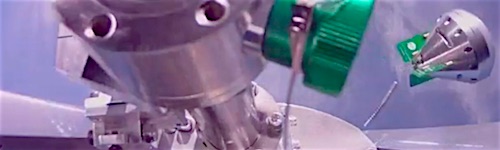
Student teams design, construct, and test small computer-interfaced payloads that are launched in Colorado on high-altitude balloons or launched on rockets in Virginia (Prof. Semak and Prof. Galovich).
Pulsating Variable Stars

Many stars change in brightness because they physically pulsate due to pressure waves traveling through them, essentially creating “starquakes”. We can use these “starquakes” to learn about the interior structure and evolution of the stars, similar to how earthquakes are used to learn about the interior of the Earth (Prof. Kuehn).
Strong-Field Physics
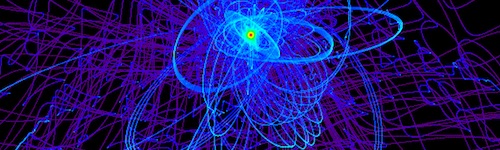
The interaction of very short and intense laser pulses with matter is studied computationally. Recently, two-color circularly polarized laser fields were used to drive novel dynamics in strong-field double ionization (Prof. Chaloupka).
Imaging Science
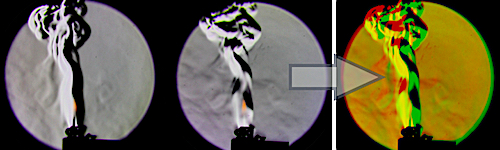
We design and develop novel techniques to capture images of physical phenomena. Recently, a two-path schlieren imaging system was created that generates two simultaneous views sensitive to phase variations along orthogonal directions (Prof. Chaloupka).
Audio Design
We explore novel and established speaker designs and tools for live audio situations, for example, how impedance matching during sound transmission affects psychoacoustical characteristics (Prof. Semak).
Robotics
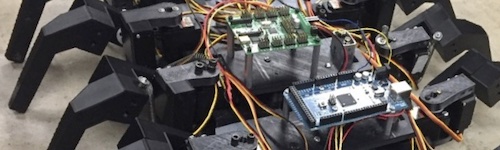
Students design, develop, and construct a variety of robots. Recent work includes a custom-designed, 3D-printed, biomimetic robot inspired by the locomotion of a centipede. (Prof. Semak).
Galaxy Evolution
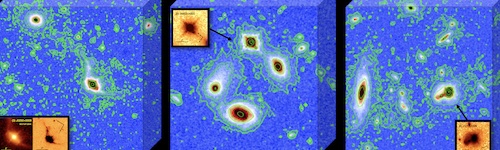
Galaxies and their central supermassive black holes influence each other’s growth via yet unknown feedback mechanisms. We test the hypothesis that quasars might be just a short evolutionary stage in the life of all galaxies (Prof. Lazarova).
Quantum Analogs

Droplets bouncing on the surface of a vibrating oil bath exhibit quantum-like wave-particle behavior, providing a fascinating physical analog to quantum mechanical systems (Prof. Chaloupka).
Nonlinear Dynamics
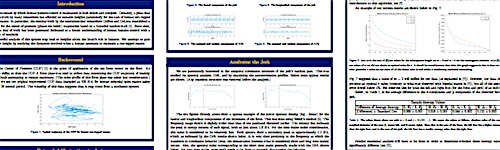
We study the effect of noise/fluctuation effects near and far from system instabilities, the behavior of complex physical systems, and model systems with history and memory, such as the process of human balance (Prof. Semak).
Physics & Astronomy Education Research
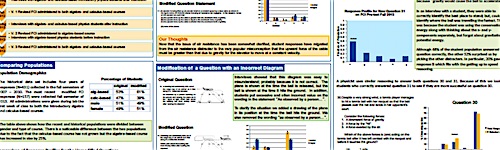
Student performance on diagnostic tests can provide insight into the process of learning physics. Our analysis of such test results may lead to improved teaching practices (Prof. Galovich and Prof. Semak). We also look at ways to remove barriers to participation in astronomy classes and labs for students with disabilities and those from traditionally underrepresented backgrounds (Prof. Kuehn).